

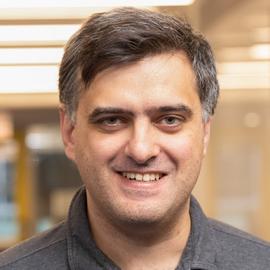
 Lorenzo Orecchia
· 4 previous affiliations
- University of ChicagoSince 2019
- Assistant Professor · Since 2019
- Boston University2015–2019
- Assistant Professor · 2015–2019
- Postdoc · 2011–2014
- PhD student · 2005–2011
Research Overview
Lorenzo Orecchia focuses on theoretical computer science, mathematical optimization, and machine learning, specifically designing efficient algorithms for combinatorial and continuous problems. His trajectory bridges spectral graph theory and first-order optimization methods to achieve nearly linear-time algorithmic speedups. Recently, his focus has expanded to encompass interpretable Riemannian machine learning and scalable hypergraph analysis.
Research Trajectory
Lorenzo Orecchia’s early research focused on network algorithms and spectral graph theory, particularly the challenge of extracting local structures from massive networks without incurring the computational cost of global analysis. This work aligns with the research direction Seed Sensitivity in Local Graph Expansion and Bootstrapping. In 2009, he co-authored A Spectral Algorithm for Improving Graph Partitions, which addressed a fundamental limitation of using the second eigenvector of a graph's Laplacian matrix for partitioning. Because standard eigenvectors often fail to capture fine-tuned information in graphs with multiple local regions of interest, Orecchia and his collaborators introduced a locally-biased analogue of the second eigenvector to highlight local data properties in a semi-supervised manner. He subsequently expanded on these themes in his first-author work, Fast Approximation Algorithms for Graph Partitioning Using Spectral and Semidefinite-Programming Techniques (2011). This research contributed to the broader area of Nearly Linear Time Spectral Graph Analysis, demonstrating how spectral and semidefinite-programming (SDP) techniques could yield fast approximation algorithms for graph partitioning, a critical primitive in image segmentation and social-network analysis.
By 2013, Orecchia’s focus had broadened to include the design of highly efficient algorithms for fundamental linear algebra problems, motivated by the theme of Algorithmic Speedups and the Hardware Implementation Gap. He co-authored A Simple, Combinatorial Algorithm for Solving SDD Systems in Nearly-Linear Time, which presented a streamlined approach to solving symmetric diagonally dominant (SDD) linear systems. Unlike previous methods that relied on heavy machinery such as recursive preconditioning or spectral sparsification, this algorithm utilized a simple, non-recursive update rule applied to a spanning tree, achieving numerical stability and nearly-linear runtime.
Following this, Orecchia increasingly leveraged convex optimization as a generic design framework. In 2014, he co-authored A Novel, Simple Interpretation of Nesterov's Accelerated Method as a Combination of Gradient and Mirror Descent. This paper provided a cleaner theoretical interpretation of Nesterov’s accelerated gradient methods by demonstrating that they can be reconstructed through the linear coupling of gradient descent (yielding primal progress) and mirror descent (yielding dual progress).
Building on these insights into first-order methods, Orecchia applied optimization theory to distributed algorithms and resource allocation. As senior author, he published Width-Independence Beyond Linear Objectives: Distributed Fair Packing and Covering Algorithms (2018). This work addressed the problem of maximizing fair utilities under positive linear constraints, providing a simple first-order method with relative-error guarantees. By leveraging the Approximate Duality Gap Technique, the research achieved significantly lower convergence times than prior state-of-the-art methods, contributing to themes such as Accelerated Alternating Minimization and Block Coordinate Descent.
Returning to graph clustering with a focus on real-world complexity, Orecchia served as the first author on Practical Almost-Linear-Time Approximation Algorithms for Hybrid and Overlapping Graph Clustering (2022). Recognizing that real-world network data rarely partitions into perfectly disjoint groups, this paper introduced a new algorithmic framework for Overlapping Graph Partitioning (OGP), providing nearly-linear-time algorithms with theoretical guarantees for finding overlapping communities in massive networks.
Current Directions
The most recent papers in the evidence indicate a dual focus on scalable hypergraph analysis and advanced geometric methods for machine learning. Recent work investigates the computational bottlenecks associated with hypergraphs—specifically their non-linear Laplacians—by developing fast, scalable first-order algorithms for hypergraph PageRank. This direction aims to make hypergraph-based semi-supervised learning practical for massive, high-dimensional datasets.
Additionally, Orecchia's recent research addresses interpretable Riemannian machine learning. Moving beyond traditional manifold-learning methods that rely on dimensionality reduction, this work focuses on learning the latent data manifold directly as a differentiable atlas. By implementing generic data structures to maintain these atlases, the research enables direct Riemannian optimization over the latent manifold, preserving key topological features that are often lost in standard embedding approaches.
Profile updated
Loading new papers…
Other researchers whose papers cluster into the same research directions — a proxy for overlapping technical interests and shared intellectual neighborhoods.
See something wrong? Report a mistake