

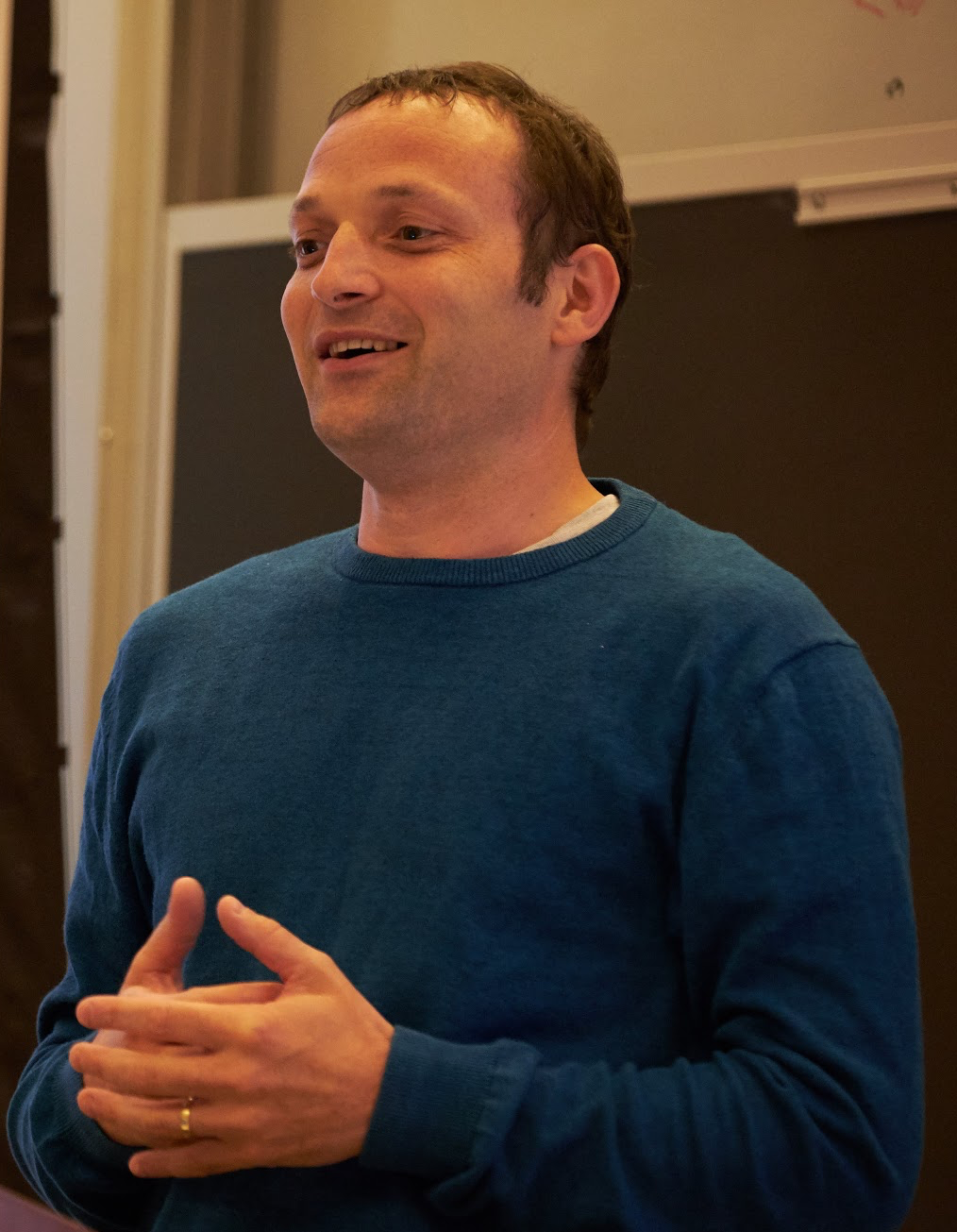
 Loic Barrault
· 4 previous affiliations
- Meta AICurrent
- Current
- Meta (United States)2022–2025
- Researcher · 2022–2025
- University of Sheffield2019–2021
- Lecturer · 2019–2021
- Le Mans Université2010–2019
- Lecturer · 2010–2019
Research Overview
Loic Barrault focuses on massively multilingual machine translation, multimodal language understanding, and the development of universal sentence representations. His trajectory spans early work in statistical and neural machine translation adaptation to recent large-scale models that unify speech and text across hundreds of languages. Currently, he investigates language modeling in abstract concept spaces to improve cross-lingual reasoning and generalization.
Research Trajectory
Barrault’s early work centered on improving machine translation systems through user feedback and monolingual data integration. He contributed to The Matecat Tool, exploring the area of online model adaptation for interactive workflows and multi-stage human-in-the-loop pipelines for multilingual evaluation. This focus on practical translation environments continued with Continuous Adaptation to User Feedback for Statistical Machine Translation, which analyzed how small amounts of parallel in-domain data could improve translator productivity. As the field transitioned to neural architectures, he collaborated on On Using Monolingual Corpora in Neural Machine Translation. This work introduced shallow and deep fusion techniques to leverage non-parallel text, advancing the broader direction of neural machine translation for low-resource languages and domain adaptation for specialized neural machine translation.
A significant portion of his research then shifted toward representation learning and multimodality. He participated in the development of InferSent in Supervised Learning of Universal Sentence Representations from Natural Language Inference Data, contributing to the research direction of Max-Pooling Over Recurrent Hidden States for Sentence Embeddings and establishing natural language inference as a universal reasoning intermediate. To better understand these dense vectors, he co-authored What you can cram into a single $&!#* vector: Probing sentence embeddings for linguistic properties, designing probing tasks that intersect with the area of Disentangling Representation Knowledge from Probe Learning and the broader field of Semantic Context Compression for Large Language Models. Concurrently, Barrault guided efforts in multimodal translation, organizing the Findings of the Third Shared Task on Multimodal Machine Translation, which fostered work in the direction of Grounding Machine Translation in Visual Context. He also helped introduce How2: A Large-scale Dataset for Multimodal Language Understanding, providing instructional videos to stimulate research in spoken language translation and multimodal summarization.
Continuing his leadership in the machine translation community, he coordinated the evaluation campaigns detailed in the Findings of the 2020 Conference on Machine Translation (WMT20), overseeing assessments that touched on document-level machine translation and discourse coherence. His research also expanded into visual question answering with In Factuality: Efficient Integration of Relevant Facts for Visual Question Answering, and into data-efficient training paradigms with Bayesian Active Learning with Pretrained Language Models, which addressed continual pretraining for domain adaptation.
In recent years, Barrault’s trajectory has been defined by massively multilingual and multimodal scaling. He was a key contributor to No Language Left Behind: Scaling Human-Centered Machine Translation, a project supporting over 200 languages that advanced the direction of scaling language models to the global long tail using sparse mixture-of-experts architectures. Recognizing the challenges of such scale, he collaborated on HalOmi: A Manually Annotated Benchmark for Multilingual Hallucination and Omission Detection in Machine Translation, addressing the hallucination problem in machine translation. He also co-authored We Need to Talk About Classification Evaluation Metrics in NLP to refine how classification models are assessed.
His focus on unifying modalities culminated in directing the development of SeamlessM4T: Massively Multilingual & Multimodal Machine Translation, a single model handling speech and text tasks across 100 languages, driving progress in self-supervised pretraining for universal speech representations. This line of research was further detailed in Joint speech and text machine translation for up to 100 languages, exploring methods for bridging the linguistic gap in multilingual models. Alongside semantic translation, he investigated prosodic fidelity in Aligning Speech Segments Beyond Pure Semantics, contributing to the area of style-conditioned duration modeling for neural speech synthesis. Most recently, Barrault introduced Large Concept Models: Language Modeling in a Sentence Representation Space. This work shifts the paradigm from token-level generation to operating on explicit, language-agnostic concepts, pushing the boundaries of cross-lingual generalization of reasoning and instruction following.
Current Directions
Recent work investigates the unification of modalities and the abstraction of language modeling beyond discrete tokens. A major ongoing theme in the evidence is the development of massively multilingual systems that seamlessly integrate speech and text, aiming to bridge linguistic gaps and preserve non-semantic features like prosody and style across languages. Concurrently, Barrault is exploring language modeling in continuous sentence representation spaces. By operating on language-agnostic concepts rather than individual subwords, this research seeks to improve zero-shot cross-lingual generalization and enable more robust, human-like reasoning in large-scale models.
Profile updated
| Paper | Venue | Year |
|---|---|---|
| Active Learning by Acquiring Contrastive ExamplesGitHubmourga/ | EMNLP | 2021 |
Loading new papers…
Other researchers whose papers cluster into the same research directions — a proxy for overlapping technical interests and shared intellectual neighborhoods.
See something wrong? Report a mistake