

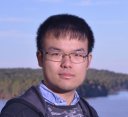
 Liu He
6 previous affiliations
- Applied Scientist · 2024
- Baidu (China)2024
- Research Intern · 2024
- Purdue University West Lafayette2019–2024
- Research Assistant · 2019–2024
- Research Intern · 2022
- Master of Arts - MA, Geography · 2017–2019
- Research Assistant · 2017–2018
- Wuhan University2013–2017
- Undergrad student · 2013–2017
1 other author named Liu He: Liu He (Tsinghua University · 1 paper)
Research Overview
Liu He focuses on generative synthesis, multimodal reasoning, and urban layout modeling. His trajectory spans from early visual analytics to developing advanced diffusion models and multi-agent systems for physical-aware video and image generation. Currently, his work addresses complex visual instruction datasets and latent-space communication in heterogeneous multi-agent architectures.
Research Trajectory
He began his research with early investigations into visual analytics, developing methods for the Visual analysis of route diversity in 2011. Following this early work, and leading into his current role as an applied scientist at Amazon, his focus shifted significantly toward generative modeling and spatial layout generation, a theme that defined his research output in 2023 and 2024. During this period, he introduced Diffusion-Based Document Layout Generation, which adapted diffusion models to operate in the sequence domain rather than the image domain. This approach allowed for the creation of complex document designs and introduced a novel evaluation metric, Document Earth Mover’s Distance, to handle heterogeneous layouts.
Expanding generative techniques to urban environments, he developed frameworks for city-scale modeling. In GlobalMapper: Arbitrary-Shaped Urban Layout Generation, he utilized graph attention networks to map arbitrary city blocks to canonical forms through skeletonization. This work contributed to the broader area of Relaxing the Manhattan World Assumption and intersected with research directions like Road Topology Reasoning for Autonomous Navigation. He subsequently advanced this domain with COHO: Context-Sensitive City-Scale Hierarchical Urban Layout Generation, employing a graph-based masked autoencoder to capture intricate relationships between urban elements for more coherent city designs. Concurrently, he addressed the challenges of extracting spatial data from degraded remote sensing imagery in Generative building feature estimation from satellite images, combining globally available satellite data with geometric feature datasets to compensate for image degradation and improve per-building feature estimation.
In 2024 and 2025, his research expanded into multimodal reasoning, synthetic data generation, and multi-agent systems. He proposed Kubrick: Multimodal Agent Collaborations for Synthetic Video Generation, a framework that decomposes video creation into distinct agent roles—such as director, programmer, and reviewer—integrated with 3D rendering engines to produce physically plausible videos from text descriptions. His work on multimodal systems continued with participation in LongPerceptualThoughts: Distilling System-2 Reasoning for System-1 Perception, which synthesized complex, multi-step reasoning traces to improve the performance of vision-language models on perception tasks, effectively distilling System-2 reasoning into System-1 perception. To address the evaluation of such models, he collaborated on MMIG-Bench: Towards Comprehensive and Explainable Evaluation of Multi-Modal Image Generation Models, a unified benchmark pairing richly annotated text prompts with multi-view reference images across diverse subjects to test compositional semantics and common knowledge.
His recent contributions also include fine-grained image refinement. In Refine-by-Align: Reference-Guided Artifacts Refinement through Semantic Alignment, he helped develop a diffusion-based framework that corrects localized artifacts—such as garbled logos or blurry textures—in AI-generated images by borrowing fine-grained details from reference images without requiring test-time fine-tuning. This research advances several methodological areas, including Tuning-Free Personalization of Text-to-Image Diffusion Models, Semantic Windows in Diffusion Representation Learning, Overcoming the Resolution Bottleneck in Patch-Based Vision Transformers, and Intrinsic Geometry for Non-Rigid Shape Correspondence. Most recently, he explored the efficiency of multi-agent collaboration in The Vision Wormhole: Latent-Space Communication in Heterogeneous Multi-Agent Systems, proposing a framework that repurposes the visual interfaces of vision-language models to enable high-bandwidth, latent-space communication, thereby bypassing the inefficiencies and information quantization loss of discrete text exchanges.
Current Directions
The most recent papers in the evidence indicate a strong focus on enhancing the reasoning capabilities and collaborative efficiency of multimodal AI systems. Current work investigates how vision-language models can move beyond discrete text communication, exploring latent-space transfers to reduce runtime overhead and information loss in heterogeneous multi-agent frameworks. Additionally, ongoing research addresses the distillation of complex, multi-step reasoning into perception models, aiming to ground generative video and image synthesis in physical reality. This involves developing comprehensive evaluation benchmarks for multimodal generation and designing agentic workflows that integrate 3D representations to ensure physical coherence and semantic alignment in synthetic media.
Profile updated
Loading new papers…
Other researchers whose papers cluster into the same research directions — a proxy for overlapping technical interests and shared intellectual neighborhoods.
See something wrong? Report a mistake