

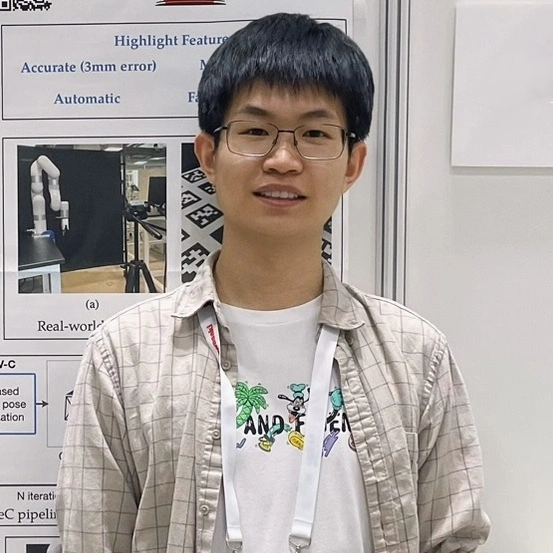
 Linghao Chen
· 2 previous affiliations
- HillbotSince 2024
- Researcher · Since 2024
- Zhejiang University2015–2024
- PhD student · 2019–2024
- Undergrad student · 2015–2019
Research Overview
Linghao Chen focuses on 3D computer vision, embodied artificial intelligence, and human motion generation. His research spans the reconstruction of 3D objects from sparse views, the synthesis of coherent human behaviors, and the development of robust generative models. Recently, his work investigates scalable autoregressive models and multi-modal frameworks for continuous motion recovery and video editing.
Research Trajectory
Linghao Chen's early work addressed fundamental challenges in 3D object detection from stereo imagery. In 2022, he introduced an instance disparity estimation network in Shape Prior Guided Instance Disparity Estimation for 3D Object Detection. This system leverages category-specific shape priors to predict disparity exclusively for objects of interest, bypassing the computational cost of full-image disparity maps. To overcome the scarcity of disparity annotations during training, this approach incorporates a statistical shape model to generate dense pseudo-ground-truth labels, significantly improving detection accuracy.
In 2023, his research broadened to encompass human motion modeling and robust representation learning. He developed frameworks for text-driven whole-body motion generation, presenting HumanTOMATO: Text-aligned Whole-body Motion Generation to simultaneously synthesize coherent facial expressions, hand gestures, and body movements aligned with textual descriptions. This addressed the limitations of prior models that often neglected fine-grained hand and face control. Continuing in this domain, he proposed HumanMAC: Masked Motion Completion for Human Motion Prediction, which utilizes a masked completion strategy to streamline the training process and improve the switching between different motion categories. Concurrently, he explored the research direction of Label Noise Propagation in Graph Neural Networks through ERASE: Error-Resilient Representation Learning on Graphs for Label Noise Tolerance. This work introduced a decoupled label propagation strategy combined with an information-theoretic objective to maintain accurate node representations even when up to half of the training data is mislabeled.
A significant portion of his subsequent work focuses on accelerating 3D asset generation and reconstruction. To address the computational bottlenecks of per-shape optimization, he contributed to the broader area of Eliminating Per-Scene Optimization with Feed-Forward 3D Reconstruction. This effort culminated in the development of One-2-3-45++, a framework that transforms a single RGB image into a high-fidelity 3D textured mesh in approximately one minute. Documented initially in a 2023 preprint and subsequently published as One-2-3-45++: Fast Single Image to 3D Objects with Consistent Multi-View Generation and 3D Diffusion, the system tiles multiple views into a single 2D diffusion pass before lifting them with a native 3D diffusion model. This approach directly advances the research direction of Synchronizing Multi-View Diffusion with Cross-View Attention and is highly effective at the research direction of Mitigating Multi View Inconsistency in Generative 3D Modeling, successfully bypassing the multi-face artifacts common in earlier methods. Building on these feed-forward principles, he also co-developed SpaRP: Fast 3D Object Reconstruction and Pose Estimation from Sparse Views, which contributes to the area of Feed-Forward 3D Scene Reconstruction by generating textured meshes and estimating relative camera poses from as few as one to six unposed images.
Returning to human motion in 2024, his work emphasized fine-grained editing and multimodal understanding. He introduced MotionCLR: Motion Generation and Training-free Editing via Understanding Attention Mechanisms, enabling precise, training-free modifications to generated animations without requiring full regeneration—solving a major usability bottleneck in generative animation. He also developed MotionLLM: Understanding Human Behaviors from Human Motions and Videos, a unified framework that combines raw video data with 3D motion sequences to improve spatial-temporal reasoning and motion captioning.
In 2025, his research trajectory expanded into global motion recovery and diffusion-based editing. He contributed to HumanMM: Global Human Motion Recovery from Multi-shot Videos, a framework designed to reconstruct continuous 3D human trajectories across abrupt camera cuts by integrating a robust shot-transition detector with a human-masked camera pose estimator and a Transformer-based motion integrator. Additionally, he co-authored Training-Free Text-Guided Color Editing with Multi-Modal Diffusion Transformer, which manipulates the attention mechanisms of diffusion models to allow precise color editing while preserving complex physical details like refractions and textures. He also participated in exploring scaling behaviors in generative models with ScaMo: Exploring the Scaling Law in Autoregressive Motion Generation Model. This work investigates the application of scaling laws to motion generation and touches upon the research direction of Mitigating Codebook Collapse in Vector Quantization through the use of a specialized motion tokenizer.
Current Directions
The most recent papers in the evidence address the challenges of continuous motion recovery in complex video environments and the fine-grained control of generative diffusion models. Recent work investigates the extraction of seamless 3D human motion from multi-shot videos, bridging disparate camera views to maintain global coordinate consistency despite abrupt transitions. Concurrently, his research explores the internal attention mechanisms of multi-modal diffusion transformers to enable training-free, text-guided editing of visual properties like color and lighting without compromising underlying physical textures. Furthermore, his recent collaborative efforts examine the scaling laws of autoregressive models in the context of motion generation, seeking to establish predictable scaling behaviors for motion tokenization and synthesis.
Profile updated
Loading new papers…
Other researchers whose papers cluster into the same research directions — a proxy for overlapping technical interests and shared intellectual neighborhoods.
See something wrong? Report a mistake