

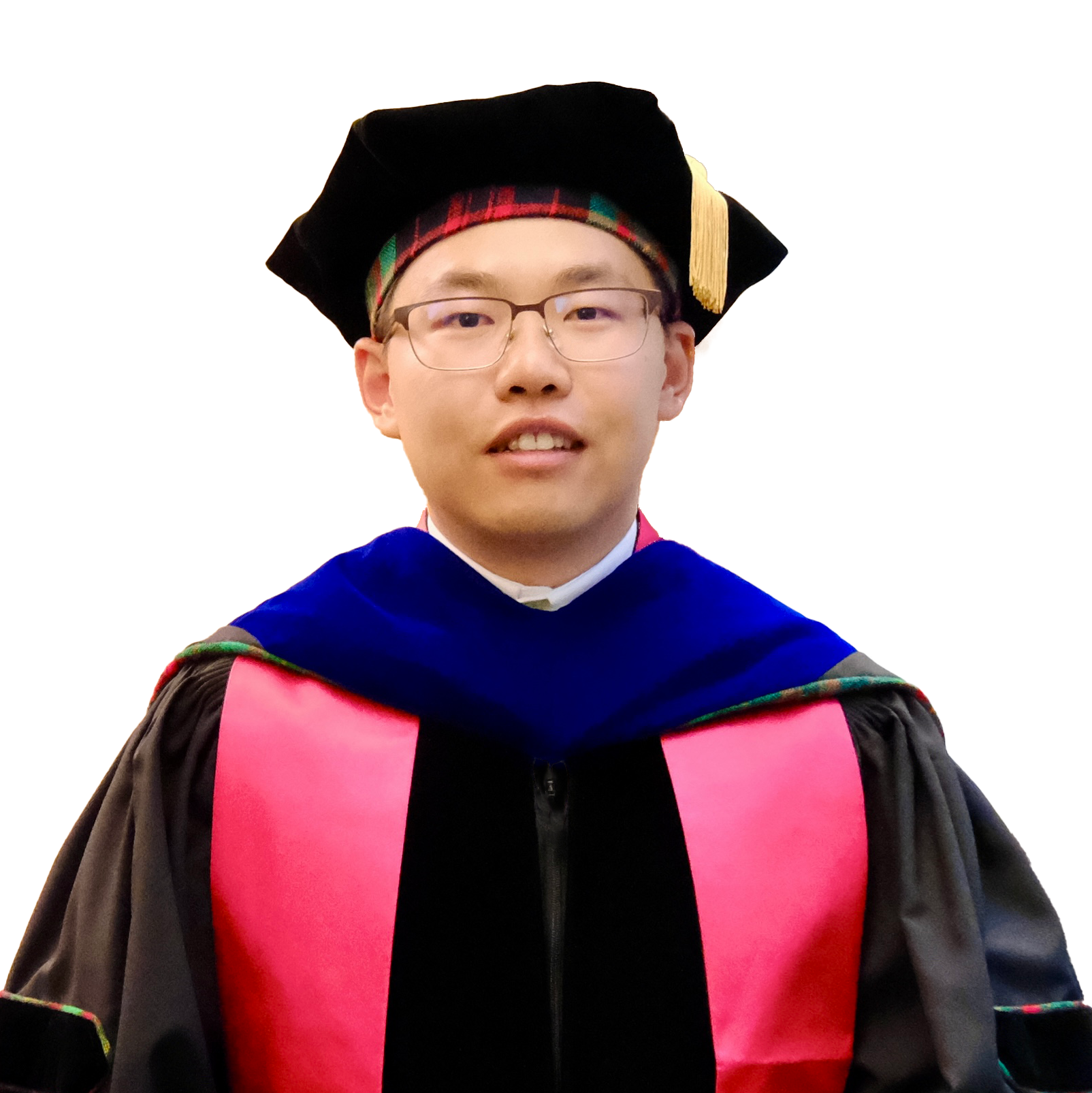
 Lijun Yu
· 6 previous affiliations
- Google DeepMind (United Kingdom)Since 2024
- Staff Research Scientist · Since 2026
- Senior Research Scientist · 2024–2026
- Google (United States)2021–2026
- Research Scientist · 2024–2026
- Research Intern / Student Researcher · 2021–2023
- PhD student · 2024
- GamesMind (startup)2018–2019
- Co-Founder, Researcher · 2018–2019
- Peking University2015–2019
- Bachelor of Science - BS, Computer Science and Technology · 2019
- Undergrad student · 2015–2019
- Microsoft (United States)2017–2018
- Research Intern · 2017–2018
Research Overview
Lijun Yu focuses on multi-modal foundation models, autoregressive visual generation, and discrete tokenization for video synthesis. His trajectory spans the development of masked generative video transformers and semantic autoencoders that bridge frozen language models with visual domains. His most recent work investigates scaling laws for next-pixel prediction and cross-modal semantic compression for efficient image and audio generation.
Research Trajectory
The early stages of his research trajectory include foundational work in the area of Semantic Event Decomposition for Temporal Sequences and the broader direction of Generative Modeling via Discrete Score Matching. Building upon these themes, his focus shifted toward large-scale visual and multimodal modeling. In 2023, he participated in the development of methods for visually-rich document understanding, addressing the statistical resilience of models trained on massive, weakly labeled web data in Document Entity Retrieval with Massive and Noisy Pre-training.
Concurrently, he significantly advanced the field of video synthesis by introducing MAGVIT: Masked Generative Video Transformer. This model utilized a novel 3D tokenizer and a multi-task training scheme to perform diverse video synthesis tasks—ranging from frame interpolation to dynamic inpainting—with substantial efficiency gains over contemporary diffusion models. Expanding on the integration of visual and textual modalities, he explored multimodal generation using frozen large language models in SPAE: Semantic Pyramid AutoEncoder for Multimodal Generation with Frozen LLMs. By translating images into a sequence of interpretable lexical tokens from the language model's own vocabulary, this approach enabled frozen LLMs to process and generate images without requiring any parameter updates.
In 2024, his research expanded deeper into the area of High Fidelity Autoregressive Visual Generation. He developed MAGVIT-v2 in Language Model Beats Diffusion - Tokenizer is key to visual generation, introducing a visual tokenizer designed to allow transformer-based language models to achieve state-of-the-art performance on image and video generation benchmarks. This work directly contributed to the research direction of Scaling Visual Vocabularies for High Fidelity Autoregressive Generation and the broader area of Scaling From Class Conditional to Text to Image Generation. Alongside autoregressive models, he also advanced diffusion-based architectures. In Photorealistic Video Generation with Diffusion Models, he introduced the Window Attention Latent Transformer (W.A.L.T), which employed a causal encoder to map images and videos into a unified latent space. By utilizing a window-restricted transformer architecture, the model generated temporally consistent, high-resolution video, contributing to the area of Scaling Text Encoders for Generative Alignment.
Continuing his focus on efficient tokenization and simulation in 2025, he introduced TexTok in Language-Guided Image Tokenization for Generation. This framework leverages descriptive text captions to guide image compression, offloading high-level semantic information to language embeddings. This strategy preserves the limited visual token capacity for fine-grained details, significantly accelerating inference times. He also collaborated on UISim: An Interactive Image-Based UI Simulator for Dynamic Mobile Environments, an image-based simulator that predicts structured layouts and renders them into pixels to generate realistic and logically consistent UI transitions for AI agents without requiring physical devices.
The most recent papers in his trajectory demonstrate a continued expansion into new modalities and fundamental scaling laws. In 2026, he participated in the development of an open-source foundation model for long-form music generation from lyrics in YuE: Scaling Open Foundation Models for Long-Form Music Generation, which utilized a two-stage autoregressive framework and track-decoupling techniques. Furthermore, he collaborated on Rethinking Generative Image Pretraining: How Far Are We From Scaling Up Next-Pixel Prediction?, applying scaling laws to autoregressive next-pixel prediction to analyze the compute bottlenecks required to make pixel-by-pixel modeling competitive with specialized vision models.
Current Directions
The most recent papers in the evidence address the fundamental scaling properties of autoregressive generation across diverse modalities, including audio and raw pixels. Recent work investigates how scaling laws apply to next-pixel prediction, analyzing the compute requirements necessary for unified vision models to process raw visual data without intermediate tokenization bottlenecks. Concurrently, research in this period explores cross-modal semantic compression, utilizing language embeddings to guide image tokenization and improve inference efficiency. His recent collaborations also extend these autoregressive and foundation model principles to the acoustic domain, focusing on structural coherence and semantic alignment for long-form generative audio and music.
Profile updated
Loading new papers…
Other researchers whose papers cluster into the same research directions — a proxy for overlapping technical interests and shared intellectual neighborhoods.
See something wrong? Report a mistake