

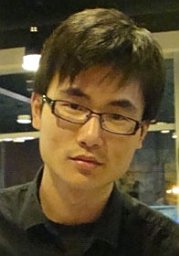
 Licheng Yu
· 4 previous affiliations
- Meta (United States)Since 2021
- Senior Staff Research Scientist & Manager · Since 2025
- Current
- Staff Research Scientist & Manager · 2022–2025
- Senior Research Scientist · 2021–2022
- Microsoft (United States)2019–2020
- Researcher · 2019–2020
- Doctor of Philosophy (Ph.D.), Computer Science · 2014–2019
- Shanghai Jiao Tong University2011–2014
- Master's degree, Information Engineering · 2011–2014
Research Overview
Licheng Yu focuses on vision-language understanding, multimodal reasoning, and generative modeling. His trajectory spans early work in referring expression comprehension and visual grounding to recent advancements in efficient multimodal large language models. Currently, his research addresses the computational efficiency of vision-language architectures and layout-agnostic visual synthesis.
Research Trajectory
Yu's early research established foundational approaches to connecting natural language with visual content. He introduced Visual Madlibs: Fill in the Blank Description Generation and Question Answering (2015), a dataset designed to gather targeted descriptions about objects, appearances, and interactions. This work contributed to the broader area of Distinctive Image Captioning for Discriminative Scene Understanding and touched upon early methods for the research direction of Scalable Evaluation of Generative Models with LLM Judges. Building on visual grounding, he developed a unified framework for referring expressions in A Joint Speaker-Listener-Reinforcer Model for Referring Expressions (2017). By training speaker, listener, and reinforcer modules jointly, the model improved both the generation and comprehension of discriminative expressions, advancing research in resolving referential ambiguity in vision-language models. He further refined this problem space with MAttNet: Modular Attention Network for Referring Expression Comprehension (2018), which decomposed language expressions into modular components—subject appearance, location, and relationships—allowing for flexible, end-to-end processing of complex queries. During this period, he also collaborated on 3D vision problems, participating in the development of Physics-Inspired Garment Recovery from a Single-View Image (2018), which extracted both the 3D geometry and physical simulation parameters of clothing from single photographs.
Moving beyond static images, Yu's work expanded into embodied AI and video understanding. He contributed to Learning to Navigate Unseen Environments: Back Translation with Environmental Dropout (2019), addressing generalization challenges in continuous vision-language navigation. In the video domain, he collaborated on Violin: A Large-Scale Dataset for Video-and-Language Inference (2020), a task requiring models to determine entailment or contradiction between video clips and natural language hypotheses. This dataset helped probe the social reasoning gap in language models and supported the research direction of Overcoming Modality Bias in Vision Language Models. He also participated in creating VALUE: A Multi-Task Benchmark for Video-and-Language Understanding Evaluation (2021), which evaluated systems across retrieval, question answering, and captioning to encourage models that generalize across tasks. In parallel, Yu explored generative modeling. He co-authored BachGAN: High-Resolution Image Synthesis From Salient Object Layout (2020), which tackled the challenge of generating fine-grained details and weaving invented backgrounds seamlessly around standalone foreground objects, contributing to the scaling of generative models for high-resolution visual synthesis.
In recent years, Yu has focused on optimizing multimodal architectures and fine-grained visual understanding. He collaborated on GEB+: A Benchmark for Generic Event Boundary Captioning, Grounding and Retrieval (2022), which shifted focus from overall segment understanding to evaluating fine-grained status changes inside generic video events. Addressing the computational trade-offs in image-text retrieval, he oversaw the development of LoopITR: Combining Dual and Cross Encoder Architectures for Image-Text Retrieval (2022). This architecture created a synergistic loop where a fast dual encoder mined hard negatives for a cross encoder, which in turn distilled fine-grained knowledge back to the dual encoder, bridging the performance gap between the two approaches. He also contributed to robust representation learning with RoPAWS: Robust Semi-supervised Representation Learning from Uncurated Data (2023), extending semi-supervised methods to handle uncurated, real-world data containing out-of-class examples.
Most recently, his research has addressed the integration of text rendering in generative models and the efficiency of large-scale architectures. He participated in SceneTextGen: Layout-Agnostic Scene Text Image Synthesis with Diffusion Models (2024), which bypassed the deterministic layout generation phase to improve the diversity of text styles and fonts in synthesized images. In 2025, he led work on Accelerating Multimodal Large Language Models by Searching Optimal Vision Token Reduction, which mitigates the quadratic computational cost of high-resolution images in multimodal models by identifying and reducing redundant vision tokens based on attention score rankings.
Current Directions
The most recent papers in the evidence address the computational scalability and generative capabilities of multimodal models. A primary focus is on accelerating Multimodal Large Language Models (MLLMs) by optimizing vision token reduction, allowing these architectures to process high-resolution images without incurring prohibitive quadratic computational costs. Additionally, recent work investigates layout-agnostic scene text synthesis using diffusion models, aiming to improve the coherence and stylistic diversity of text rendered within generated images.
Profile updated
Loading new papers…
Other researchers whose papers cluster into the same research directions — a proxy for overlapping technical interests and shared intellectual neighborhoods.
See something wrong? Report a mistake