

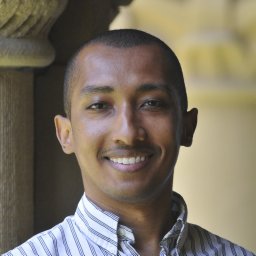
 Lester Mackey
· 7 previous affiliations
- Microsoft (United States)Since 2016
- Senior Principal Researcher · Since 2016
- Current
- Researcher · Since 2016
- Stanford University2012–2016
- Assistant Professor · 2013–2016
- Postdoc · 2012–2013
- University of California, Berkeley2007–2012
- Doctoral Student · 2007–2012
- Master of Arts (MA), Statistics · 2011–2012
- PhD student · 2007–2012
- Research Intern · 2011
- The Ensemble2009
- Team Partner · 2009
Research Overview
Lester Mackey focuses on statistical machine learning, scalable approximate inference, and distribution compression. His trajectory spans foundational work in Stein's method and matrix factorization to applied machine learning for subseasonal climate forecasting. Most recently, his research addresses the efficiency of interacting particle systems, causal inference, and factual hallucination in large language models.
Research Trajectory
Early work explored scalable techniques for machine learning and predictive modeling. This included participation in Feature-Weighted Linear Stacking (2009), which demonstrated how meta-features could improve ensemble methods while retaining the speed and interpretability of linear regression. Building on the theme of scalability, he subsequently introduced Divide-and-Conquer Matrix Factorization (2011), a parallel framework that partitions large-scale noisy matrix factorization tasks into smaller subproblems, achieving near-linear speed-ups with rigorous recovery guarantees.
A significant portion of his research has focused on approximate inference and the rigorous evaluation of sampling methods. In 2015, he presented Measuring Sample Quality with Stein's Method, introducing a computationally efficient discrepancy metric to bound errors in high-speed Markov chain Monte Carlo (MCMC) algorithms. This work advanced the research direction of Score Based Inference for Unnormalized Models. He continued to optimize high-dimensional sampling by developing principled approaches to accelerate classical tools, as detailed in Improving Gibbs Sampler Scan Quality with DoGS (2017). Expanding these theoretical foundations, his research group unified score matching and contrastive divergence under a single framework in Minimum Stein Discrepancy Estimators (2019). This contribution provided new diffusion kernel estimators and stochastic optimization algorithms, deepening his involvement in the broader area of Nonparametric Goodness of Fit for Unnormalized Models.
Parallel to his theoretical work in statistics, he has led applied initiatives in climate modeling. In 2019, he developed machine learning approaches for the Subseasonal Climate Forecast Rodeo, detailed in Improving Subseasonal Forecasting in the Western U.S. with Machine Learning. This initiated a sustained effort in the research area of Bridging the Subseasonal Weather Predictability Gap, which aims to predict temperature and precipitation weeks in advance. He later expanded on this by combining state-of-the-art dynamical forecasts with machine learning observations in Adaptive Bias Correction for Improved Subseasonal Forecasting (2023).
During this same period, his theoretical work continued to evolve. He contributed to the evaluation of complex generative models with intractable distributions in A kernel Stein test for comparing latent variable models (2023). Additionally, he explored the reliability of modern artificial intelligence systems, investigating whether large language models possess the internal knowledge to recognize their own fabricated citations in Do Language Models Know When They're Hallucinating References? (2023). This work provided a novel consistency-check mechanism, contributing to the research direction of Factual Inaccuracy and Hallucination in Large Language Models.
In 2024, he further advanced the mathematical foundations of probability metrics by deriving an explicit upper bound for continuous random variables in Bounding Hellinger Distance with Stein's Method. Moving into 2025, his focus expanded to distribution compression and causal inference. His research group developed sub-Gaussian thinning algorithms in Low-Rank Thinning, which summarize datasets using small sets of representative points. This low-rank analysis was subsequently applied to neural network architectures in Thinformer: Guaranteed Attention Approximation via Low-Rank Thinning. That same year, he bridged causal inference and signal processing by demonstrating how to estimate treatment effects using independent component analysis in Estimating Treatment Effects with Independent Component Analysis.
The most recent papers in his trajectory address both computational bottlenecks and the rigorous evaluation of predictive models. In 2026, his group introduced Thinned Mean Field Langevin Dynamics, utilizing kernel thinning to select representative coresets of particles. This significantly reduced the complexity of optimizing over probability distributions, advancing the research direction of Mitigating the Quadratic Bottleneck in Interacting Particle Systems. He also investigated the hidden vulnerabilities of standard evaluation metrics, proving that cross-validation can be highly unreliable for comparing certain algorithms in The Relative Instability of Model Comparison with Cross-validation. Finally, he continued his long-term climate research by introducing a machine learning framework to correct historical probabilistic forecasts in Bridging the "Predictability Desert": A Probabilistic Bias Correction Framework for AI and Dynamical Subseasonal Forecasts.
Current Directions
Recent work investigates the intersection of scalable distribution compression, rigorous model evaluation, and applied probabilistic forecasting. The most recent papers in the evidence address the computational challenges of interacting particle systems and attention mechanisms, utilizing low-rank thinning and coreset selection to maintain theoretical guarantees while drastically reducing complexity. Additionally, current research explores the stability of fundamental machine learning evaluation practices, such as cross-validation, and continues to push the boundaries of subseasonal climate forecasting by developing probabilistic bias correction frameworks that integrate artificial intelligence with dynamical physical models.
Profile updated
| Title | Venue | Year |
|---|---|---|
| Express Language Modeling | NeurIPS | 2026 |
| Express Language Modeling | Efficient Reasoning @ COLM | 2026 |
| The Relative Instability of Model Comparison with Cross-validation | ICML | 2026 |
| Advancing Subseasonal Forecasting with Machine Learning | arXiv | 2026 |
| WildCat: Near-Linear Attention in Theory and Practice | AdaptFM @ ICML | 2026 |
| Bridging the "Predictability Desert": A Probabilistic Bias Correction Framework for AI and Dynamical Subseasonal Forecasts | ML4RS Main Track @ ICLR | 2026 |
| Universal Bounds for Self-Normalized Kullback-Leibler Estimation | arXiv | 2026 |
| Coevolutionary Continuous Discrete Diffusion: Make Your Diffusion Language Model a Latent Reasoner | ICML | 2026 |
| Efficient Concentration with Gaussian Approximation | Openreview | 2026 |
| Bounding Hellinger Distance with Stein's Method | Openreview | 2026 |
Loading new papers…
Other researchers whose papers cluster into the same research directions — a proxy for overlapping technical interests and shared intellectual neighborhoods.
See something wrong? Report a mistake