

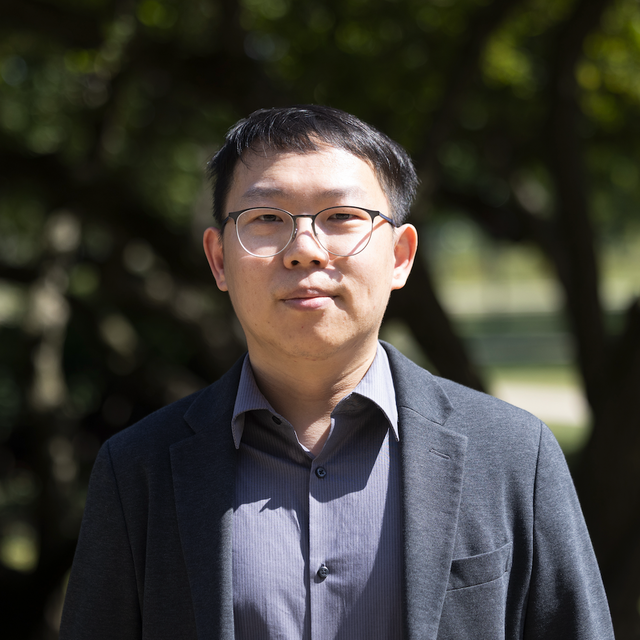
 Lei Zhang
· 2 previous affiliations
- Northern Illinois UniversitySince 2024
- Assistant Professor · Since 2024
- Virginia Tech2016–2024
- Researcher · 2024
- PhD student · 2016–2023
43 other authors named Lei Zhang: Lei Zhang (Hong Kong Polytechnic University · 860 papers), Lei Zhang (Sichuan University · 345 papers), Lei Zhang (251 papers), Lei Zhang (169 papers), Lei Zhang (Peking University · 141 papers), and 38 more
Research Overview
Lei Zhang focuses on graph neural networks, spatiotemporal modeling, and the application of deep learning to complex network structures. His trajectory spans from early work in social media analytics to foundational advancements in dynamic graph transformations and causal inference. Most recently, his research addresses combinatorial optimization on networks and theoretical frameworks for graph neural network expressivity.
Research Trajectory
Lei Zhang’s early research explored predictive modeling and feature interaction in social media contexts. In 2018, he developed a situation-based feature interaction model to improve personality prediction, detailed in Situation-Based Interpretable Learning for Personality Prediction in Social Media. By leveraging the DIAMONDS psychological lexicon to extract situation features and compute interaction values in user posts, this work addressed existing bottlenecks in predictive accuracy by formally integrating contextual information.
In subsequent years, his focus shifted toward the design and application of graph neural networks (GNNs) across diverse, complex domains, contributing to the broader area of Learning on Non-Euclidean Graph Structures. He contributed to hardware security research with Deep Graph Learning for Circuit Deobfuscation, which utilized graph learning to estimate the runtime of deobfuscation attacks on digital integrated circuits—a task traditionally complicated by the varying-size topology and structural complexity of the circuits. Around the same time, he participated in the development of HateNet: A Graph Convolutional Network Approach to Hate Speech Detection, addressing data sparsity and class imbalance in social network text through a semi-supervised hybrid framework that balances semantic similarity with the noisy nature of online language.
Moving into spatiotemporal modeling, Zhang introduced frameworks that prioritize causal relationships over fixed topologies. In Granger Causal Inference for Interpretable Traffic Prediction, he proposed a spatiotemporal causal graph inference model that decouples the prediction process into two distinct steps: causal graph inference and autoregressive processing. This approach mitigates the spurious correlations that often plague models relying on fixed road networks. This emphasis on interpretability aligns with his broader interest in the research direction of Explaining Predictions in Graph Neural Networks.
By 2023, his work increasingly addressed the temporal evolution of graphs. He tackled the challenge of mapping changing node attributes to evolving graph topologies in Fast and adaptive dynamics-on-graphs to dynamics-of-graphs translation. Utilizing a scalable deep echo-state network, this work overcame obstacles related to the need for highly adaptable models without rigid hypotheses, as well as the inefficiencies of processing data at varying granularities. Expanding on complex graph dynamics, he developed an equilibrium model for attributed graph transformation in Infinitely Deep Graph Transformation Networks. This architecture captures iterative, long-range interactions and jointly models four types of atomic interactions (nodes-to-edges, nodes-to-nodes, edges-to-nodes, and edges-to-edges), advancing methods for node-edge co-evolution.
More recently, Zhang has explored the intersection of GNNs and combinatorial optimization. In Network Interdiction Goes Neural, he investigated the use of neural architectures to solve network interdiction problems—complex attacker-defender scenarios that emerge in military operations, disease spread analysis, and communication network management. This work addresses the primary bottleneck in network interdiction caused by the high time complexity of conventional exact solvers. Concurrently, he has contributed to foundational GNN theory. He collaborated on Bridging the Gap between Spatial and Spectral Domains: A Unified Framework for Graph Neural Networks, which organizes existing models into a hierarchical structure based on approximation theory, enabling better model selection and design. This work directly advances the research direction of A Unified Hierarchy for Graph Neural Network Expressivity, and connects to his broader engagement with the area of Scaling Expressive Graph Neural Networks.
Current Directions
Recent work investigates the theoretical underpinnings of graph neural networks and their application to complex optimization tasks. The most recent papers in the evidence address the expressivity of GNNs, seeking to unify spatial and spectral domains through hierarchical frameworks based on approximation theory. Alongside these theoretical contributions, Zhang is exploring neural approaches to combinatorial optimization, specifically focusing on network interdiction problems where traditional exact solvers struggle with high time complexity. This dual focus on foundational expressivity and scalable heuristic solvers for adversarial network scenarios characterizes his current research trajectory.
Profile updated
Loading new papers…
Other researchers whose papers cluster into the same research directions — a proxy for overlapping technical interests and shared intellectual neighborhoods.
See something wrong? Report a mistake