

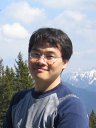
 Kwang In Kim
· 4 previous affiliations
- Associate Professor · Since 2023
- Full Professor · 2019–2023
- University of Bath2016–2019
- Senior lecturer · 2016–2019
- Lancaster University2013–2016
- Lecturer · 2013–2016
Research Overview
Kwang In Kim focuses on machine learning on non-Euclidean manifolds, active learning, and distributed optimization. His early work explored kernel methods and geometric regularization for semi-supervised learning and image processing. More recently, his research addresses robust gradient aggregation in federated environments, active client selection, and methods for improving deep neural networks through structural priors and predictor combination.
Research Trajectory
In the early 2000s, Kim's research applied non-linear machine learning techniques to computer vision tasks. He utilized kernel methods to extract facial features in Face recognition using kernel principal component analysis (2002), computing principal components within the space spanned by high-order correlations of input pixels. The following year, he combined support vector machines with a continuously adaptive mean shift algorithm in Texture-Based Approach for Text Detection in Images Using Support Vector Machines and Continuously Adaptive Mean Shift Algorithm (2003), enabling robust text detection directly from raw pixel intensities without relying on external feature extraction modules.
Moving into the late 2000s and early 2010s, Kim focused heavily on geometric and manifold-based regularization. In Semi-supervised Regression using Hessian energy with an application to semi-supervised dimensionality reduction (2009), he introduced the use of second-order Hessian energy to overcome the constant-bias limitations of graph Laplacian methods. This work demonstrated that Hessian energy prefers functions that vary linearly with respect to natural data parameters, advancing the broader area of The Limits of Tangent Space Linearization on Curved Manifolds. He also applied sparse kernel ridge regression to image processing, developing a framework to map low-resolution inputs to high-resolution targets in Single-Image Super-Resolution Using Sparse Regression and Natural Image Prior (2010). Continuing his investigation into manifold learning, he explicitly modeled how manifolds are embedded within ambient spaces in Curvature-Aware Regularization on Riemannian Submanifolds (2013), characterizing both intrinsic and extrinsic curvature to improve diffusion and regularization algorithms.
By the late 2010s, Kim's focus expanded to the optimization and efficiency of deep neural networks. He investigated the mechanisms underlying network compression in On Implicit Filter Level Sparsity in Convolutional Neural Networks (2019). This study analyzed how adaptive gradient descent techniques, combined with Batch Normalization and weight decay, naturally induce sparsity, contributing to research directions such as Implicit Sparsification in Adaptive Optimization and the area of Identifying and Eliminating Parameter Redundancy in Deep Networks.
In the 2020s, Kim addressed transfer learning, active learning, and the challenges of noisy data. He developed a framework to boost target models using black-box reference predictors from entirely different domains in Improving Predictors via Combination Across Diverse Task Categories (2021), aligning diverse data distributions in a shared latent space while preserving local structures. To mitigate the high costs of label noise, he proposed a method to identify optimal examples for re-labeling in Active Label Correction Using Robust Parameter Update and Entropy Propagation (2022), a key contribution to the research direction of Hybrid Uncertainty and Diversity Sampling for Active Learning. During this period, he also contributed to architectural improvements in computer vision, such as box-supervised instance representations in BoIR: Box-Supervised Instance Representation for Multi-Person Pose Estimation (2023).
Most recently, Kim has tackled the complexities of distributed and federated learning environments. He developed algorithms to handle non-i.i.d. client data by leveraging manifold structures in Robust Distributed Gradient Aggregation Using Projections onto Gradient Manifolds (2024). To improve convergence rates when communication resources are limited and client updates are noisy, he introduced a sampling distribution based on global model associations in Distributed Active Client Selection With Noisy Clients Using Model Association Scores (2024). His active learning research also evolved to utilize Gaussian Process surrogate models that mimic deep neural network progress without frequent retraining, as detailed in Active Learning Guided by Efficient Surrogate Learners (2024). He extended these concepts to privacy-preserving distributed environments in Diffusion-Based Active Learning for Distributed Client Manifolds (2025), simulating how uncertainty reduction spreads via anisotropic diffusion across embedded client parameters.
His ongoing work continues to refine predictor combination and structural reasoning. In Combining Task Predictors via Enhancing Joint Predictability (2026), he introduced algorithms that jointly assess the relevance of multiple reference predictors rather than relying on pairwise relationships. Additionally, he addressed the limitations of Large Language Models in processing two-dimensional data layouts in HInT: Hypergraph Infusion at the Structural Layers Improves Table Understanding (2026), injecting hypergraph-based features directly into the structural layers of LLMs to enhance complex table reasoning.
Current Directions
The most recent papers in the evidence indicate a strong focus on distributed optimization, advanced active learning, and the integration of structural priors into large-scale models. In federated settings, Kim investigates robust gradient aggregation and active client selection, specifically designing algorithms that operate over parameter manifolds to filter out noisy updates and handle heterogeneous client distributions. He also continues to advance active learning efficiency by employing surrogate models and diffusion processes to identify high-impact data points in privacy-preserving environments. Furthermore, his recent work explores the enhancement of Large Language Models for structured tasks, utilizing hypergraph infusion to improve their spatial and relational reasoning over tabular data.
Profile updated
Loading new papers…
Other researchers whose papers cluster into the same research directions — a proxy for overlapping technical interests and shared intellectual neighborhoods.
See something wrong? Report a mistake