

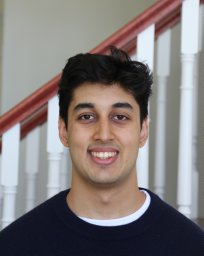
 Kusha Sareen
· 5 previous affiliations
- Master's Research · Since 2024
- MS student · 2024–2026
- McGill UniversityCurrent
- Current
- Machine Learning and Signal Processing Team Lead · 2021–2023
- Bachelor of Science - BS, Honours Physics and Computer Science · 2019–2023
- Research Assistant · 2020–2021
- The Meditation Club at McGill2021–2023
- Leader · 2021–2023
- Armilla AI2021
- Machine Learning Research and Development Intern · 2021
- A. B. Lucas Secondary School2015–2020
- 2015–2020
Research Overview
Kusha Sareen focuses on reasoning, generative modeling, and representation learning within deep neural networks. His trajectory spans foundational theoretical computer science to the geometric properties of overparameterized models and the alignment of generative systems. Currently, his work emphasizes scaling inference-time compute and unifying generation with self-verification to improve the reasoning capabilities of large language models.
Research Trajectory
Sareen's early research explored foundational problems in theoretical computer science, particularly concerning information bottlenecks and the limits of local computation. In 2024, he led work on Communication Complexity and Discrepancy of Halfplanes, which established tight bounds for the communication discrepancy of the halfplane membership problem. By proving a surprisingly small discrepancy for specific input distributions alongside a general lower bound, this work bridged discrepancy theory and distributed computation to clarify the fundamental limits of the problem.
Moving into deep learning and generative modeling, his focus shifted toward incorporating geometric priors and improving inference-time alignment. He introduced a novel approach to the research direction of Geometric Equivariance for Robust Representation Learning with Symmetry-Aware Generative Modeling through Learned Canonicalization. Rather than relying entirely on equivariant generative processes—which carry inherent network limitations—this work proposed learning a group-equivariant canonicalization network to map training samples to a canonical pose. This allowed a non-equivariant model to learn a single representative element per orbit, effectively decoupling symmetry from computation. In parallel, he contributed to aligning generative models with new rewards during inference. With collaborators, he developed Diffusion Tree Sampling: Scalable inference‑time alignment of diffusion models, which adapts Monte Carlo Tree Search to build denoising trajectories. By reusing past computations, this method advanced the broader areas of Parallelizing Tree Search for Hardware Accelerators and Token Level Credit Assignment for Sequence Generation, significantly reducing the compute required for alignment compared to traditional methods.
A major subsequent theme in Sareen's trajectory is enhancing the reasoning capabilities of large language models through test-time scaling and verification. He developed RL$^V$ in Putting the Value Back in RL: Better Test-Time Scaling by Unifying LLM Reasoners With Verifiers, a method that jointly trains an LLM as both a problem-solver and a verifier using reinforcement learning. This contribution to the area of Inference Time Compute Scaling for Complex Reasoning demonstrated substantial efficiency gains without heavy overhead. He further participated in expanding these verification paradigms in V1: Unifying Generation and Self-Verification for Parallel Reasoners. This framework addressed the bottleneck of selecting correct answers from generated candidates by shifting from absolute scalar scoring to pairwise verification, advancing research directions such as Relative Judgment for Robust LLM Reasoning and Evaluation and Adaptive Matchmaking for Efficient Preference Ranking.
Alongside his applied work in generative models and reasoning, Sareen has continued to investigate the theoretical underpinnings of neural network optimization. In The Role of Symmetry in Optimizing Overparameterized Networks, he analyzed how symmetries introduced by overparameterization function as a form of diagonal preconditioning on the Hessian of the loss landscape. This geometric transformation helps explain a key mechanism behind deep learning's success, demonstrating how overparameterization smooths the landscape to help optimizers find well-conditioned global minima.
Current Directions
The most recent papers in the evidence address the intersection of deliberative reasoning, test-time compute scaling, and the theoretical properties of deep learning optimization. A primary focus is on developing unified frameworks where models act as both generators and self-verifiers, utilizing pairwise judgment and reinforcement learning to improve accuracy on complex reasoning, math, and coding tasks. Concurrently, ongoing theoretical work investigates the geometry of loss landscapes, specifically how architectural symmetries and overparameterization naturally precondition optimization trajectories to discover robust minima.
Profile updated
Loading new papers…
Other researchers whose papers cluster into the same research directions — a proxy for overlapping technical interests and shared intellectual neighborhoods.
See something wrong? Report a mistake