

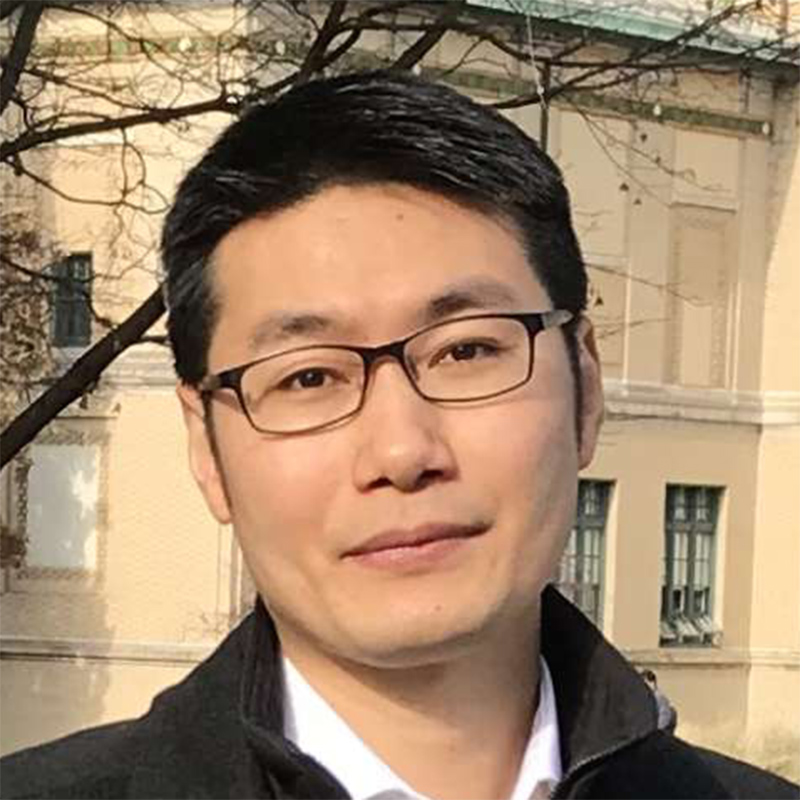
 Kun Zhang
· 2 previous affiliations
- Full Professor · Since 2023
- Carnegie Mellon UniversitySince 2015
- Full Professor · Since 2025
- Associate Professor · 2020–2025
- Assistant Professor · 2015–2020
7 other authors named Kun Zhang: Kun Zhang (Hefei University of Technology · 99 papers), Kun Zhang (University of Science and Technology of China · 13 papers), Kun Zhang (Tencent (China) · 5 papers), Kun Zhang (Nanjing University of Science and Technology · 1 paper), Kun Zhang (Altos Labs · 1 paper), and 2 more
Research Overview
Kun Zhang focuses on causal discovery, causal representation learning, and the philosophical foundations of machine learning. His work traces an arc from early methods in blind source separation to comprehensive frameworks for identifying complex causal structures from observational data. Recently, his research emphasizes handling nonstationary environments, latent confounders, and disentangled representations in generative artificial intelligence.
Research Trajectory
Kun Zhang, a professor at Carnegie Mellon University and visiting professor at MBZUAI, began his research trajectory by addressing the challenges of blind source separation. In Extended Gaussianization Method for Blind Separation of Post-Nonlinear Mixtures (2005), he extended gaussianization techniques to handle post-nonlinear mixtures, contributing to the broader area of Overcoming the Gaussian Identifiability Barrier in ICA. This early focus on nonlinear distortions naturally evolved into a rigorous investigation of causal directionality. He established foundational identifiability results in On the Identifiability of the Post-Nonlinear Causal Model (2009) and subsequently proposed a comprehensive framework for distinguishing causes from effects in Nonlinear acyclic causal models (2010), which accounted for sensor distortions via inner additive noise. To support these models with robust statistical tools, he developed the KCI-test in Kernel-based Conditional Independence Test and Application in Causal Discovery (2011), providing a computationally efficient method for evaluating conditional independence among continuous variables.
As his work progressed, Zhang expanded his focus to environments where data distributions shift across domains or over time. He explored these challenges through a causal lens in Multi-Source Domain Adaptation: A Causal View (2015). This line of inquiry culminated in significant methodological advances for handling heterogeneous data, notably in Causal Discovery from Heterogeneous/Nonstationary Data (2020). Here, he introduced the CD-NOD framework to recover causal skeletons and estimate mechanism changes, advancing the research direction of Causal Discovery from Nonstationary Distribution Shifts. Concurrently, he tackled the pervasive issue of unobserved variables, formalizing approaches for linear non-Gaussian systems in Learning Linear Non-Gaussian Causal Models in the Presence of Latent Variables (2020).
To democratize access to these complex algorithms, Zhang and his collaborators released a comprehensive open-source Python library detailed in Causal-learn: Causal Discovery in Python (2024). His subsequent work demonstrates a sustained focus on unifying latent variable discovery, nonstationarity, and selection bias. In Identifying Partially Observed Causal Models from Heterogeneous/Nonstationary Data (2026), he introduced LCD-NOD, a framework that leverages the mathematical equivalence between stable and nonstationary structural constraints to discover causal relationships in shifting environments with hidden variables.
He also addressed complex biases that distort causal inference. In Causal Modeling of Selection in Evolution (2026), he investigated selection bias as a multi-generational process rather than a single-event filter. Similarly, he examined the subtle distortions introduced by filtering data after an experiment in Characterization and Learning of Causal Graphs with Latent Confounders and Post-treatment Selection from Interventional Data (2026).
In the domain of structure learning, Zhang has made strides in the research area of Recursive Discovery of Latent Causal Hierarchies. He introduced LGES in Score-based Greedy Search for Structure Identification of Partially Observed Causal Models (2026), providing a score-based greedy search algorithm with theoretical identifiability guarantees for partially observed models. Expanding on this, he provided a graphical characterization of distributional equivalence for systems with both hidden variables and feedback loops in Distributional Equivalence in Linear Non-Gaussian Latent-Variable Cyclic Causal Models: Characterization and Learning (2026), contributing to the broader field of Causal Discovery for Complex Latent Hierarchies.
To support these advanced models, he developed LiNGIC, a highly accurate independence test tailored for linear non-Gaussian data, detailed in Independence Test for Linear Non-Gaussian Data and Applications in Causal Discovery (2026). Finally, Zhang has applied causal principles to generative artificial intelligence. In Controllable Video Generation with Provable Disentanglement (2026), he addressed the opaque nature of AI video generators by disentangling object identity from motion, aligning with his ongoing work in the research directions of Identifiable Representation Learning for Latent Causal Processes and Invertible Mappings for Causal Representation Learning.
Extending causal representation learning to scientific domains, Zhang contributed to MOSAIC: Module Discovery via Sparse Additive Identifiable Causal Learning for Scientific Time Series (2026), which pairs temporal identifiability with support recovery over observed variables to yield interpretable latent modules. In On the Recoverability of Causal Relations from Bulk Gene Expression Data (2026), Zhang investigated the theoretical and empirical limits of learning gene regulatory networks under aggregation, demonstrating that recovering causal relations requires stringent linearity conditions that rarely hold in real data. Moving into learning theory and model compression, Zhang also collaborated on Requential Coding: Pushing the Limits of Model Compression with Self-Generated Training Data (2026), introducing a compression strategy where a teacher selects samples from a student network's own distribution to achieve parameter-independent code lengths and PAC-Bayes generalization bounds.
Current Directions
Recent work investigates the intersection of causal discovery, latent variable modeling, and generative artificial intelligence. A primary focus is the development of robust algorithms capable of identifying causal structures in highly complex environments, particularly those characterized by nonstationary data distributions, hidden confounders, and cyclic feedback loops. This includes creating score-based search methods and graphical characterizations that do not rely on restrictive structural assumptions.
Additionally, current research addresses the nuanced challenges of selection bias, modeling it both as a multi-generational evolutionary process and as a post-treatment artifact in interventional data. Finally, these causal and theoretical frameworks extend to scientific time series, aggregation limits in biological data, and deep learning, spanning provable disentanglement in generative video alongside compression-based generalization bounds for large neural networks.
Profile updated
Loading new papers…
Other researchers whose papers cluster into the same research directions — a proxy for overlapping technical interests and shared intellectual neighborhoods.
See something wrong? Report a mistake