

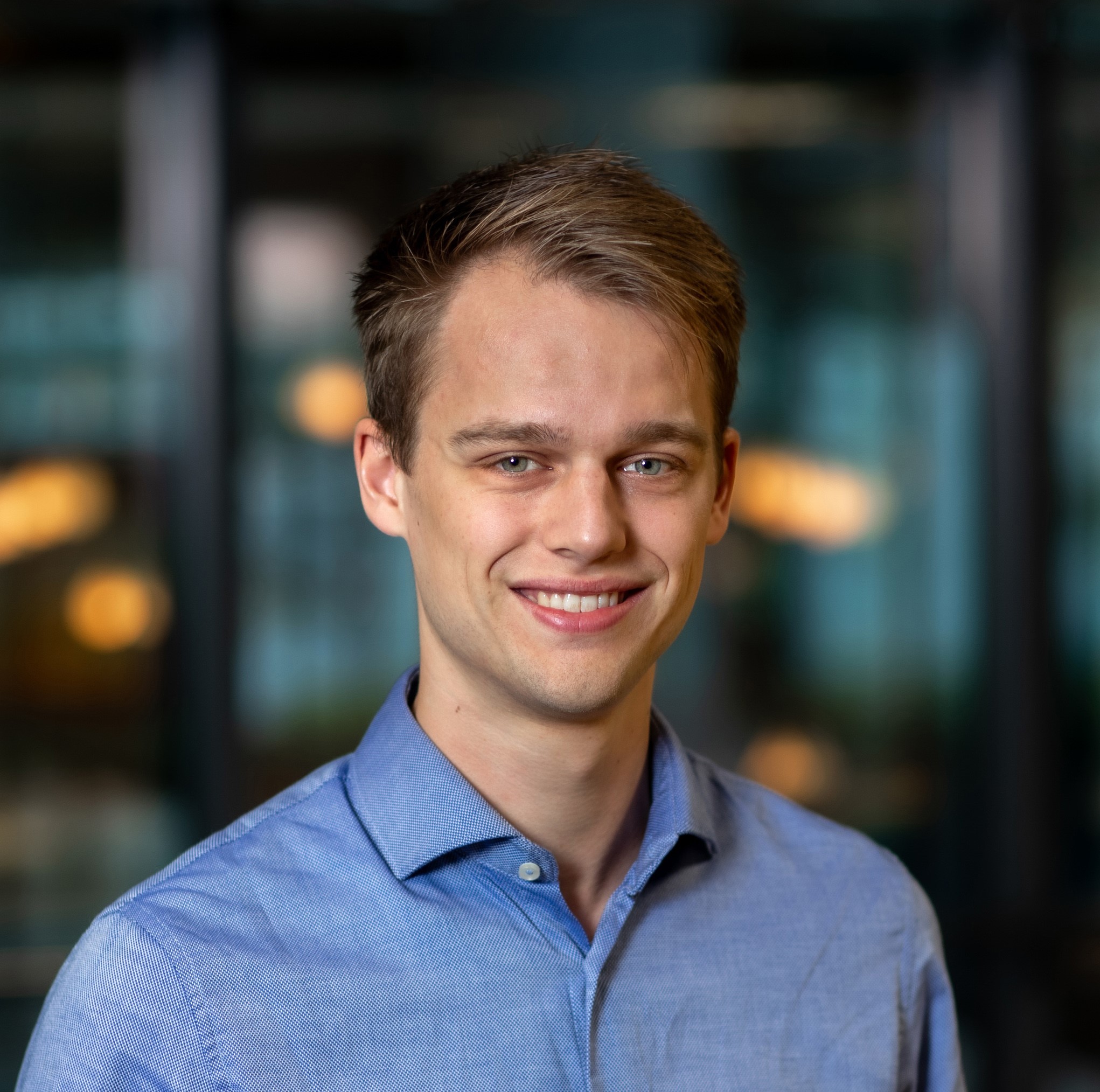
 Koen Minartz
· 5 previous affiliations
- ASML (United States)Since 2025
- Data Scientist · Since 2025
- Eindhoven University of Technology2016–2026
- PhD student · 2021–2026
- Research, teaching and industry consulting projects · 2017–2021
- MS student · 2019–2021
- Undergrad student · 2016–2019
- Erasmus University Rotterdam2020–2021
- Research Assistant · 2020–2021
- Stichting Studiebegeleiding Leiden2017–2019
- Teacher · 2017–2019
- AthenaStudies2018–2019
- Teacher · 2018–2019
Research Overview
Koen Minartz focuses on developing generative machine learning models for time-evolving data and stochastic physical simulations. His trajectory spans from accelerating partial differential equation solvers to modeling complex multi-agent systems like cellular dynamics and pedestrian crowds. Recently, his work emphasizes embedding physical symmetries and domain knowledge into neural simulators to improve the accuracy and stability of spatiotemporal predictions.
Research Trajectory
His early research addressed scalable data analysis and the foundational steps of neural simulation. In 2022, he developed methods for scalable pattern recognition in large time-series datasets with Multivariate correlations discovery in static and streaming data. Concurrently, he began exploring deep learning for biological systems, proposing an autoregressive probabilistic model in Towards Learned Simulators for Cell Migration to reproduce the spatiotemporal dynamics of single-cell migration traditionally handled by the Cellular Potts model.
Expanding on stochastic simulation, he introduced Equivariant Probabilistic Neural Simulation (EPNS) in Equivariant Neural Simulators for Stochastic Spatiotemporal Dynamics. This framework ensures models output equivariant distributions rather than just point estimates, improving data efficiency and rollout stability in domains ranging from celestial mechanics to cellular biology. This work contributed to several broader research areas, including the direction of Neural Stochastic Differential Equations for Noisy Systems and efforts in Mitigating Compounding Errors in Autoregressive Physical Simulators. It also advanced techniques in the area of Multi-Step Unrolling for Stable Neural Simulators and the broader field of Permutation Equivariant Architectures for Multi Agent Coordination.
In 2024, the focus broadened to encompass diverse physical and social systems. He investigated active matter physics by modeling pedestrian movements in Understanding complex crowd dynamics with generative neural simulators, moving beyond oversimplified pairwise interaction assumptions to capture complex crowd behaviors. This research intersects with the area of Vision-Constrained Social Interaction Modeling. In the domain of fluid dynamics, he developed neural PDE surrogates capable of accelerating the simulation of complex two-phase flows—such as oil displacement in porous media—by incorporating physics-inspired constraints like mass conservation in Accelerating Simulation of Two-Phase Flows with Neural PDE Surrogates. Additionally, he addressed mesoscopic material formation with Efficient Probabilistic Modeling of Crystallization at Mesoscopic Scale. By implementing a samplewise decoder dropout technique, this model preserves the stochastic variations inherent in crystal growth while achieving significant computational speedups over traditional numerical methods.
Building on his earlier biological and crowd simulations, his 2025 research formalized new paradigms for surrogate modeling. He bridged traditional biological simulation and deep learning in Deep Neural Cellular Potts Models by replacing hand-crafted energy functions with neural networks trained on observational data. This model bakes physical symmetries, such as translation and cell-label invariance, directly into the architecture to simulate complex multicellular organization. Concurrently, he advanced the study of pedestrian dynamics with Discovering interaction mechanisms in crowds via deep generative surrogate experiments. Utilizing graph neural networks, this approach combines the parametric control of laboratory studies with the statistical resolution of real-world measurements to better understand social interactions in crowds.
Extending these generative approaches to broader geometric contexts, he collaborated on STFlow: Data-Coupled Flow Matching for Geometric Trajectory Simulation. This work improves the accuracy of trajectory simulations for N-body systems, molecules, and human movement by replacing standard Gaussian noise with an informed prior based on observed initial frames, significantly reducing the computational effort required to map noise to realistic physical dynamics.
Current Directions
Recent work investigates the intersection of generative modeling and physical simulation, with a particular focus on embedding structural priors into neural architectures. The most recent papers in the evidence address the challenge of scaling trajectory simulations for complex systems—ranging from molecular dynamics to human crowds—by leveraging data-coupled flow matching and graph neural networks. A central theme in this domain is balancing computational efficiency with strict adherence to physical symmetries and conservation laws, enabling high-fidelity surrogate experiments that combine laboratory-level parametric control with real-world statistical resolution.
Profile updated
Loading new papers…
Other researchers whose papers cluster into the same research directions — a proxy for overlapping technical interests and shared intellectual neighborhoods.
See something wrong? Report a mistake