

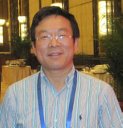
 Ke Chen
· 3 previous affiliations
- University of LiverpoolSince 1993
- Full Professor · 2007–2031
- Professor · 1993–2023
- University of StrathclydeSince 2023
- Professor and Chair at University of Strathclyde · Since 2023
- University of Reading1990–1992
- Postcdoc · 1990–1992
11 other authors named Ke Chen: Ke Chen (University of Manchester · 352 papers), Ke Chen (Zhejiang University · 158 papers), Ke Chen (Adobe Systems (United States) · 47 papers), Ke Chen (30 papers), Ke Chen (4 papers), and 6 more
Research Overview
Ke Chen focuses on mathematical image processing, variational methods, and weakly supervised learning for computer vision. Early work concentrated on multilevel algorithms for image denoising and deblurring, establishing efficient computational techniques for noise removal. More recently, this research has shifted toward advanced image segmentation, particularly applying contrast-based variational models to complex domains like histopathology.
Research Trajectory
The trajectory of Ke Chen’s research begins with foundational computational methods for image restoration, specifically focusing on efficient algorithms for noise reduction and deblurring. In 2008, Chen co-authored Fast Multilevel Algorithm for a Minimization Problem in Impulse Noise Removal, developing specialized multilevel techniques to address the minimization challenges inherent in clearing impulse noise from digital images. Multilevel algorithms are critical in this context, as they accelerate the convergence of optimization problems across hierarchical grids. This focus on robust, computationally efficient image reconstruction continued into 2010 with the publication of A Multilevel Algorithm for Simultaneously Denoising and Deblurring Images. In these early collaborative works, Chen contributed to the mathematical optimization strategies required to handle complex, degraded visual data without losing essential structural details.
Following this foundational work in image restoration, Chen’s focus expanded to the domain of image segmentation, leveraging variational methods to isolate specific regions of interest. A major challenge in traditional segmentation models is the reliance on manual parameter tuning and the risk of optimization algorithms converging on local minima. This progression is evident in the 2019 paper Parameter-Free Selective Segmentation With Convex Variational Methods. By utilizing convex formulations, this research provided more reliable and automated approaches to selective segmentation, ensuring global optima and creating a more robust pipeline for downstream image analysis tasks.
More recently, Chen has participated in applying these mathematical models to specialized and data-constrained domains, such as medical imaging. As a contributing researcher to the 2023 study Weakly Supervised Segmentation With Point Annotations for Histopathology Images via Contrast-Based Variational Model, Chen collaborated on addressing the high cost of dense annotations in medical datasets. Histopathology images often feature target regions with high morphological variation and irregular shapes, making pixel-perfect annotation prohibitively expensive. This work introduced a contrast-based variational model designed to generate reliable segmentation masks from sparse point annotations. These masks subsequently serve as complementary supervision for training deep learning segmentation networks, bridging the gap between classical variational methods and modern deep learning.
Current Directions
The most recent papers in the evidence indicate a focus on weakly supervised learning and its intersection with variational methods for medical image analysis. Current directions involve reducing the annotation burden in complex visual domains by utilizing sparse point annotations to guide deep segmentation models. This represents a synthesis of traditional mathematical imaging techniques—specifically contrast-based variational models—with modern neural network architectures to solve practical challenges in data-scarce environments like computational pathology.
Profile updated
Loading new papers…
Other researchers whose papers cluster into the same research directions — a proxy for overlapping technical interests and shared intellectual neighborhoods.
See something wrong? Report a mistake