

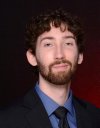
 Karl Schmeckpeper
· 4 previous affiliations
- The AI InstituteSince 2023
- Researcher · Since 2023
- University of Pennsylvania2017–2023
- PhD student · 2019–2023
- MS student · 2017–2019
- Student Researcher · 2016–2017
- University of Massachusetts Amherst2013–2016
- Undergrad student · 2013–2016
Research Overview
Karl Schmeckpeper focuses on robot learning, vision-based control, and spatial navigation. His early work explored large-scale multi-robot datasets and methods for learning control policies directly from action-free human video. More recently, his research investigates the integration of generative models, foundation models, and uncertainty estimation to adapt robotic policies to novel environments and complex manipulation tasks.
Research Trajectory
Karl Schmeckpeper’s early research focused on the development of scalable datasets and models for robotic control. In 2019, he participated in the creation of RoboNet: Large-Scale Multi-Robot Learning, an effort to pool interaction data across multiple robotic platforms to train high-capacity predictive models. This work contributed to broader research areas such as Scaling Robotic Intelligence Across Diverse Hardware and Scaling Robotic Control to Long-Horizon Multi-Stage Tasks, while also touching on early efforts in the direction of Scaling General Purpose Robotics via Vision Language Action Models.
In 2020, his focus shifted toward learning predictive models and control policies from human observation, addressing the bottleneck of collecting extensive online robotic experience. He led research on Learning Predictive Models from Observation and Interaction, which explored how augmenting robotic interaction data with observational data from other agents could help robots learn the dynamics of complex skills. He expanded on this concept in Reinforcement Learning with Videos: Combining Offline Observations with Interaction. In this work, he developed methods to perform reinforcement learning directly on human video data, overcoming the challenges of missing action annotations and significant visual domain shifts between humans and robots. This research advanced the area of Bridging the Embodiment Gap in Robot Learning and the broader direction of State Only Imitation Learning.
Continuing the theme of scalable robot learning in 2021, he collaborated on Bridge Data: Boosting Generalization of Robotic Skills with Cross-Domain Datasets, which investigated how multi-task, multi-domain datasets could enable practical data reuse for end-to-end skill learning. Concurrently, he explored active learning for dynamics models in An Adversarial Objective for Scalable Exploration. This work proposed an exploration method that uses a discriminator network to guide a planner toward state-action sequences that yield the least realistic predictions, thereby improving the sample efficiency of robotic exploration.
In 2022, his research expanded to include spatial navigation and semantic mapping in unseen environments. He contributed to Learning to Map for Active Semantic Goal Navigation, which introduced a framework for actively generating semantic maps outside an agent's field of view to inform long-term goal selection. This work aligned with the research direction of Generative Semantic Map Inpainting for Autonomous Navigation. He also developed spatial representations for vision-and-language navigation in Cross-modal Map Learning for Vision and Language Navigation, demonstrating that grounding language and vision within explicit top-down egocentric maps improves path prediction compared to unstructured memory or purely egocentric attention.
By 2024, his work began integrating generative models and foundation models into robotic control architectures. In IMAGINATION POLICY: Using Generative Point Cloud Models for Learning Manipulation Policies, he helped design a multi-task key-frame policy network that generates point clouds to imagine desired states for high-precision pick-and-place tasks, effectively transforming action inference into a local generative process. He also co-developed Theia: Distilling Diverse Vision Foundation Models for Robot Learning, a vision foundation model that distills knowledge from multiple off-the-shelf models to provide rich, holistic visual representations for downstream robot learning tasks.
His most recent work focuses on adapting policies to new environments and constraints. In 2025, he proposed methods for Accelerating Residual Reinforcement Learning with Uncertainty Estimation, utilizing uncertainty estimates from a base policy to focus exploration during residual reinforcement learning, which improved sample efficiency for stochastic policies. In 2026, he contributed to Adapting Diffusion Policies to Novel Environments via Policy-Steered Optimization, utilizing a model-based planner to optimize trajectories that satisfy both novel environmental constraints and the implicit task constraints learned by generative diffusion policies.
Current Directions
The most recent papers in the evidence address the challenge of adapting pre-trained robotic policies to novel environments and complex runtime constraints. Recent work investigates the use of generative models—such as point cloud generation for manipulation and diffusion models for trajectory planning—to improve the generalization and precision of robotic control. Additionally, this research explores the integration of distilled vision foundation models to provide robust visual representations, alongside uncertainty estimation techniques designed to accelerate residual reinforcement learning when adapting stochastic base policies to new tasks.
Profile updated
Loading new papers…
Other researchers whose papers cluster into the same research directions — a proxy for overlapping technical interests and shared intellectual neighborhoods.
See something wrong? Report a mistake