

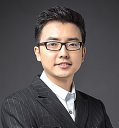
 Kai Xu
· 1 previous affiliation
- Chinese Academy of SciencesSince 2025
- Professor · Since 2025
6 other authors named Kai Xu: Kai Xu (IBM Research - Thomas J. Watson Research Center · Red Hat (United States) · 44 papers), Kai Xu (National University of Singapore · 8 papers), Kai Xu (4 papers), Kai Xu (2 papers), Kai Xu (1 paper), and 1 more
Research Overview
Kai Xu focuses on 3D computer vision, neural rendering, and physics-integrated scene representations. His trajectory spans from spatial reasoning and inverse rendering to the development of dynamic, simulation-ready 3D and 4D assets. Most recently, his research investigates the intersection of generative models and physical simulation for predictive manipulation and zero-shot 4D mesh generation.
Research Trajectory
Xu’s early work in the provided corpus addresses embodied spatial reasoning and industrial automation. In Learning Efficient Online 3D Bin Packing on Packing Configuration Trees (2022), his group tackled the online 3D bin packing problem. By introducing a hierarchical representation called a packing configuration tree, this work provided a comprehensive description of the state and action space, where the size of the action space scales with the leaf nodes. This structure enabled more effective packing policy learning through deep reinforcement learning, addressing complex practical constraints often missed by standard spatial discretization methods.
Moving into 2023, his research expanded into neural scene representations and inverse rendering. To address the ill-posed nature of inverse rendering from single photographs, he led the development of Weakly-supervised Single-view Image Relighting. This work introduced a weakly-supervised approach using a low-rank constraint and a differentiable specular rendering layer to insert and relight Lambertian and low-frequency specular objects in new environments. This contribution advanced the broader research area of Differentiable Path Tracing for Inverse Rendering and intersected with methods in the area of Synthetic Supervision for Physical Scene Decomposition.
In parallel, his team investigated 3D feature curve reconstruction. With NEF: Neural Edge Fields for 3D Parametric Curve Reconstruction from Multi-View Images (2023), they proposed a neural implicit field to represent the density distribution of 3D edges. By optimizing this field with a view-based rendering loss against 2D edge maps, the method bypassed the need for 3D edge supervision or cross-view correspondence, contributing to the direction of Multi-view Fusion for Occlusion Robustness.
In 2024, Xu continued to refine techniques for extracting 3D geometry and material properties from 2D images. He directed research on PlaneRecTR: Unified Query Learning for 3D Plane Recovery from a Single View, which unified the traditionally separate subtasks of plane detection, segmentation, and parameter estimation into a single query-based learning framework. By enriching the reasoning among semantic entities through unified query learning, the method addressed performance limitations inherent in treating these subtasks sequentially. Addressing complex material properties, his group also published Learning to Transfer Heterogeneous Translucent Materials from a 2D Image to 3D Models. This work provided a pipeline for estimating parameters of challenging materials, such as jade and human skin, from a single image and transferring them to 3D models. The pipeline utilizes an efficient viewpoint selection algorithm to minimize redundancy and ensure comprehensive coverage, followed by initializing a homogeneous material to guide the rendering process.
By 2025, Xu’s focus broadened to include predictive modeling for robotics. He oversaw the development of LaDi-WM: A Latent Diffusion-Based World Model for Predictive Manipulation. By integrating geometric and semantic features from pre-trained visual foundation models into a latent diffusion framework, this research enabled more accurate and generalizable predictions of future robot-object interactions to inform manipulation policies.
Most recently, in 2026, his work has bridged high-fidelity rendering with physical simulation and generative modeling. In Fracture-GS: Dynamic Fracture Simulation with Physics-Integrated Gaussian Splatting, his lab combined the Material Point Method (MPM) with 3D Gaussian Splatting to simulate and render objects breaking in extreme collisions. This framework dynamically heals and renders newly exposed surfaces while preventing sticky artifacts, advancing research areas such as Transforming Surface Splats into Simulation Ready Volumetric Particles and Learning Simulation Ready Physical Properties from Visual Data. Concurrently, he led TextMesh4D: Zero-shot Text-to-4D Mesh Generation, a framework for creating dynamic 3D meshes directly from text prompts. By shifting the deformation process from individual vertices to the differential domain of faces and applying a novel dual-level semantic regularizer, this approach generates temporally consistent, graphics-ready 4D assets, contributing to the broader area of Neural Jacobian Fields for Mesh Deformation.
Current Directions
The most recent papers in the evidence indicate a strong focus on integrating physical simulation and generative AI with advanced 3D representations. Current work investigates how to make neural rendering techniques, such as 3D Gaussian Splatting, physically responsive for complex dynamic events like fracturing and extreme collisions. Additionally, his group is exploring zero-shot generative frameworks for 4D asset creation, aiming to produce temporally consistent, graphics-ready meshes directly from text prompts. This trajectory highlights an ongoing effort to merge visual fidelity with physical accuracy, predictive modeling, and semantic control in dynamic 3D environments.
Profile updated
Loading new papers…
Other researchers whose papers cluster into the same research directions — a proxy for overlapping technical interests and shared intellectual neighborhoods.
See something wrong? Report a mistake