

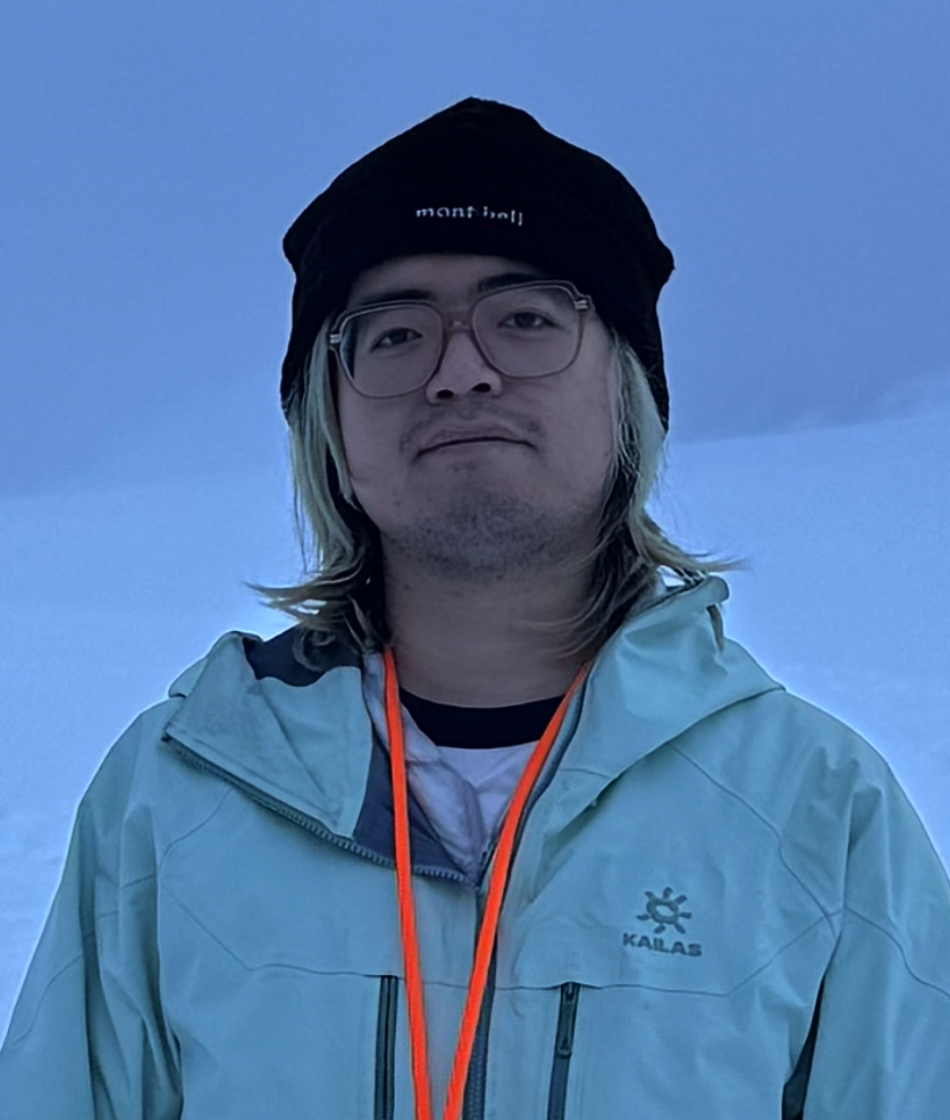
 Kai Li
· 3 previous affiliations
- Tsinghua UniversitySince 2019
- PhD student · 2024–2028
- MS student · 2021–2024
- Research Assistant · 2019–2021
- Research Internship · 2025
- Tencent (China)2021–2022
- Research Intern · 2021–2022
16 other authors named Kai Li: Kai Li (Princeton University · 181 papers), Kai Li (NEC (United States) · 96 papers), Kai Li (Chinese Academy of Sciences · 49 papers), Kai Li (Meta (United States) · 7 papers), Kai Li (Huawei Technologies (China) · 5 papers), and 11 more
Research Overview
Kai Li focuses on audio-visual speech separation, brain-inspired neural architectures, and the trustworthiness of audio large language models. His trajectory spans from early work in bio-inspired selective attention mechanisms to the development of highly efficient, real-time models for isolating speech in complex acoustic environments. Most recently, his research addresses the safety and evaluation of foundational audio models alongside advanced state-space architectures for long-sequence processing.
Research Trajectory
Kai Li’s early research began with an exploration of deep reinforcement learning for autonomous systems, demonstrated by his work on Multi-USVs Coordinated Detection in Marine Environment with Deep Reinforcement Learning in 2018. He subsequently transitioned to his primary focus on speech processing and neural acoustics. In 2021, he contributed to the area of Scaling Multi-Talker Speech Processing Beyond Binary Mixtures with Speech Separation Using an Asynchronous Fully Recurrent Convolutional Neural Network. This work proposed a bio-inspired architecture utilizing bottom-up, top-down, and lateral connections to fuse information across various time scales. This biological framing aligned with his participation in modeling the cocktail party effect, investigating how top-down signals modulate sensory neurons in Inferring Mechanisms of Auditory Attentional Modulation with Deep Neural Networks. Together, these projects established a foundation in the research direction of Selective Attention for Multi-Speaker Speech Separation.
Between 2023 and 2024, his work heavily emphasized efficient, brain-inspired models for audio-visual speech separation (AVSS). He introduced TDFNet: An Efficient Audio-Visual Speech Separation Model with Top-Down Fusion, which leveraged multi-scale fusion to isolate voices with significantly reduced computational overhead. He further refined this approach in An efficient encoder-decoder architecture with top-down attention for speech separation, mimicking the brain's global and local attention mechanisms to maintain performance while decreasing model complexity. Continuing the theme of biologically plausible models, he developed An Audio-Visual Speech Separation Model Inspired by Cortico-Thalamo-Cortical Circuits, which modeled the thalamic integration of auditory and visual cues. During this period, he also explored recurrent time-frequency modeling in RTFS-Net: Recurrent Time-Frequency Modelling for Efficient Audio-Visual Speech Separation and intra- and inter-modality attention mechanisms in IIANet: An Intra- and Inter-Modality Attention Network for Audio-Visual Speech Separation. These advancements contributed to the broader field of Neural Speech Processing with Variable Speaker Cardinality. Concurrently, he applied his expertise in efficient neural architectures to remote sensing, proposing DiffCR: A Fast Conditional Diffusion Framework for Cloud Removal From Optical Satellite Images.
Moving into 2025, his research prioritized real-time applicability and long-sequence modeling. He introduced A Fast and Lightweight Model for Causal Audio-Visual Speech Separation, a strictly causal architecture designed for streaming applications like hearing aids and live captioning. To address the limitations of CNNs and Transformers in capturing long temporal dependencies, he integrated bidirectional Mamba modules into speech separation with SPMamba: Leveraging Long-Sequence Modeling with State Space Models for Speech Separation. His interest in robust acoustic evaluation led to the creation of SonicSim: A customizable simulation platform for speech processing in moving sound source scenarios, bridging the gap between static simulations and dynamic environments. He also expanded his methodological scope to generative audio, addressing high-frequency artifacts in singing voice synthesis with Enhancing Spectrogram Realism in Singing Voice Synthesis via Explicit Bandwidth Extension Prior to Vocoder. Additionally, he applied state space models to the area of Learning from Limited Data in Specialized Medical Domains, participating in the development of EAGLE: An Efficient Global Attention Lesion Segmentation Model for Hepatic Echinococcosis.
In his most recent work, he has tackled the emerging challenges of foundational audio models and data efficiency. He led the development of AudioTrust: Benchmarking The Multifaceted Trustworthiness of Audio Large Language Models, a comprehensive framework evaluating vulnerabilities to non-semantic cues like emotion and accent. He also emphasized data quality over volume in A Semantically Consistent Dataset for Data-Efficient Query-Based Universal Sound Separation, introducing the Hive dataset. Returning to audio-visual separation, he contributed to the research direction of Robust Audio-Visual Speech Processing Under Visual Occlusion by proposing Efficient Audio-Visual Speech Separation with Discrete Lip Semantics and Multi-Scale Global-Local Attention, which utilizes discrete lip-motion tokens for highly efficient edge inference. Finally, he collaborated on Dual-View Predictive Diffusion: Lightweight Speech Enhancement via Spectrogram-Image Synergy, advancing the area of Learnable Spectral Compression for Full-Band Speech Enhancement by treating spectrograms simultaneously as physical signals and visual textures to reduce the computational cost of diffusion models.
Current Directions
Recent work investigates the safety, efficiency, and foundational capabilities of modern audio processing systems. A primary focus is the evaluation of Audio Large Language Models (ALLMs), specifically benchmarking their trustworthiness against vulnerabilities like hallucination and manipulation via non-semantic acoustic cues. Concurrently, ongoing research addresses the computational bottlenecks of speech separation on edge devices. By integrating discrete visual semantics, state space models (such as Mamba), and dual-view diffusion techniques, these recent architectures aim to achieve real-time, high-fidelity audio enhancement with minimal parameter counts. Additionally, there is an emphasis on data-efficient learning, demonstrating that highly curated, semantically consistent datasets can match the performance of massive corpora in universal sound separation tasks.
Profile updated
Loading new papers…
Other researchers whose papers cluster into the same research directions — a proxy for overlapping technical interests and shared intellectual neighborhoods.
See something wrong? Report a mistake