

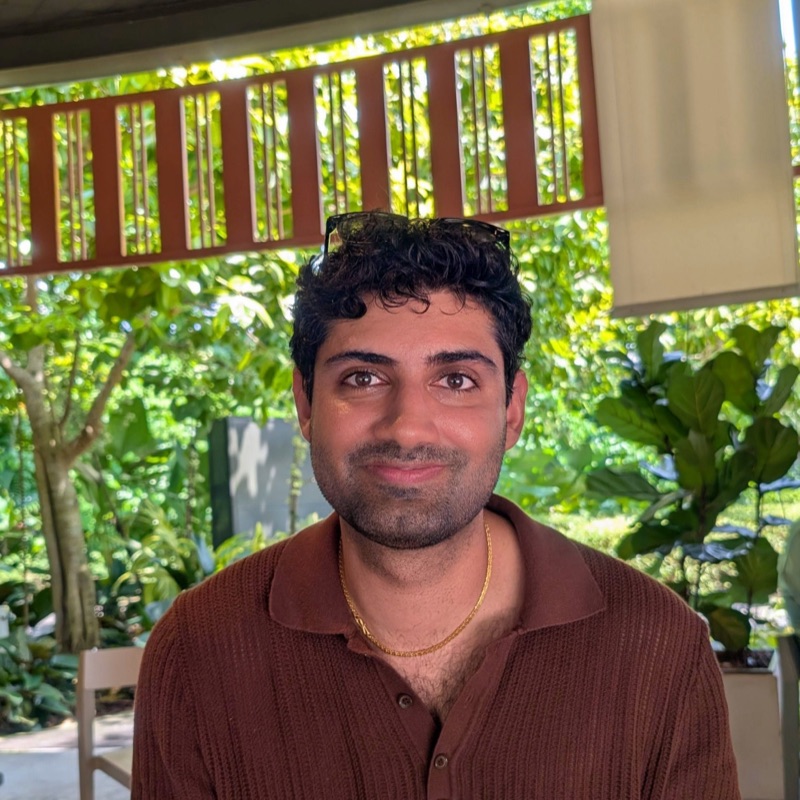
 Justin Singh Kang
7 previous affiliations
- University of California, Berkeley2021–2026
- Doctor of Philosophy - PhD, Electrical Engineering and Computer Science · 2021–2026
- PhD student · 2021–2026
- Research Intern · 2025
- Student Researcher - Google Cloud · 2024
- University of Toronto2019–2021
- Graduate Researcher · 2019–2021
- Intel (United States)2017–2018
- Error Correction Coding Research Intern · 2017–2018
- VoIP Software Verification Engineering Intern · 2016
Research Overview
Justin Singh Kang focuses on machine learning interpretability, feature attribution, and the application of signal processing techniques to large-scale models. His early research addressed scheduling and feedback in massive random access networks before shifting toward statistical guarantees and data valuation in federated learning. Currently, his work emphasizes scalable algorithms for identifying high-order feature interactions and evaluating the faithfulness of explanations in large language models.
Research Trajectory
Kang's early research investigated efficiency and resource allocation in wireless communications, specifically within the area of Grant-Free Random Access for Massive IoT Networks. In Minimum Feedback for Collision-Free Scheduling in Massive Random Access, he explored how to schedule a small number of active users in a massive wireless network while minimizing the feedback required from the base station to prevent data collisions. This work demonstrated that feedback requirements could scale almost independently of the total number of users. He expanded on these scheduling mechanisms in Scheduling Versus Contention for Massive Random Access in Massive MIMO Systems, proposing a coordinated three-phase random access scheme that utilizes efficient activity detection and a single common feedback message to assign orthogonal pilots, thereby improving system throughput over traditional contention-based approaches.
Transitioning toward the intersection of signal processing, information theory, and machine learning, Kang began addressing statistical guarantees and data valuation. He contributed to the broader area of Total Variation Distance for Robust Statistical Guarantees with Learning a 1-layer conditional generative model in total variation, which examined the sample complexity required to learn conditional distributions without relying on restrictive assumptions about the underlying data. Concurrently, he investigated the algorithmic challenges of non-binary sequences in Efficiently Computing Sparse Fourier Transforms of q-ary Functions. Because real-world data such as biological sequences often require q-ary alphabets, this work sought to compute sparse Fourier transforms directly without the computational inefficiencies of binary encoding. He also applied cooperative game theory to federated learning in The Fair Value of Data Under Heterogeneous Privacy Constraints in Federated Learning. Contributing to work in Heterogeneous Differential Privacy, this research introduced a Shapley-based axiomatic framework to determine fair compensation for users sharing data under varying privacy levels.
Kang's subsequent research established a strong focus on machine learning interpretability, particularly the challenge of identifying how multiple input features interact to drive model predictions. In Learning to Understand: Identifying Interactions via the Möbius Transform, he introduced the Sparse Möbius Transform. By framing the discovery of feature interactions as a group testing problem, this algorithm efficiently isolates higher-order interactions in black-box models without the exponential computational costs typically required. He later scaled these signal processing techniques to large language models in SPEX: Scaling Feature Interaction Explanations for LLMs, advancing the research direction of High Order Feature Interactions in Deep Learning. This work addressed the limitation of traditional explainability methods that evaluate features in isolation, providing a mechanism to capture the complex synergies that define modern AI reasoning. To further optimize this process, he and his collaborators developed ProxySPEX: Inference-Efficient Interpretability via Sparse Feature Interactions in LLMs, which tackles the computational bottlenecks of extracting these interactions during inference, contributing to Low-Latency Interpretability for Real-Time Machine Learning.
Extending these efficient attribution methods to new domains, Kang participated in developing techniques for the area of Amortized Inference for Real-Time Model Explanations. This included SHAP zero Explains Biological Sequence Models with Near-zero Marginal Cost for Future Queries, which leverages mathematical connections between the Sparse Fourier Transform and Shapley values to dramatically reduce the cost of explaining biological sequence models across large datasets. Continuing his focus on the theoretical foundations of attribution, he co-authored An Odd Estimator for Shapley Values. This paper provides a fundamental justification for the paired sampling heuristic used in Shapley estimation, proving that the Shapley value depends exclusively on the odd component of a set function. Finally, his research also evaluates the reliability of the explanations themselves. In A Positive Case for Faithfulness: LLM Self-Explanations Help Predict Model Behavior, he investigated whether self-explanations generated by large language models accurately reflect their internal reasoning, introducing the Normalized Simulatability Gain (NSG) metric to quantify how well these explanations help humans predict model behavior on new inputs.
Current Directions
Kang's most recent work investigates the theoretical foundations and practical scalability of feature attribution in massive neural networks. A primary focus is the development of inference-efficient algorithms that can isolate high-order feature interactions without incurring the exponential computational costs traditionally associated with Shapley values and Möbius transforms. By bridging signal processing techniques—such as sparse Fourier transforms—with machine learning interpretability, this research aims to make real-time, amortized attribution feasible for both large language models and biological sequence models. Additionally, his current research addresses the evaluation of interpretability itself, exploring new metrics to rigorously test the faithfulness of self-generated explanations in complex AI systems.
Profile updated
Loading new papers…
Other researchers whose papers cluster into the same research directions — a proxy for overlapping technical interests and shared intellectual neighborhoods.
See something wrong? Report a mistake