

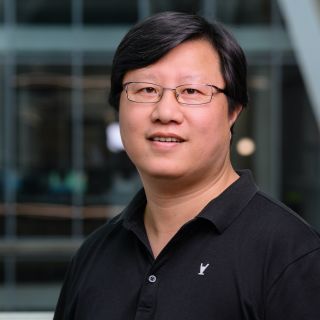
 Jungong Han
· 7 previous affiliations
- University of SheffieldSince 2023
- Full Professor · Since 2023
- Tsinghua UniversitySince 2024
- Full Professor · Since 2024
- Aberystwyth University2020–2022
- Professor · 2020–2022
- University of Warwick2019–2020
- Associate Professor · 2019–2020
- Lancaster University2017–2019
- Associate Professor · 2017–2019
- Northumbria University2015–2017
- Senior Lecturer · 2015–2017
- Xidian University2001–2004
- PhD student · 2001–2004
1 other author named Jungong Han: Jungong Han (1 paper)
Research Overview
Jungong Han focuses on computer vision, efficient neural network inference, and cross-modal visual matching. His trajectory spans from foundational video content analysis and zero-shot learning to the development of structural reparameterization techniques for real-time edge computing. Currently, his research addresses multimodal reasoning, 3D generation, and unified architectures for video understanding.
Research Trajectory
Jungong Han’s early research established a foundation in computer vision and visual recognition systems. In 2013, he provided a comprehensive overview of depth-sensing technologies and their applications in Enhanced Computer Vision With Microsoft Kinect Sensor: A Review. As his focus shifted toward the scalability of recognition systems, he contributed significantly to the area of Overcoming the Manual Attribute Annotation Bottleneck. This was demonstrated in From Zero-Shot Learning to Conventional Supervised Classification: Unseen Visual Data Synthesis (2017), where he developed a framework to synthesize visual features for unseen classes using semantic attributes as intermediate clues, effectively converting zero-shot recognition into a conventional supervised problem.
A major and highly impactful theme in his trajectory is the research direction of Collapsing Multi-Branch Networks for Efficient Inference. In 2019, he introduced ACNet: Strengthening the Kernel Skeletons for Powerful CNN via Asymmetric Convolution Blocks. This work proposed asymmetric convolution blocks that improve accuracy during training but can be mathematically fused back into standard square convolution layers for inference, resulting in a more powerful model with zero extra computational cost or latency. He later participated in the development of RepVGG: Making VGG-Style ConvNets Great Again (2021), applying structural reparameterization to allow complex, multi-branch neural networks to be executed as simple, highly optimized stacks of convolutions during runtime.
Parallel to his work on efficient architectures, he advanced the capabilities of cross-modal retrieval and matching. In IMRAM: Iterative Matching With Recurrent Attention Memory for Cross-Modal Image-Text Retrieval (2020), he developed a progressive recurrent gating mechanism that allows models to revisit images and text over multiple steps, capturing complex semantic relationships that single-pass attention models typically miss. He also focused heavily on the area of Bridging the Modality Gap in Cross Spectral Vision. In FMCNet: Feature-Level Modality Compensation for Visible-Infrared Person Re-Identification (2022), his lab tackled the challenge of matching identities across visible and infrared cameras by hallucinating missing modality-specific information at the feature level, avoiding the artifacts common in image-to-image translation. He expanded on this cross-spectral research by integrating pose estimation as a core auxiliary learning task in On exploring pose estimation as an auxiliary learning task for Visible-Infrared Person Re-identification (2023).
By 2024, his work on architectural efficiency expanded to modernize both convolutional networks and real-time object detectors. He contributed to Rep ViT: Revisiting Mobile CNN From ViT Perspective, which integrated structural insights from Vision Transformers into pure CNNs to achieve exceptional latency and accuracy on mobile devices. In the domain of object detection, he participated in the development of YOLOv10: Real-Time End-to-End Object Detection, which introduced a consistent dual assignment training strategy to eliminate the non-maximum suppression (NMS) bottleneck, setting new benchmarks for real-time performance.
In 2025, his research broadened into medical imaging, 3D generation, and universal video tracking. Addressing the subjectivity of sparse clinical annotations, he developed Addressing Inconsistent Labeling With Cross Image Matching for Scribble-Based Medical Image Segmentation, utilizing a global reference set of features to smooth out labeling inconsistencies. For 3D assets, he introduced a unified distillation sampling framework in Rethinking Score Distilling Sampling for 3D Editing and Generation, refining how gradients are distilled from 2D diffusion models to prevent over-smoothing and identity loss. In video understanding, he proposed Tracking and Segmenting Anything in Any Modality, a universal framework that unifies single and multi-object tracking across RGB, thermal, depth, and event modalities using a decoupled mixture-of-experts mechanism.
Moving into 2026, his work addresses both extreme model efficiency and the reliability of complex multimodal reasoning. He advanced neural image compression by developing Efficient Learned Image Compression without Entropy Coding, which removes the sequential bottleneck of entropy coding to achieve significantly faster decoding. In the realm of Vision Transformers, he introduced Selective Coupling of Decoupled Informative Regions: Masked Attention Alignment for Data-Free Quantization of Vision Transformers, optimizing data-free quantization for ultra-low bit-width scenarios by focusing on sparse, informative image patches. Simultaneously, his research tackles the robustness of Multimodal Large Language Models (MLLMs). He proposed a reinforcement learning framework in Controllable Exploration in Hybrid-Policy RLVR for Multi-Modal Reasoning to prevent entropy collapse during reasoning exploration. Furthering this focus on grounded reasoning, he developed CofactGVR: Counterfactual Intervention for Grounded Visual Reasoning, utilizing causal interventions to force models to rely on visual evidence rather than linguistic priors. His lab also expanded into recurrent vision-language architectures with LoopVL: Recurrent Visual Intelligence, combining module- and model-loop computation with shared parameters to iteratively refine a unified multimodal state. In visual synthesis and editing, they introduced RATR: Training-Free Material Rebinding via Role Assignment and Temporal Routing, a diffusion-based framework that resolves role entanglement by decoupling target geometry from reference material cues during denoising.
Current Directions
The most recent themes in the evidence indicate a dual focus on the robustness of multimodal reasoning systems and the physical deployment limits of neural architectures. Current work investigates how to sustain productive exploration in large reasoning models and how to enforce strict visual grounding to overcome ingrained language priors in multimodal large language models. On the systems side, ongoing research addresses the absolute limits of model compression, exploring data-free quantization techniques for vision transformers and novel learned compression paradigms that bypass traditional entropy coding bottlenecks to maximize hardware efficiency.
Profile updated
Loading new papers…
Other researchers whose papers cluster into the same research directions — a proxy for overlapping technical interests and shared intellectual neighborhoods.
See something wrong? Report a mistake