

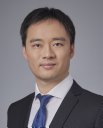
 Junchi Yan
· 3 previous affiliations
- Shanghai Jiao Tong UniversitySince 2018
- Full Professor · Since 2023
- Associate Professor · 2018–2023
- PhD student · 2012–2015
- Research Staff Member · 2011–2018
- East China Normal University2015–2018
- Postdoc · 2015–2018
Research Overview
Junchi Yan focuses on machine learning for combinatorial optimization, quantum machine learning, and advanced graph representation learning. His trajectory spans early foundational work in multi-graph matching to recent innovations in neural solvers and differentiable optimization. Currently, his research investigates generative models, reinforcement learning, and formal theorem proving to solve complex structural and mathematical constraints.
Research Trajectory
Junchi Yan's early research concentrated on the complexities of graph matching, particularly the challenge of maintaining consistency across multiple graphs. He introduced a novel formulation for joint optimization in Joint Optimization for Consistent Multiple Graph Matching, addressing the mapping inconsistencies that arise when matching more than two graphs. He expanded on this by separating affinity optimization and consistency enforcement in Multi-Graph Matching via Affinity Optimization with Graduated Consistency Regularization., which mitigated the propagation of matching errors over iterative optimization steps. His work also extended into computer vision, participating in the development of progressive regression techniques for complex object detection. This included R3Det: Refined Single-Stage Detector with Feature Refinement for Rotating Object, which addressed feature misalignment in rotating objects with large aspect ratios and dense distributions.
Returning to graph-structured data, Yan began exploring the intersection of graph neural networks and quantum computing. With collaborators, he developed GraphQNTK: Quantum Neural Tangent Kernel for Graph Data, a model designed to capture structural information while utilizing quantum parallelism to improve computational efficiency. Concurrently, he addressed the scalability of classical graph models in the research direction of Scaling Graph Transformers to Large Graphs. This effort culminated in SGFormer: Simplifying and Empowering Transformers for Large-Graph Representations, which demonstrated that a single layer of linear global attention could scale to graphs with over 100 million nodes while significantly accelerating inference.
A major theme in Yan's trajectory is the integration of complex constraints into neural architectures. He advanced the area of differentiable optimization by introducing a satisfiability layer in LinSATNet: The Positive Linear Satisfiability Neural Networks, enabling neural networks to enforce positive linear constraints end-to-end via a generalized Sinkhorn algorithm. Parallel to this classical approach, he explored the area of Native Constraint Enforcement in Quantum Optimization. He guided the development of a quantum neural network for the Quadratic Assignment Problem in Towards Quantum Machine Learning for Constrained Combinatorial Optimization: a Quantum QAP Solver, which treated the problem as a supervised learning task to generalize across instances and outperform standard heuristics. This work also contributed to bridging the gap between theoretical quantum algorithms and practical implementation, a focus within the research direction of The Quantum Simulation to Hardware Performance Gap.
Building on his quantum machine learning expertise, Yan expanded into generative modeling for molecular structures. He oversaw the creation of QVAE-Mole: The Quantum VAE with Spherical Latent Variable Learning for 3-D Molecule Generation, a fully quantum Variational Autoencoder that leveraged a spherical latent space to generate 3-D molecular structures with a fraction of the parameters required by classical models. Simultaneously, he applied generative models to combinatorial optimization, a persistent theme in his work. He addressed the sampling inefficiencies of diffusion models in Fast T2T: Optimization Consistency Speeds Up Diffusion-Based Training-to-Testing Solving for Combinatorial Optimization, accelerating the solution of NP-hard problems like the Traveling Salesman Problem. This research advanced the broader area of Zero Shot Scale Generalization in Neural Combinatorial Optimization.
Yan's focus on optimization extended to classical linear programming. He participated in developing deep learning frameworks to accelerate the Simplex method in Learning Initial Basis Selection for Linear Programming via Duality-Inspired Tripartite Graph Representation and Comprehensive Supervision. This work utilized novel representations to improve initial basis selection, contributing to the research direction of Bipartite Graph Representations for Mathematical Optimization.
In his most recent work, Yan has significantly broadened the scope and capabilities of neural solvers for combinatorial and symbolic problems. He led the development of multi-task meta-learning frameworks for generative combinatorial optimization in Problem Distributions as Tasks: Repurposing Meta Learning for Generative Combinatorial Optimization towards Multi-task Pretraining and Adaptation, allowing a single neural solver to master multiple graph-based problems simultaneously. He further unified pre-training paradigms using contrastive learning in ConRep4CO: Contrastive Representation Learning of Combinatorial Optimization Instances across Types, which utilized Boolean Satisfiability as a universal language to bridge different problem types and improve generalization to larger scales.
His recent trajectory also encompasses reinforcement learning and formal theorem proving. He guided the creation of RulePlanner: All-in-One Reinforcement Learner for Unifying Design Rules in 3D Floorplanning, a framework that employs specialized matrix representations to satisfy complex industrial design rules simultaneously. In the domain of formal mathematics, he oversaw the development of Let's Explore Step by Step: Generating Provable Formal Statements with Deductive Exploration, a framework that generates provable mathematical problems by simulating a step-by-step discovery process within the Lean 4 proof assistant. Finally, he unified deep generative priors with direct optimization for symbolic regression in MOD-SR: Unifying Multimodal Learning and Direct Optimization with Gradient-Guided Diffusion Model for Symbolic Regression, introducing a differentiable tree structure to steer the generation process using gradients.
More recently, Yan's research has expanded into LLM architectures, agent verification, multi-modal perception, and chemical synthesis. To improve transformer scaling and KV cache efficiency, Yan supervised the design of DepthGraft: Structural Regularization through Hierarchical Cross-Layer KV Reconstruction, a hierarchical cross-layer KV-sharing architecture that acts as a structural regularizer by propagating gradients from deep layers. In multi-modal 3D perception, Yan led the introduction of FusionNeXt: Sequence-First 3D Multi-Modal Fusion in the Era of LLMs, which unifies camera and LiDAR features into packed 1D sequences processed by standard transformer blocks. Yan also directed work on target-conditioned retrosynthesis in RECIPE: Learning to Rank Complete Precursor Sets for Inorganic Retrosynthesis, framing inorganic reaction planning as set-level reranking over candidate precursor combinations. Addressing the evaluation and security of LLM-based systems, Yan contributed to See, Read, Compare: Candidate-Aware Verification for Agent Test-Time Scaling, an execution-free verifier using pairwise comparisons across candidate agent trajectories, and supervised StableJudge: A Lightweight Adversarial Defense Framework for LLM-as-a-Judge, a modular pre-scoring sentry designed to defend LLM evaluators against prompt-injection attacks.
Current Directions
The most recent papers in the evidence indicate a strong focus on creating unified, generalizable neural solvers for complex combinatorial and symbolic problems. Recent work investigates multi-task meta-learning and contrastive representation learning to allow single models to master diverse optimization tasks, such as the Traveling Salesman Problem and Boolean Satisfiability, while generalizing to unseen problem scales. Additionally, current research explores the application of reinforcement learning to highly constrained industrial tasks, such as 3D floorplanning, and the use of deductive exploration within proof assistants like Lean 4 to generate provable mathematical statements. Finally, there is an ongoing effort to integrate deep generative models with direct optimization, while also exploring efficient transformer architectures, sequence-based 3D multi-modal fusion, set-level retrosynthesis ranking, and robust LLM agent verification and defense.
Profile updated
Loading new papers…
Other researchers whose papers cluster into the same research directions — a proxy for overlapping technical interests and shared intellectual neighborhoods.
See something wrong? Report a mistake