

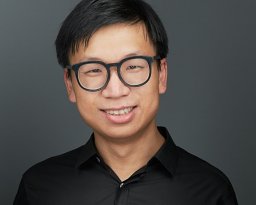
 Jun-Yan Zhu
· 7 previous affiliations
- Carnegie Mellon UniversitySince 2020
- Michael B. Donohue Associate Professor of Computer Science and Robotics · Since 2026
- Assistant Professor · 2020–2026
- Doctor of Philosophy (PhD), Computer Science · 2012–2013
- Adobe Systems (United States)2013–2020
- Research Scientist · 2019–2020
- Research Intern · 2013
- Postdoctoral Researcher · 2018–2019
- Postdoc · 2018–2019
- University of California, Berkeley2013–2017
- Ph.D. student · 2013–2017
- PhD student · 2013–2017
- Tsinghua University2008–2012
- Undergrad student · 2008–2012
Research Overview
Jun-Yan Zhu focuses on generative models with applications in computer vision, graphics, and computational photography. His trajectory spans foundational work in image-to-image translation and generative adversarial networks to recent advances in diffusion models, 3D scene synthesis, and model interpretability. His current research investigates interactive visual synthesis, training data attribution, and real-time video generation.
Research Trajectory
His early research explored the capabilities of generative adversarial networks (GANs) for intuitive image manipulation. In Generative Visual Manipulation on the Natural Image Manifold, he introduced a method to constrain user edits to a learned natural image manifold, enabling real-time, photorealistic transformations of shape and color. This foundational work naturally led to broader frameworks for visual synthesis. He developed Image-to-Image Translation with Conditional Adversarial Networks, demonstrating that a single conditional GAN architecture could learn both the mapping and the loss function required for a wide variety of domain translations, such as converting sketches to photos or maps to satellite imagery. Addressing the limitation of requiring paired training data, he subsequently introduced Unpaired Image-to-Image Translation Using Cycle-Consistent Adversarial Networks. By coupling an adversarial loss with a cycle consistency loss, this approach enabled high-quality translation between domains—such as turning horses into zebras—without aligned image pairs.
As generative models grew in capability, his research expanded into the area of Multi-Scale Discriminators for High Resolution Image Synthesis. With collaborators, he presented High-Resolution Image Synthesis and Semantic Manipulation With Conditional GANs, detailing a coarse-to-fine generator that produced megapixel-resolution images from semantic label maps and allowed for interactive object-level editing. His work on Semantic Image Synthesis With Spatially-Adaptive Normalization further advanced this domain by introducing the SPADE layer, which modulates activations using input masks to preserve semantic information that previous architectures tended to wash away.
Concurrently, he sought to bridge 2D image generation with 3D understanding. In Visual Object Networks: Image Generation with Disentangled 3D Representations, he proposed an end-to-end adversarial framework that unravels the image formation process into shape, viewpoint, and texture, contributing to the broader fields of Disentangling Geometry and Appearance for Controllable Generative Synthesis and Compositional and Scalable 3D Scene Synthesis. To better understand the internal representations of these models, he investigated the research direction of Mechanistic Interpretability of Deep Generative Models. In GAN Dissection: Visualizing and Understanding Generative Adversarial Networks, he presented an analytic framework to identify interpretable units within GANs, shedding light on how they represent visual concepts and what causes synthesis artifacts.
Addressing the challenge of Preventing Discriminator Overfitting in Low Data Generative Training, he participated in the development of Differentiable Augmentation for Data-Efficient GAN Training. This technique applies differentiable augmentations to both real and generated samples, stabilizing training and improving convergence in low-data regimes.
His recent work has increasingly focused on diffusion models and their application to 3D and tactile modalities. His research on Tactile DreamFusion: Exploiting Tactile Sensing for 3D Generation incorporates high-resolution tactile sensing into a diffusion-based refinement pipeline to produce 3D assets with physically accurate surface geometry. In the domain of text-to-image personalization, his work on Customizing Text-to-Image Diffusion with Camera Viewpoint Control integrates a volumetric feature-rendering module into a diffusion architecture. This method allows users to inject real-world objects into generated scenes with precise 3D viewpoint control, advancing the area of Cross-Attention Fine-Tuning for Diffusion Model Customization.
His ongoing research explores novel paradigms for image editing, model accountability, and temporal synthesis. He contributed to a comprehensive overview of the field in Generative Modeling, detailing how these systems learn complex one-to-many mappings. To improve the reliability of text-to-image generation, he introduced Generative Photomontage, a framework that performs segmentation and blending in the diffusion feature space, allowing users to composite the best elements of multiple generated images seamlessly. His research also encompasses Learning an Image Editing Model without Image Editing Pairs, which leverages differentiable feedback from Vision-Language Models to follow editing instructions without relying on supervised before-and-after image pairs.
Addressing copyright and compensation issues in generative AI, he developed Fast Data Attribution for Text-to-Image Models. This method distills expensive attribution techniques into a fast feature embedding space, enabling scalable, real-time identification of influential training images. Most recently, his work includes MotionStream: Real-Time Video Generation with Interactive Motion Controls, a framework that distills a high-quality teacher model into a causal student model, enabling real-time, interactive video generation guided by user trajectories.
Current Directions
Recent work investigates the intersection of interactive control, model accountability, and real-time synthesis in diffusion models. The most recent papers in the evidence address the challenge of training data attribution, developing scalable methods to identify which training images influence specific generated outputs. Additionally, his research explores novel training paradigms for instruction-based image editing that eliminate the need for paired supervised data by leveraging feedback from vision-language models. In the domain of temporal synthesis, current efforts focus on real-time video generation, utilizing model distillation and causal architectures to enable interactive motion control at high frame rates.
Profile updated
Loading new papers…
Other researchers whose papers cluster into the same research directions — a proxy for overlapping technical interests and shared intellectual neighborhoods.
See something wrong? Report a mistake