

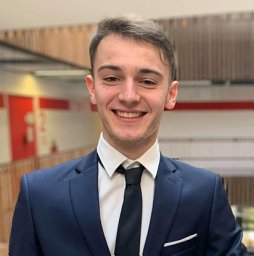
 Julien Gaubil
· 8 previous affiliations
- École PolytechniqueSince 2025
- PhD student · Since 2025
- Visiting Student · 2024
- Intern · 2023
- École Normale Supérieure - PSL2022–2023
- MS student · 2022–2023
- ENS Paris-Saclay2022–2023
- Master's degree MVA, Mathematics, Vision & Learning · 2022–2023
- Computer Vision Research intern · 2022
- École Centrale de Lyon2019–2022
- Master of Science - MS, Major in Mathematics and Machine Learning · 2019–2022
- Computer Vision Research intern · 2021
Research Overview
Julien Gaubil focuses on the intersection of generative modeling, computer vision, and document analysis, with a specific emphasis on developing robust machine learning methods for complex, low-resource data environments. His work addresses the challenges of interpreting physically degraded historical documents and optimizing the efficiency of generative flow models through advanced mathematical frameworks such as Koopman theory. By bridging the gap between fundamental algorithmic research and applied paleography, Gaubil contributes to the development of systems capable of Overcoming Data Scarcity in Ancient Script Recognition and improving the interpretability of deep generative architectures.
Research Trajectory
Gaubil’s research trajectory reflects a transition from applied document analysis to more fundamental investigations into the dynamics of generative models. In the earlier stages of the observed period, his work was centered on the practical difficulties of Adapting to Style Variability in Handwriting Recognition. This research was motivated by the "generalization gap" that occurs when standard optical character recognition (OCR) models, trained on clean digital text, are applied to the idiosyncratic and often damaged surfaces of historical manuscripts.
During this phase, Gaubil participated in research exploring unsupervised and generative approaches to character recognition. This work was particularly relevant for Mitigating Optical Character Recognition Noise in Document Analysis, where the primary challenge is distinguishing the intended "signal" of the script from the physical "noise" of age, erosion, and material decay. By utilizing generative frameworks that learn to reconstruct images from a limited set of visual elements, this research path sought to bypass the need for the massive labeled datasets typically required by deep learning models.
Starting in 2026, Gaubil’s focus shifted toward the theoretical optimization of generative models, specifically Continuous Normalizing Flows (CNFs) and Conditional Flow Matching (CFM). This work addresses a fundamental bottleneck in generative AI: the high computational cost and lack of interpretability associated with solving non-linear ordinary differential equations (ODEs) during the sampling process. By applying Koopman operator theory to these dynamics, Gaubil and his collaborators have worked to linearize complex generative paths, moving toward one-step generation that preserves the integrity of the original model's trajectory. This shift indicates an interest in the broader problem of Alignment Free Sequence Training with Connectionist Temporal Classification and other sequence-based generative tasks where synchronization between discrete symbols and continuous streams is critical.
Current Directions
Gaubil’s current research is primarily concerned with the linearization and acceleration of generative flows. The central problem in this domain is that while CNFs offer high-quality samples and elegant mathematical properties, they are often too slow for practical deployment because they require hundreds of function evaluations to produce a single output. Gaubil’s recent contributions involve "unfolding" these flows by lifting them into a higher-dimensional Koopman space.
This approach aims to represent the evolution of a generative model as a single linear operator. The implications of this work are twofold: first, it enables high-speed, one-step sampling without the "black box" nature of previous acceleration methods like Rectified Flow; second, it provides deep spectral interpretability, allowing researchers to analyze the generative process through the lens of linear dynamics. This work represents a significant step toward making complex generative models more efficient and transparent, particularly in domains where computational resources are limited or where the underlying data dynamics are highly non-linear.
Representative Work
Gaubil has contributed to several key papers that define his research profile in document analysis and generative modeling. As a middle author on these projects, his work demonstrates a consistent involvement in high-level collaborative research at major machine learning and document analysis venues.
In the field of document analysis, Gaubil collaborated on The Learnable Typewriter: A Generative Approach to Text Analysis. This research presented a document-specific approach to character recognition using unsupervised multi-object segmentation. The core innovation involved the use of "sprites"—a limited set of learned visual elements—to reconstruct text lines. This method is particularly effective for historical documents where traditional training data is scarce, as it can learn a large number of different characters from a small set of text lines with similar handwriting or fonts. By adapting deep unsupervised segmentation to the specific constraints of text line analysis, this work provided a new pathway for processing manuscripts in the "data desert" of ancient epigraphy.
In the domain of fundamental generative modeling, Gaubil participated in the development of a framework to linearize the paths of generative models. This research is detailed in Unfolding Generative Flows with Koopman Operators: Trajectory-Preserving Linearization and its related iteration, Unfolding Generative Flows. These papers address the efficiency bottleneck of Continuous Normalizing Flows. By lifting Conditional Flow Matching into a higher-dimensional Koopman space, the research team demonstrated that it is possible to represent the complex, non-linear evolution of these models with a single linear operator. This contribution is significant because it allows for one-step image generation that remains faithful to the model's entire trajectory, combining the speed of simplified models with the theoretical rigor of full generative flows.
While the available evidence for Gaubil's work is concentrated in the 2024–2026 period, the trajectory suggests a strong focus on the mathematical refinement of generative processes and their application to challenging, real-world data structures. His contributions consistently seek to reduce the reliance on large-scale supervised data while increasing the efficiency and interpretability of the underlying models.
Profile updated
| Title | Venue | Year |
|---|---|---|
| Understanding Multi-View Transformers | NeurIPS | 2026 |
| Unfolding Generative Flows | Openreview | 2026 |
| Unfolding Generative Flows with Koopman Operators: Trajectory-Preserving Linearization | ICML | 2026 |
| The Learnable Typewriter: A Generative Approach to Text Analysis | Icdar | 2024 |
Loading new papers…
Other researchers whose papers cluster into the same research directions — a proxy for overlapping technical interests and shared intellectual neighborhoods.
See something wrong? Report a mistake