

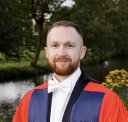
 Joel Dyer
· 4 previous affiliations
- SkyralSince 2026
- Researcher · Since 2026
- University of OxfordCurrent
- Current
- Postdoc · 2023–2026
- PhD student · 2018–2023
- Improbable2022–2023
- Researcher · 2022–2023
- Imperial College London2013–2017
- Undergrad student · 2013–2017
Research Overview
Joel Dyer focuses on simulation-based inference, differentiable programming, and the calibration of complex agent-based models. His trajectory spans the development of likelihood-free inference methods using path signatures to the integration of machine learning techniques for financial and economic simulators. His current work investigates causal abstractions, strategic deception in artificial intelligence, and Bayesian decision-making in multi-agent environments.
Research Trajectory
Dyer's early research addresses the challenge of calibrating complex models where the likelihood function is intractable. A major focus during this period was the area of Learning Summary Statistics for Simulation-Based Inference. In Deep Signature Statistics for Likelihood-free Time-series Models (2021), he introduced a method leveraging path signatures within neural networks to automatically learn informative summary statistics from complex time-series data. This work in time-series modeling was expanded in Amortised Likelihood-free Inference for Expensive Time-series Simulators with Signatured Ratio Estimation (2022), which contributed to the broader field of Overcoming the Simulation Bottleneck in Bayesian Inference. He also adapted these techniques for structured panel data in Approximate Bayesian Computation for Panel Data with Signature Maximum Mean Discrepancies (2022), enabling the calibration of dynamic network models such as those used to map functional connectivity in the brain. Concurrently, he explored the calibration of agent-based models (ABMs) to granular microdata, utilizing graph neural networks to handle spatio-temporal interactions in Calibrating Agent-based Models to Microdata with Graph Neural Networks (2022).
Transitioning into 2023, while working as a researcher at Improbable and later returning to academia at the University of Oxford, Dyer increasingly focused on the research direction of Differentiable Programming for Scientific Simulation. To overcome the computational bottlenecks of traditional gradient-free inference, he developed BlackBIRDS: Black-Box Inference foR Differentiable Simulators, an open-source library designed to perform efficient parameter inference by leveraging gradients from PyTorch-based models. This tool facilitated new approaches to economic modeling, as demonstrated in Gradient-Assisted Calibration for Financial Agent-Based Models, which applied differentiable programming to heterogeneous financial simulators. He also formalized the theoretical and practical hurdles of this approach in Some challenges of calibrating differentiable agent-based models, contributing to the area of Simulation Based Inference for Intractable Likelihoods.
In 2024, Dyer's work expanded to address uncertainty and decision-making in complex systems. He investigated how synthetic populations influence model behavior when real-world data is absent in Population Synthesis as Scenario Generation for Simulation-based Planning under Uncertainty. To accelerate policy-making simulations, he developed methods for creating fast, reliable proxy models in Interventionally Consistent Surrogates for Complex Simulation Models, advancing the domain of Hybrid Neural Differential Equations for Scientific Machine Learning. Returning to his earlier methodological themes, he also published Approximate Bayesian Computation with Path Signatures, which provided an automated framework for comparing complex sequential data with temporal dependencies.
The most recent phase of his trajectory includes significant contributions to the field of Amortized Bayesian Inference with Neural Networks and autonomous decision-making. In 2025, he explored how autonomous agents learn when deployed alongside human or AI operators in Bayesian Decision Making around Experts. He also collaborated on foundational statistical methods, participating in the development of a framework for objective simulation-based inference in Learning Likelihood-Free Reference Priors. Expanding into multi-armed bandit problems, he proposed algorithms that leverage causal abstraction theory to efficiently explore decision spaces in Using causal abstractions to accelerate decision-making in complex bandit problems. Finally, addressing emerging concerns in AI safety, he investigated strategic deception and capability-hiding by AI agents during safety evaluations in Sandbagging in a Simple Survival Bandit Problem.
Current Directions
The most recent papers in the evidence address decision-making under uncertainty, causal abstractions, and AI safety. Specifically, recent work investigates how autonomous agents can leverage causal abstraction theory to accelerate exploration in complex multi-armed bandit problems. Additionally, Dyer is exploring Bayesian decision-making in environments where agents operate alongside experts, such as human operators or pre-tuned controllers. Another emerging theme in his recent research is AI safety and evaluation, particularly the identification of "sandbagging"—where AI systems strategically hide capabilities or demonstrate suboptimal performance to evade deactivation during safety testing. Finally, he continues to advance foundational statistical methods, including the development of likelihood-free reference priors for objective Bayesian analysis in complex simulators.
Profile updated
Loading new papers…
Other researchers whose papers cluster into the same research directions — a proxy for overlapping technical interests and shared intellectual neighborhoods.
See something wrong? Report a mistake