

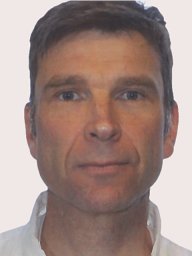
 Jochen Lang
· 4 previous affiliations
- University of OttawaSince 2004
- Full Professor · Since 2018
- Associate Professor · 2011–2018
- Assistant Professor · 2004–2011
- Max Planck Institute for Informatics2002–2004
- Researcher · 2002–2004
- University of British Columbia2001–2002
- Postdoc · 2001–2002
- Doctor of Philosophy - PhD, Computer Science · 2001
- York University1994–1996
- MS student · 1994–1996
Research Overview
Jochen Lang focuses on computer graphics, specifically the acquisition, processing, and interactive rendering of complex 3D models. His early collaborative work addresses the virtualization of real-world objects, including their geometry, texture, and reflectance behavior. He has also contributed to methods for rendering translucent materials at interactive rates.
Research Trajectory
The available evidence captures Lang's collaborative research in the early 2000s within the field of computer graphics, primarily focusing on 3D modeling and rendering techniques. Throughout this period, Lang participated as a middle author on several projects, contributing to team-based efforts to improve the realism and interactivity of virtual objects.
In 2002, Lang was part of a research team that investigated the real-time display of complex materials. The paper Interactive Rendering of Translucent Objects presented a method for modifying viewpoint and illumination at interactive rates. The approach involved precomputing the impulse response to incoming light, modeling local effects as per-texel filter kernels and global responses as vertex-to-vertex throughput factors on a triangle mesh. A subsequent journal version of this research was published the following year as Interactive Rendering of Translucent Objects.
In 2003, Lang also contributed to broader efforts in 3D object virtualization. As a co-author on Virtualizing Real-World Objects, he participated in the development of algorithms for acquiring and interacting with complex textured 3D objects in real-time. This research emphasized the integration of geometry, texture, and reflectance behavior into a single framework to produce high-quality 3D models suitable for applications like e-commerce and virtual museums. Similar themes were explored that same year in Modeling the world: the virtualization pipeline, which further detailed the pipeline for acquiring, processing, and interactively displaying these virtual models.
Current Directions
The most recent papers in the provided evidence date to 2003. At that time, Lang's collaborative efforts were directed toward the comprehensive virtualization of real-world objects, focusing on the seamless integration of geometry, texture, and complex lighting behaviors for interactive 3D display.
Profile updated
| Title | Venue | Year |
|---|---|---|
| Modeling the world: the virtualization pipeline | Iciap | 2003 |
| Virtualizing Real-World Objects | Computer Graphics International | 2003 |
| Interactive Rendering of Translucent Objects | Pg | 2002 |
Loading new papers…
Loading research neighbors…
See something wrong? Report a mistake