

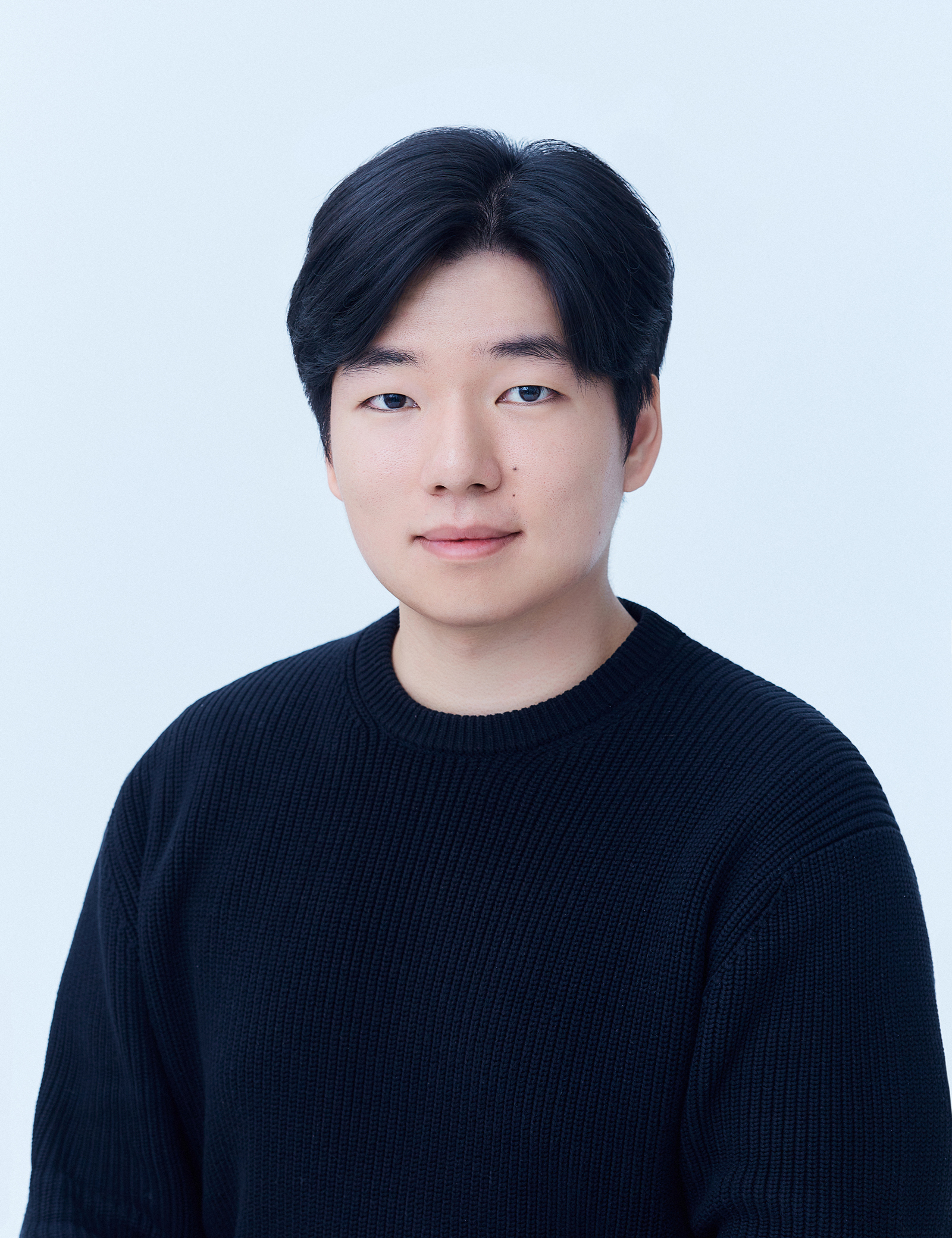
 Jiwoo Kim
· 2 previous affiliations
- Duke UniversitySince 2024
- PhD student · Since 2024
- Individual2019–2024
- Undergrad student · 2019–2024
1 other author named Jiwoo Kim: Jiwoo Kim (Sungkyunkwan University · 1 paper)
Research Overview
Jiwoo Kim focuses on visual robotic manipulation, SE(3)-equivariant representations, and generative modeling for neural network synthesis. Early work explored data-efficient manipulation learning through equivariant descriptor fields and diffusion models for motion planning. More recently, the focus has shifted toward generating functional neural network weights for zero-shot robotics tasks using width-agnostic diffusion transformers.
Research Trajectory
Jiwoo Kim’s research trajectory begins with a focus on improving the data efficiency and generalizability of end-to-end visual robotic manipulation. In 2023, Kim introduced Robotic Manipulation Learning with Equivariant Descriptor Fields: Generative Modeling, Bi-equivariance, Steerability, and Locality. This work examined the design principles of SE(3)-equivariant methods, specifically leveraging Equivariant Descriptor Fields (EDFs). By grounding the approach in generative modeling, bi-equivariance, steerable representations, and locality, the research addressed the persistent challenges of data inefficiency that often limit conventional manipulation learning techniques.
Around the same time, Kim participated in collaborative research applying diffusion models to robotics, intersecting with the area of Neural Operators for Fast Physics Simulation. This effort included the development of Denoising Heat-inspired Diffusion with Insulators for Collision Free Motion Planning. The model integrated goal generation and collision avoidance into a single, end-to-end process. By employing a "heat-inspired" diffusion kernel that mimics how heat avoids insulators, the system learned to plan paths that naturally steered clear of obstacles, removing the need for explicit obstacle detection or auxiliary sensors during inference.
Moving into 2024, Kim and collaborators combined these parallel interests—equivariant representations and diffusion models—in Diffusion-EDFs: Bi-Equivariant Denoising Generative Modeling on SE(3) for Visual Robotic Manipulation. This SE(3)-equivariant diffusion-based approach proved highly data-efficient, requiring only five to ten human demonstrations to achieve effective end-to-end training in under an hour. The method demonstrated strong generalizability and robustness across both benchmark evaluations and real-hardware experiments.
By 2026, the research trajectory expanded significantly from generating robotic actions to generating the neural network parameters themselves. In NNiT: Width-Agnostic Neural Network Generation with Structurally Aligned Weight Spaces, Kim introduced a generative framework capable of synthesizing functional weights for previously unseen architectures. By treating weight matrices as spatially correlated "patches" rather than flat vectors, NNiT effectively decoupled weight generation from fixed network dimensions and achieved high success rates on zero-shot robotics tasks. This work contributes to several emerging research directions, including the area of Learning and Generating in Neural Weight Space and the broader field of Generative Parameter Synthesis on the Weight Manifold. The methodology also intersects with the research direction Aligning Neural Weights via Permutation Symmetries and advances capabilities in the area of Zero-Shot Parameter Synthesis from Task Descriptions. Furthermore, the architectural approach touches upon the direction of Trading Spatial Depth for Temporal Iteration.
Current Directions
The most recent work in the evidence, from 2026, investigates the direct synthesis of neural network parameters using generative models. This research addresses the challenge of generating functional weights for novel architectures without requiring traditional gradient-based training on task-specific datasets. By framing weight matrices as structured, spatially correlated elements rather than flat vectors, current efforts aim to decouple weight generation from fixed network dimensions. This approach facilitates zero-shot policy generation, particularly for robotics applications, and points toward broader investigations into how diffusion transformers can manipulate and synthesize functional representations within neural weight spaces.
Profile updated
Loading new papers…
Other researchers whose papers cluster into the same research directions — a proxy for overlapping technical interests and shared intellectual neighborhoods.
See something wrong? Report a mistake