

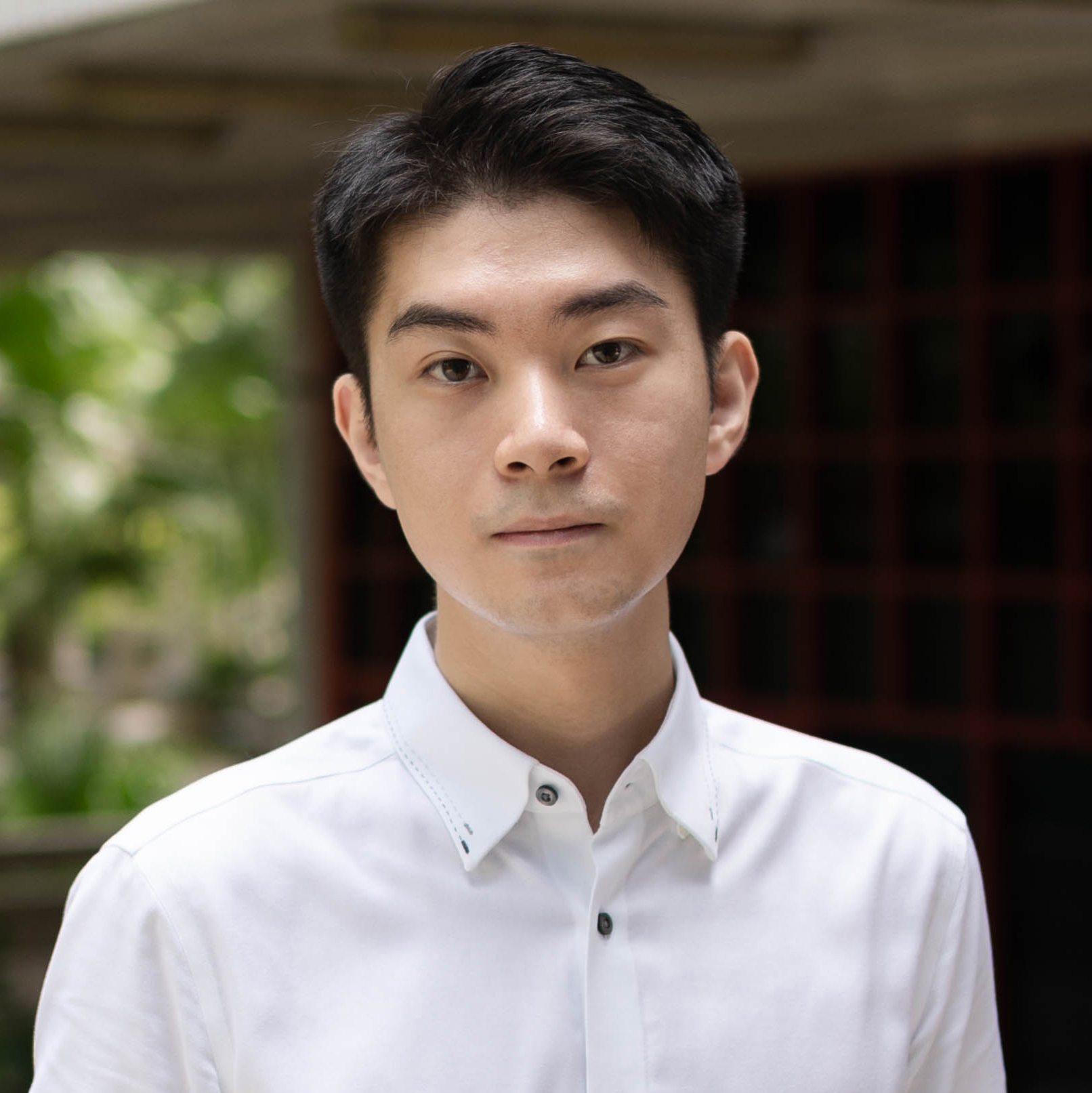
 Jinpeng Chen
· 7 previous affiliations
- ModelBestSince 2026
- Researcher · Since 2026
- City University of Hong KongCurrent
- Current
- PhD student · 2021–2025
- Huawei Technologies (China)2025–2026
- Researcher · 2025–2026
- Researcher · 2025–2026
- Research Intern · 2024–2025
- Bachelor of Engineering - BE, Electronics Information Science and Technology · 2017–2021
- Undergrad student · 2017–2021
- Tsinghua University2019–2021
- Research Intern · 2019–2021
1 other author named Jinpeng Chen: Jinpeng Chen (Beijing University of Post and Telecommunication · 111 papers)
Research Overview
Jinpeng Chen focuses on continual learning, multimodal understanding, and agentic reinforcement learning. His work addresses the challenge of enabling models to acquire new knowledge without catastrophic forgetting, particularly in complex computer vision tasks like semantic segmentation. Recently, his research has expanded to optimize the reasoning capabilities and noise tolerance of multimodal large language models.
Research Trajectory
Jinpeng Chen’s early research concentrated on complex visual segmentation environments and the foundational challenges of continual learning. In 2023, he participated in the development of SDDNet: Style-guided Dual-layer Disentanglement Network for Shadow Detection, an architecture inspired by the human visual system that separates images into background and shadow layers to mitigate the adverse effects of complex background colors. Concurrently, he addressed the notoriously difficult problem of Class-Incremental Semantic Segmentation (CISS), where models must learn new object categories without forgetting previously learned ones—a task complicated by old classes frequently appearing in the background of new training data. He introduced Saving 100x Storage: Prototype Replay for Reconstructing Training Sample Distribution in Class-Incremental Semantic Segmentation, a method that reconstructs training distributions using prototype replay rather than storing massive amounts of historical data. This work contributed significantly to the area of Selective Knowledge Distillation for Incremental Learning and the research direction of Feature Distribution Replay for Exemplar Free Continual Learning.
In 2024, his work on segmentation architectures broadened to include salient instance and few-shot segmentation. He developed KepSalinst: Using Peripheral Points to Delineate Salient Instances, a network that utilizes the center and peripheral points of an instance as geometric guidance for dynamic convolutions, effectively delineating spatial extents. He also collaborated on Query-Guided Prototype Evolution Network for Few-Shot Segmentation, which integrates query features into the generation of foreground and background prototypes to create customized representations attuned to specific queries. Returning to the challenge of catastrophic forgetting, he extended his continual learning methodologies to panoptic segmentation with Strike a Balance in Continual Panoptic Segmentation. This research introduced past-class backtrace distillation, a technique that retraces features associated with past classes to balance the stability of existing knowledge with the plasticity required to adapt to new information.
By 2025, his foundational work in segmentation and continual learning matured into several specialized journal publications. He further refined CISS methodologies in Replay Without Saving: Prototype Derivation and Distribution Rebalance for Class-Incremental Semantic Segmentation and tackled the practical challenge of incomplete data in Trace Back and Go Ahead: Completing partial annotation for continual semantic segmentation. In the few-shot domain, he investigated semantic transfer mechanisms in Concept-Level Semantic Transfer and Context-Level Distribution Modeling for Few-Shot Segmentation and explored multi-granularity prompting strategies in MM-Prompt: Multi-modality and Multi-granularity Prompts for Few-Shot Segmentation.
Simultaneously, a major evolution in his trajectory occurred as he applied his expertise in continual learning and reinforcement learning to Multimodal Large Language Models (MLLMs). He introduced SEFE: Superficial and Essential Forgetting Eliminator for Multimodal Continual Instruction Tuning, a framework designed to prevent MLLMs from losing previously acquired skills during instruction tuning. By distinguishing between "superficial" forgetting (the loss of correct output formatting) and "essential" forgetting (the actual loss of factual knowledge), the framework utilizes data-diversification and regularized adaptation to maintain performance. To improve the robustness of MLLM training, he developed From Exploration to Exploitation: A Two-Stage Entropy RLVR Approach for Noise-Tolerant MLLM Training. This approach uses Reinforcement Learning with Verifiable Rewards (RLVR) and a two-stage entropy optimization strategy to enable effective learning even when a significant portion of training labels are incorrect, advancing work in the broader areas of Preventing Entropy Collapse in Reinforcement Learning and Overcoming the Zero Variance Problem in Group Reinforcement Learning.
During this period, he also led the creation of VP-Bench: A Comprehensive Benchmark for Visual Prompting in Multimodal Large Language Models. This large-scale evaluation framework systematically tests how MLLMs perceive visual prompts like bounding boxes and masks, revealing that while models handle regular geometric shapes well, they struggle with irregular marks and complex spatial reasoning. This benchmark contributes to the research direction of Decomposing Perception and Reasoning in Multimodal Models and the area of Knowledge Augmented Visual Reasoning. Extending this focus on real-world multimodal evaluation, he collaborated on PhoStream: Benchmarking Real-World Streaming for Omnimodal Assistants in Mobile Scenarios in 2026. The study evaluated how AI assistants handle real-time streaming data, identifying a critical "impatience" where models often hallucinate answers before the necessary visual evidence appears in the stream.
Current Directions
The most recent papers in the evidence indicate a strong focus on the reasoning capabilities, robust training, and real-world deployment of Multimodal Large Language Models (MLLMs). Recent work investigates how to prevent catastrophic forgetting during continual instruction tuning, ensuring models retain factual knowledge while adapting to new tasks and formats. Additionally, there is an emphasis on agentic reinforcement learning, specifically using verifiable rewards and entropy optimization to train models effectively even in the presence of highly noisy data. Another active area involves benchmarking how MLLMs process visual prompts and handle real-time, streaming multimodal inputs in mobile scenarios, highlighting the ongoing challenge of aligning visual perception with timely, accurate reasoning.
Profile updated
Loading new papers…
Other researchers whose papers cluster into the same research directions — a proxy for overlapping technical interests and shared intellectual neighborhoods.
See something wrong? Report a mistake