

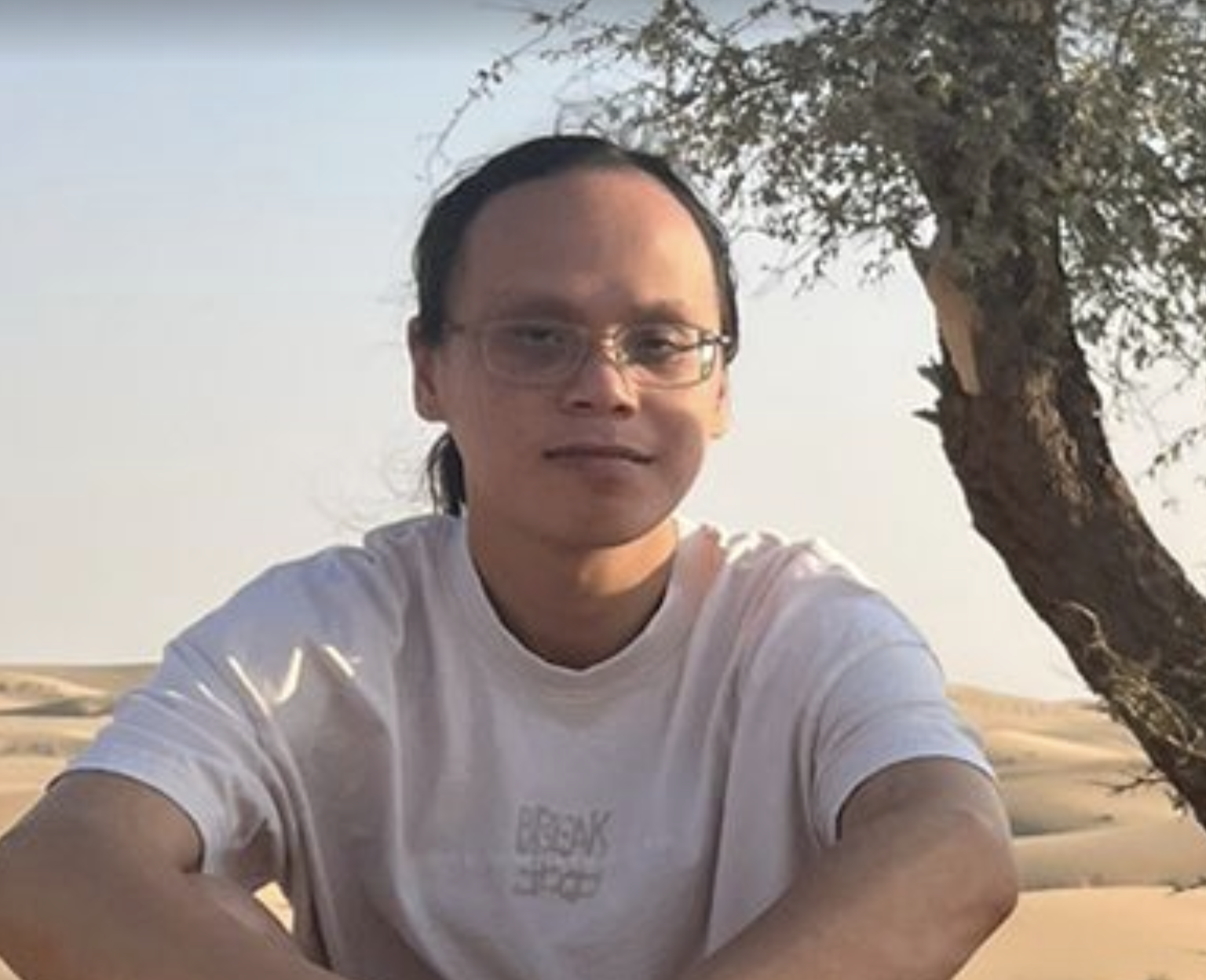
 Jiayou Zhang
· 5 previous affiliations
- GenBio AISince 2024
- Intern · Since 2024
- PhD student · 2022–2026
- Research Assistant · 2022
- Visiting Researcher · 2024
- BioMap2023
- Intern · 2023
- Tsinghua University2018–2022
- Undergrad student · 2018–2022
Research Overview
Jiayou Zhang focuses on machine learning methodologies for biological foundation models, discrete generative architectures, and prompt optimization. His trajectory spans from biomedical natural language processing to foundational improvements in autoregressive generation and vector quantization. Currently, his work addresses structural bottlenecks in generative models, developing techniques to scale discrete vocabularies and stabilize high-fidelity synthesis.
Research Trajectory
Zhang’s early work explored the intersection of natural language processing and structured biomedical ontologies. In 2023, he contributed to GraphPrompt: Graph-Based Prompt Templates for Biomedical Synonym Prediction, a methodology designed to integrate relational graph structures directly into prompt templates for language models. By leveraging the rich relational data embedded in ontologies, this approach significantly improved prediction accuracy, particularly in challenging zero-shot and few-shot scenarios. This work advanced the research direction of Mapping Lexical Variation to Standardized Domain Concepts and was supported by the introduction of OBO-syn, a large-scale biomedical dataset created to facilitate further research in the domain.
Expanding his focus on language model interactions and instruction tuning, Zhang participated in collaborative research addressing the area of Transferable Instruction Optimization for Large Generative Models. This effort resulted in PromptAgent: Strategic Planning with Language Models Enables Expert-level Prompt Optimization in 2024. The project framed prompt engineering as a rigorous planning problem, utilizing techniques in the broader area of Strategic Optimization via Monte Carlo Tree Search. By systematically exploring the space of possible instructions, the framework enabled models to iteratively refine their own prompts, contributing to the field of Iterative Optimization via Textual Feedback Loops.
In 2025, Zhang’s research shifted toward foundational architectural improvements in generative models, specifically addressing the trade-offs between discrete and continuous latent representations. He introduced MixAR: Mixture Autoregressive Image Generation, a hybrid framework designed to synthesize the training stability of discrete autoregressive models with the high-fidelity output characteristic of continuous latent prediction. By utilizing discrete tokens as a structural scaffolding to guide continuous generation, MixAR maintains computational efficiency while achieving strong performance on complex visual benchmarks such as ImageNet-256.
Continuing his investigation into discrete latent spaces, Zhang identified critical structural limitations in Vector-Quantized Variational Autoencoders (VQVAEs). In Dimensional Collapse in VQVAEs: Evidence and Remedies, he demonstrated that these models frequently suffer from dimensional collapse, effectively utilizing only a small fraction of their available latent dimensions—often as few as 4 to 10—regardless of the total space provided. To resolve this bottleneck, he developed Divide-and-Conquer VQ (DCVQ), a method that partitions the latent space into multiple independently quantized, low-dimensional subspaces. This architectural intervention significantly enhanced model capacity and reconstruction quality, advancing the broader areas of Mitigating Codebook Collapse in Vector Quantization and Subspace Decomposition for Scalable Vector Quantization.
Current Directions
The most recent papers in the evidence indicate a strong focus on optimizing the fundamental architectures of generative models. Recent work investigates the structural inefficiencies of discrete latent spaces, particularly addressing dimensional collapse in vector quantization and the exposure bias inherent in autoregressive generation. By developing hybrid autoregressive frameworks and subspace decomposition techniques, Zhang's current research aims to scale model capacity, stabilize training dynamics, and improve the fidelity of generative outputs without sacrificing computational efficiency.
Profile updated
Loading new papers…
Other researchers whose papers cluster into the same research directions — a proxy for overlapping technical interests and shared intellectual neighborhoods.
See something wrong? Report a mistake