

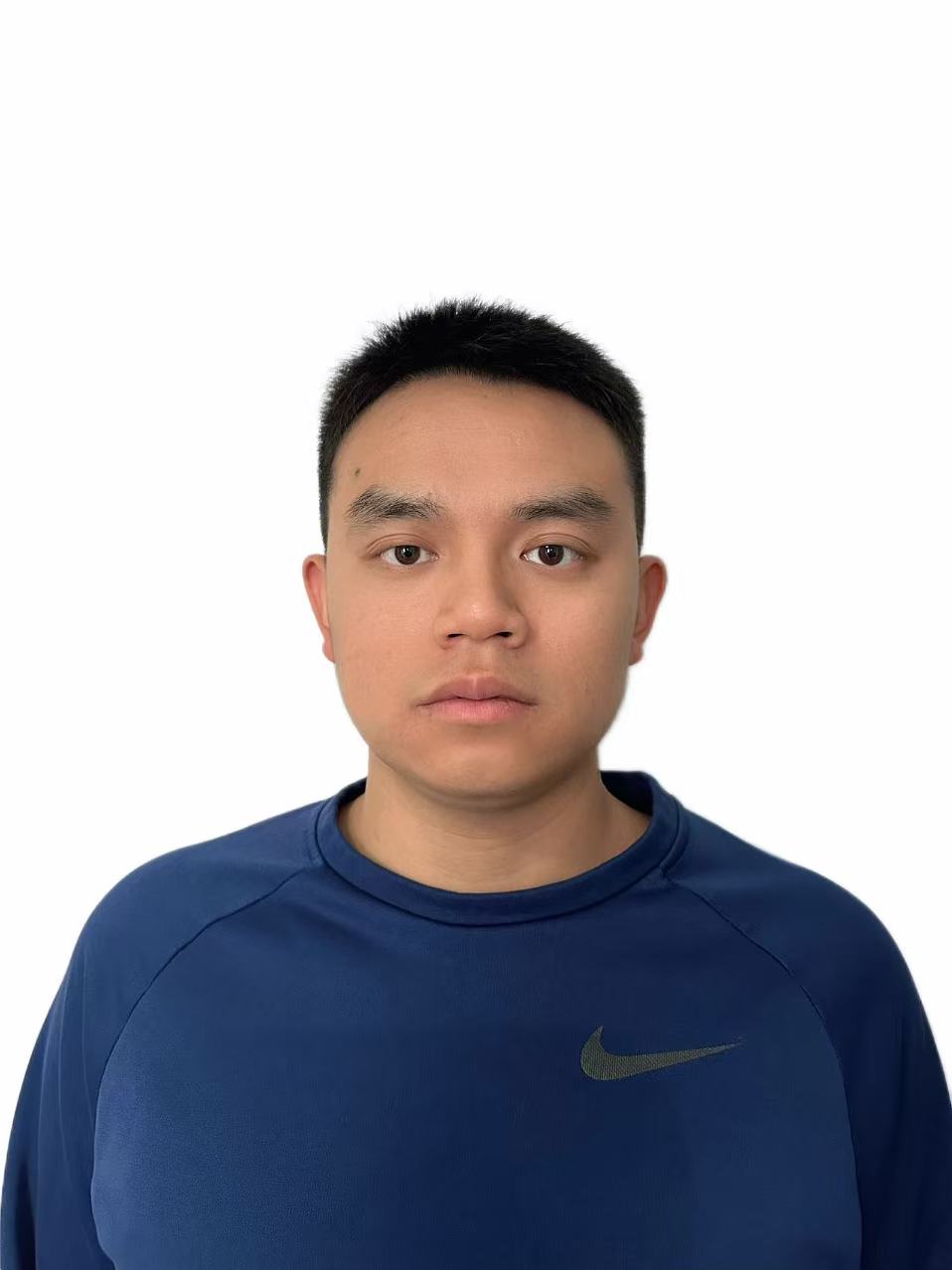
 Jiapeng Tang
· 2 previous affiliations
- Technical University of MunichSince 2021
- PhD student · Since 2021
- Current
- South China University of Technology2014–2021
- MS student · 2018–2021
- Undergrad student · 2014–2018
Research Overview
Jiapeng Tang focuses on 3D computer vision, generative artificial intelligence, and the reconstruction of complex geometries from sparse visual data. His early trajectory addressed the topological challenges of recovering 3D object surfaces and dynamic human shapes from single images and point clouds. More recently, his work emphasizes the application of diffusion models to video, multi-view, and 3D generation for realistic scene synthesis and digital avatars.
Research Trajectory
His early trajectory addressed the research direction of Overcoming the Fixed Topology Constraint in 3D Modeling, as well as the broader area of Learning 3D Geometry from Single 2D Projections. In 2019, he introduced A Skeleton-Bridged Deep Learning Approach for Generating Meshes of Complex Topologies From Single RGB Images. This work tackled the difficulty of recovering surfaces with complex topologies by leveraging skeleton-based representations, which preserve topological structure while remaining computationally efficient to learn. This methodology was later formalized and expanded in the journal article SkeletonNet: A Topology-Preserving Solution for Learning Mesh Reconstruction of Object Surfaces From RGB Images, which further demonstrated how skeletal shape representations can constrain and assist downstream object surface reconstruction.
Concurrently, he investigated 4D shape reconstruction and implicit representations. In Learning Parallel Dense Correspondence From Spatio-Temporal Descriptors for Efficient and Robust 4D Reconstruction, he developed a pipeline to capture temporal evolution in 3D human shapes by establishing spatially continuous transformation functions among cross-frame occupancy fields. He also contributed to the area of Efficient Volumetric Representations for 3D Deep Learning with SA-ConvONet: Sign-Agnostic Optimization of Convolutional Occupancy Networks. This method enables surface reconstruction from raw, unoriented point clouds by optimizing local implicit fields without requiring accurate surface normals, effectively bypassing the sign conflict problem in overlapping regions.
The trajectory then expanded to include non-rigid shape manipulation and generative scene synthesis. He presented Neural Shape Deformation Priors, a method that learns deformation behaviors from underlying geometric properties to predict mesh deformations from user-provided handle movements. This work intersects with research directions such as Neural Skinning Fields for Articulated Avatars and Neural Skinning via Attention for Articulated Mesh Recovery. Transitioning toward generative models, he developed RGBD2: Generative Scene Synthesis via Incremental View Inpainting Using RGBD Diffusion Models. This approach sequentially generates novel views along a camera trajectory to recover underlying scene geometry, contributing to the broader area of Scaling Diffusion Models Directly in Pixel Space.
In recent years, his focus has shifted heavily toward applying diffusion models to complex 3D and 4D generation tasks. He participated in developing DiffuScene: Denoising Diffusion Models for Generative Indoor Scene Synthesis, which represents scenes as unordered sets of object attributes to generate physically plausible room layouts. In the domain of digital humans, he contributed to DPHMs: Diffusion Parametric Head Models for Depth-Based Tracking, leveraging latent diffusion priors to reconstruct and track 3D heads from noisy depth data while ensuring plausible identities and expressions.
Continuing this theme, he collaborated on FactorPortrait: Controllable Portrait Animation via Disentangled Expression, Pose, and Viewpoint, a video diffusion framework utilizing a Diffusion Transformer (DiT) to achieve high-fidelity, controllable portrait animation from a single reference image. He also presented ROGR: Relightable 3D Objects using Generative Relighting, a framework that distills knowledge from a generative diffusion model into a specialized Neural Radiance Field (NeRF) to enable real-time relighting under arbitrary environment maps. Most recently, his research culminated in Motion2VecSets: 4D Latent Vector Set Diffusion for Non-rigid Shape Reconstruction and Tracking. This work introduces a 4D diffusion model that uses a latent vector set representation to reconstruct dynamic, non-rigid shapes from imperfect point clouds, advancing the area of Probabilistic Generative Models for 3D Shape Completion.
Current Directions
Recent work investigates the intersection of diffusion models and dynamic 3D/4D representations for high-fidelity scene and avatar generation. The most recent papers in the evidence address the challenge of reconstructing and tracking non-rigid shapes over time using 4D latent vector set diffusion, particularly from noisy, sparse, or partial point cloud data. Additionally, current research explores controllable video diffusion frameworks for portrait animation—enabling disentangled control over facial expressions, head poses, and camera viewpoints—as well as generative relighting techniques that distill diffusion priors into Neural Radiance Fields (NeRFs) for real-time, environment-agnostic illumination of 3D objects.
Profile updated
Loading new papers…
Other researchers whose papers cluster into the same research directions — a proxy for overlapping technical interests and shared intellectual neighborhoods.
See something wrong? Report a mistake