

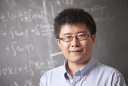
 Jianfeng Lu
· 1 previous affiliation
- Duke UniversitySince 2016
- Professor · Since 2020
- Associate Professor · 2016–2020
5 other authors named Jianfeng Lu: Jianfeng Lu (Nanjing University of Science and Technology · 183 papers), Jianfeng Lu (46 papers), Jianfeng Lu (Wuhan University of Science and Technology · 22 papers), Jianfeng Lu (Nanjing University of Science and Technology · 2 papers), Jianfeng Lu (1 paper)
Research Overview
Jianfeng Lu focuses on applied mathematics and computational physics, developing scalable algorithms for quantum chemistry and high-dimensional function approximation. His trajectory spans from linear-scaling electronic structure calculations to the rigorous analysis of neural networks and generative models. Currently, he investigates the mathematical foundations of diffusion models and optimization techniques for near-term quantum hardware.
Research Trajectory
Lu’s early research addressed the computational bottlenecks of simulating complex materials and quantum systems. In 2009, he introduced a multipole representation to accelerate these calculations in Multipole representation of the Fermi operator with application to the electronic structure analysis of metallic systems. This work advanced the research direction of Linear Scaling Electronic Structure for Metallic Systems, reducing computational costs from linear or square-root scaling to near-logarithmic scaling. Continuing this focus on scalable computation, he explored the area of Hierarchical Low-Rank Matrix Compression with the 2011 publication Fast construction of hierarchical matrix representation from matrix-vector multiplication.
In 2012, he further optimized Density Functional Theory (DFT) calculations. With collaborators, he developed Adaptive local basis set for Kohn-Sham density functional theory in a discontinuous Galerkin framework I: Total energy calculation. By utilizing a Discontinuous Galerkin framework, this approach drastically reduced the required basis functions per atom while maintaining high accuracy, which contributed to the broader area of Localized Basis Functions for Linear Scaling Multiscale Simulations.
Moving into the 2020s, Lu’s trajectory expanded to encompass the mathematical foundations of machine learning and high-dimensional function approximation. In 2021, he co-authored On the Representation of Solutions to Elliptic PDEs in Barron Spaces, which derived complexity estimates for solving high-dimensional partial differential equations using neural networks. This work provided dimension-explicit bounds and serves as a key contribution to the research direction of Barron Spaces for High-Dimensional Function Approximation.
By 2023, his focus on the intersection of machine learning and physics yielded several significant theoretical results. He addressed the exact representation of continuous, totally anti-symmetric functions—essential for modeling fermions—in Exact and Efficient Representation of Totally Anti-Symmetric Functions. This mathematical framework achieves polynomial scaling, bypassing the exponential costs traditionally associated with such quantum mechanical systems.
Simultaneously, Lu made extensive contributions to the theory of generative models. He provided rigorous guarantees for score-based methods in Convergence of score-based generative modeling for general data distributions. He also analyzed progressive flow-based models by framing their training as proximal gradient descent in Wasserstein space in Convergence of flow-based generative models via proximal gradient descent in Wasserstein space. These papers significantly advanced the research direction of Generative Convergence Beyond Smoothness and Log-Concavity, proving that these models can generate data distributions with exponential efficiency.
His 2023 work also included algorithmic optimizations for machine learning and physics simulations. He helped develop HeteRSGD: Tackling Heterogeneous Sampling Costs via Optimal Reweighted Stochastic Gradient Descent, which introduced an efficiency metric to intelligently sample data points with varying computational costs. Additionally, he established global convergence and energy dissipation for discrete-time numerical schemes in On the convergence of Sobolev gradient flow for the Gross-Pitaevskii eigenvalue problem, leveraging Riemannian optimization techniques to prove exponential convergence to the ground state.
In 2024 and 2025, Lu continued to refine the theoretical understanding of generative AI while simultaneously tackling challenges in quantum computing. He oversaw a fine-grained mathematical analysis of diffusion model guidance in What does guidance do? A fine-grained analysis in a simple setting. He also contributed to Consistency Posterior Sampling for Diverse Image Synthesis, a framework utilizing Langevin dynamics in the noise space of pre-trained consistency models to efficiently solve inverse problems like deblurring and inpainting.
In the quantum domain, his recent work addresses the limitations of near-term hardware. He guided research on variational quantum excited-state solvers in Qubit Count Reduction by Orthogonally Constrained Orbital Optimization for Variational Quantum Excited-State Solvers.. Building on this, he co-authored State-Specific Orbital Optimization for Enhanced Excited-States Calculation on Quantum Computers, which tailors the orbital basis to individual electronic states to improve precision. This aligns with the broader area of Active Space Embedding for Scalable Quantum Chemistry. Finally, he explored the equilibration of quantum systems in Mixing Time of Open Quantum Systems via Hypocoercivity., introducing a framework inspired by classical kinetic theory to estimate mixing times without relying on the full spectral gap.
Current Directions
Recent work investigates the mathematical foundations of modern generative artificial intelligence and the optimization of algorithms for near-term quantum hardware. In the realm of machine learning, Lu is exploring the theoretical mechanics of diffusion models—specifically the role of guidance—and developing efficient posterior sampling frameworks for consistency models to solve complex inverse problems. Concurrently, his quantum computing research addresses the accurate calculation of excited states through state-specific orbital optimization and the theoretical estimation of mixing times in open quantum systems using hypocoercivity.
Profile updated
Loading new papers…
Other researchers whose papers cluster into the same research directions — a proxy for overlapping technical interests and shared intellectual neighborhoods.
See something wrong? Report a mistake