

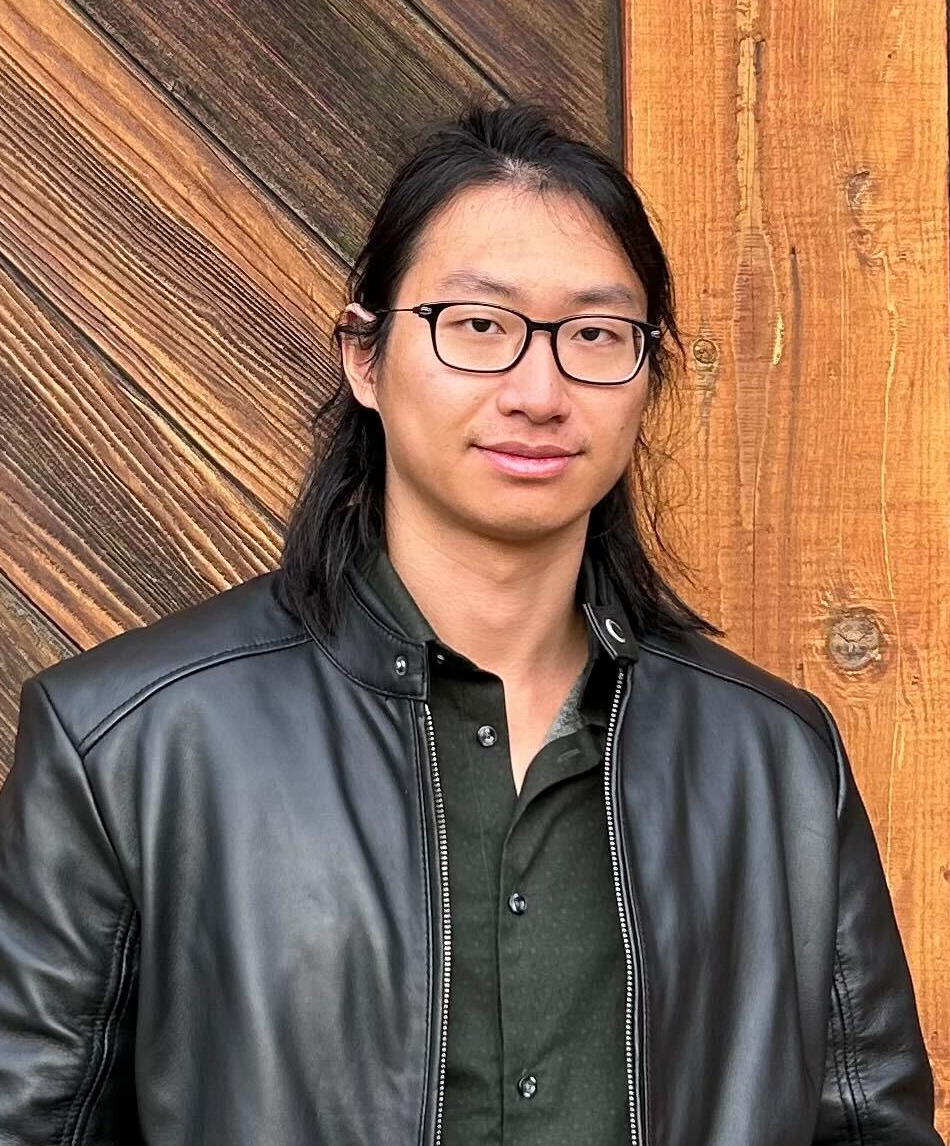
 Jiahao Luo
· 7 previous affiliations
- ByteDance (China)Since 2026
- Research Intern · Since 2026
- University of California, Santa CruzSince 2018
- PhD student · 2021–2027
- PHD Student · Since 2021
- Current
- Master's degree, Electrical Engineering · 2018–2020
- Snap Inc.2024–2026
- Research Intern · 2024–2026
- Flawless2024
- Research Scientist Intern · 2024
- Bellus3D2020–2021
- Computer Vision Engineer · 2020–2021
- Bachelor of Engineering - BE, Electrical, Electronics and Communications Engineering · 2014–2018
- Undergrad student · 2014–2018
Research Overview
Jiahao Luo focuses on generative modeling, 3D character animation, and image enhancement. His early work explored architectural innovations in generative adversarial networks to improve training stability and mitigate mode collapse. More recently, his research has shifted toward text-to-3D generation and the creation of animatable, stylized digital avatars using advanced rendering techniques.
Research Trajectory
Luo's early research addressed fundamental challenges in the training dynamics of generative adversarial networks (GANs). A persistent issue in standard GAN architectures is mode collapse and training instability, often stemming from the two-player min-max game between a single generator and discriminator. With collaborators, he explored architectural modifications to stabilize this process, contributing to the research direction Dual Discriminators for Robust Generative Modeling. This work culminated in the development of PeerGAN: Generative Adversarial Networks with a Competing Peer Discriminator. By introducing a second, "peer" discriminator into the adversarial framework, the methodology created a secondary game between the two discriminators to actively discourage their agreement. This approach provided a novel mechanism for the area of Diversifying Adversarial Feedback for Generative Stability and advanced the broader area of Mitigating Gradient Saturation in Adversarial Learning. The underlying concepts were further formalized in the subsequent publication DuelGAN: A Duel Between Two Discriminators Stabilizes the GAN Training, which reinforced the utility of multi-discriminator duels in generating high-quality samples while avoiding mode collapse, aligning with work in Multi-Component Adversarial Networks for Constrained Representation Learning.
Following these foundational improvements to GAN stability, Luo applied adversarial learning paradigms to practical computer vision tasks. In 2022, he contributed to Low-light Image Enhancement Using Chain-consistent Adversarial Networks. Recognizing the limitations of traditional enhancement methods that require manual parameter tuning, as well as supervised learning approaches that depend on massive datasets of paired images, this research proposed a semi-supervised alternative. By utilizing a chain of cycle-consistent generators, the method effectively enhanced image clarity and brightness in low-light conditions without relying strictly on paired training data.
By 2025, Luo's research focus evolved toward 3D computer vision, specifically the generation and animation of digital human avatars. As digital self-representation became increasingly prominent, existing systems struggled with limited expressivity, tedious customization, and inefficient rendering. He participated in the development of Snapmoji: Instant Generation of Animatable Dual-Stylized Avatars, a system designed to instantly create personalized, animatable avatars from a single selfie. This project leveraged Gaussian Domain Adaptation, pre-training on large-scale 3D datasets and fine-tuning to achieve efficient rendering and stylization. This contribution intersected with the research direction Feed-Forward 3D Scene Reconstruction and the area of Identity Preservation in Facial Stylization and Caricature.
Building on the challenges of 3D character animation, he introduced T2Bs: Text-to-Character Blendshapes via Video Generation. This framework bypassed the need for image inputs entirely, allowing for the generation of animatable 3D character head blendshape models directly from text prompts. By integrating static text-to-3D generation techniques with video diffusion models and a novel deformable 3D Gaussian splatting approach, the T2Bs framework addressed existing limitations in temporal consistency, enabling the production of high-quality, expressive 4D character animations.
Current Directions
The most recent papers in the evidence address the intersection of generative AI, 3D rendering, and character animation. Luo's current work investigates the automated generation of expressive, animatable digital avatars from minimal inputs, such as single images or text prompts. A major theme in this recent research is the utilization of advanced representation techniques, particularly deformable 3D Gaussian splatting, to overcome the computational and expressive limitations of traditional mesh-based or predefined avatar systems. Furthermore, the integration of video diffusion models with static 3D generation points to an ongoing focus on ensuring temporal consistency and high-fidelity movement in 4D character animation.
Profile updated
Loading new papers…
Other researchers whose papers cluster into the same research directions — a proxy for overlapping technical interests and shared intellectual neighborhoods.
See something wrong? Report a mistake