

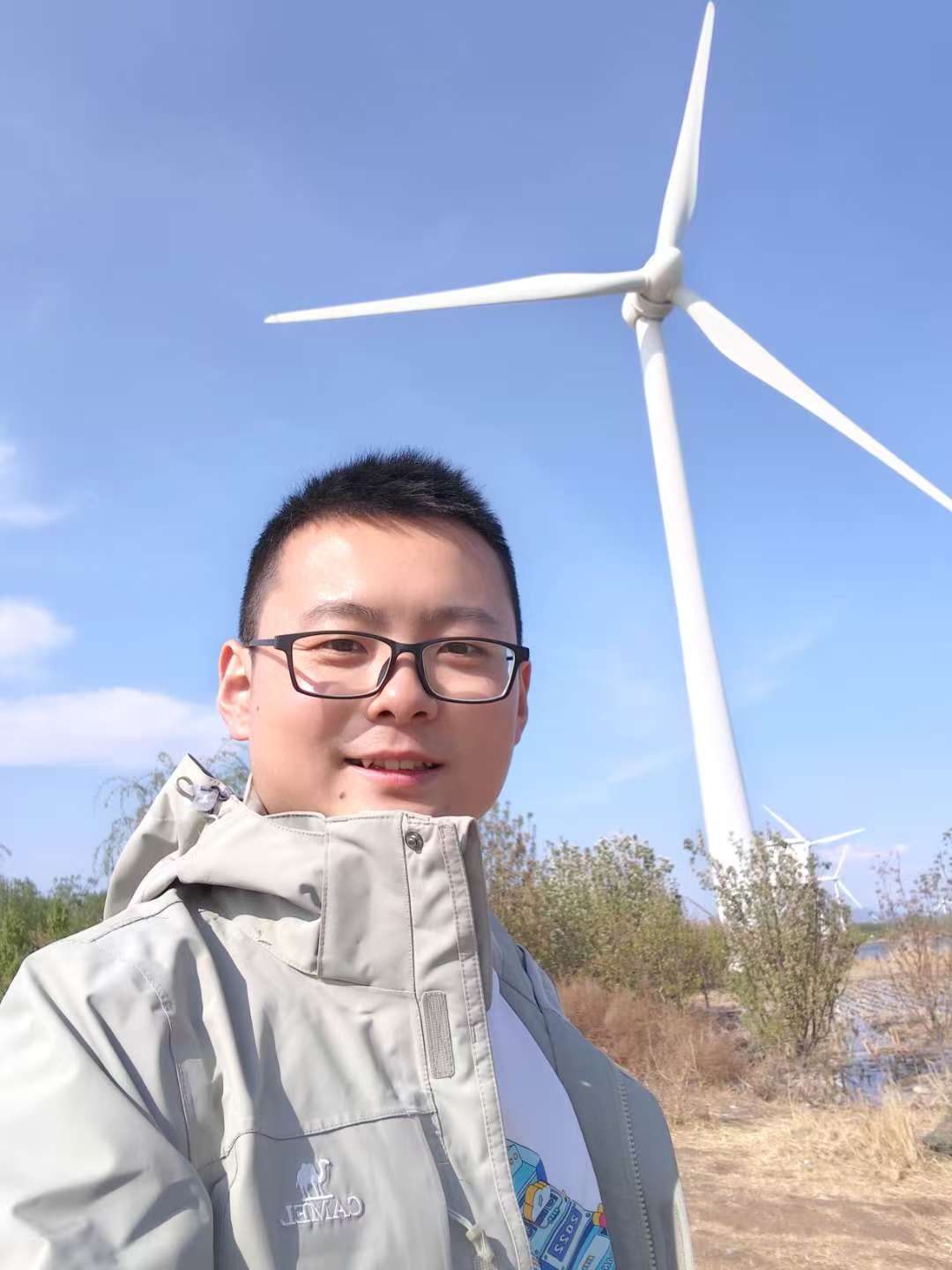
 Jiafeng Xu
· 6 previous affiliations
- 字节跳动Since 2022
- 算法工程师 · Since 2022
- ByteDance (China)Current
- Current
- Researcher · 2022–2025
- 腾讯2020–2022
- Robotics Researcher · 2020–2022
- Tencent (China)2020–2022
- Researcher · 2020–2022
- Beijing Institute of Technology2013–2020
- Master's degree, Mechanical Electronics Engineering · 2017–2020
- Undergrad student · 2013–2017
- Undergrad student · 2017
Research Overview
Jiafeng Xu focuses on robotic reinforcement learning, learning-based robot manipulation, and unified control frameworks for embodied intelligence. His trajectory spans from visual-force imitation for mobile manipulators to the development of large-scale video generative pre-training for robotic control. Recent work investigates high-precision dexterous manipulation and accurate geometry perception to bridge the simulation-to-reality gap in robotics.
Research Trajectory
Jiafeng Xu's research trajectory reflects a sustained focus on bridging the gap between complex, high-dimensional perception and robust robotic control. Early in his career, his work addressed the challenges of contact-rich tasks in mobile manipulation. He collaborated on MOMA-Force: Visual-Force Imitation for Real-World Mobile Manipulation (2023), which integrated representation learning for perception with admittance whole-body control to improve the accuracy and robustness of mobile manipulators in real-world environments.
In 2024, his research expanded significantly into the intersection of large-scale generative models and embodied intelligence. He contributed to the development of GR-1, detailed in Unleashing Large-Scale Video Generative Pre-training for Visual Robot Manipulation. This work demonstrated that GPT-style transformers pre-trained on massive datasets of human activity videos could achieve strong zero-shot generalization in robotic environments. This advanced the research direction of Visual Foresight for Embodied Reasoning and Action and the broader area of Video Foundation Models for Robotic Manipulation. Building on this foundation, he participated in the creation of GR-2: A Generative Video-Language-Action Model with Web-Scale Knowledge for Robot Manipulation. By fine-tuning a model pre-trained on 38 million internet videos to predict future frames and actions simultaneously, the system achieved high success rates across numerous tasks, contributing to the field of Action Chunking for Robust Robotic Control.
By 2025, Xu's work encompassed both algorithmic advancements and specialized hardware design. He directed the development of ByteWrist: A Parallel Robotic Wrist Enabling Flexible and Anthropomorphic Motion for Confined Spaces, introducing a high-performance, nested-motor design that provides human-like dexterity and high structural stiffness for tasks in restricted environments. Concurrently, he continued to refine learning-based manipulation through GR-RL: Going Dexterous and Precise for Long-Horizon Robotic Manipulation. This multi-stage training framework transformed generalist vision-language-action models into high-precision specialists by filtering noisy demonstrations and applying online reinforcement learning in a latent space. His research also extended to mobile platforms, as seen in his contributions to World Model-Based Perception for Visual Legged Locomotion.
Alongside applied robotics, Xu has engaged with foundational reinforcement learning methodologies. He collaborated on Flow-Based Policy for Online Reinforcement Learning (2025), which addressed the limitations of simple Gaussian policies in complex, multimodal environments. This work advanced research directions such as Overcoming the Unimodal Constraint in Reinforcement Learning and Reinforcement Learning as Weighted Supervised Learning.
Most recently, his research has focused on overcoming the simulation-to-reality gap in perception. He contributed to Manipulation as in Simulation: Enabling Accurate Geometry Perception in Robots (2026), which introduced Camera Depth Models to convert noisy raw depth sensor data into accurate metric depth. This approach allows robot policies trained on clean simulated data to transfer directly to real-world tasks without additional fine-tuning.
Current Directions
Recent work investigates methods for bridging the simulation-to-reality gap and enabling high-precision, long-horizon robotic autonomy. The most recent papers in the evidence address the challenge of unreliable real-world perception by developing models that transform noisy sensor data into clean, simulation-like metric depth, allowing zero-shot transfer of policies trained in simulation. Additionally, current research explores multi-stage training frameworks that combine large-scale vision-language-action models with online reinforcement learning to achieve specialized, dexterous manipulation. This is complemented by ongoing investigations into generative policies that better handle complex, multimodal decision-making in reinforcement learning environments.
Profile updated
Loading new papers…
Other researchers whose papers cluster into the same research directions — a proxy for overlapping technical interests and shared intellectual neighborhoods.
See something wrong? Report a mistake