

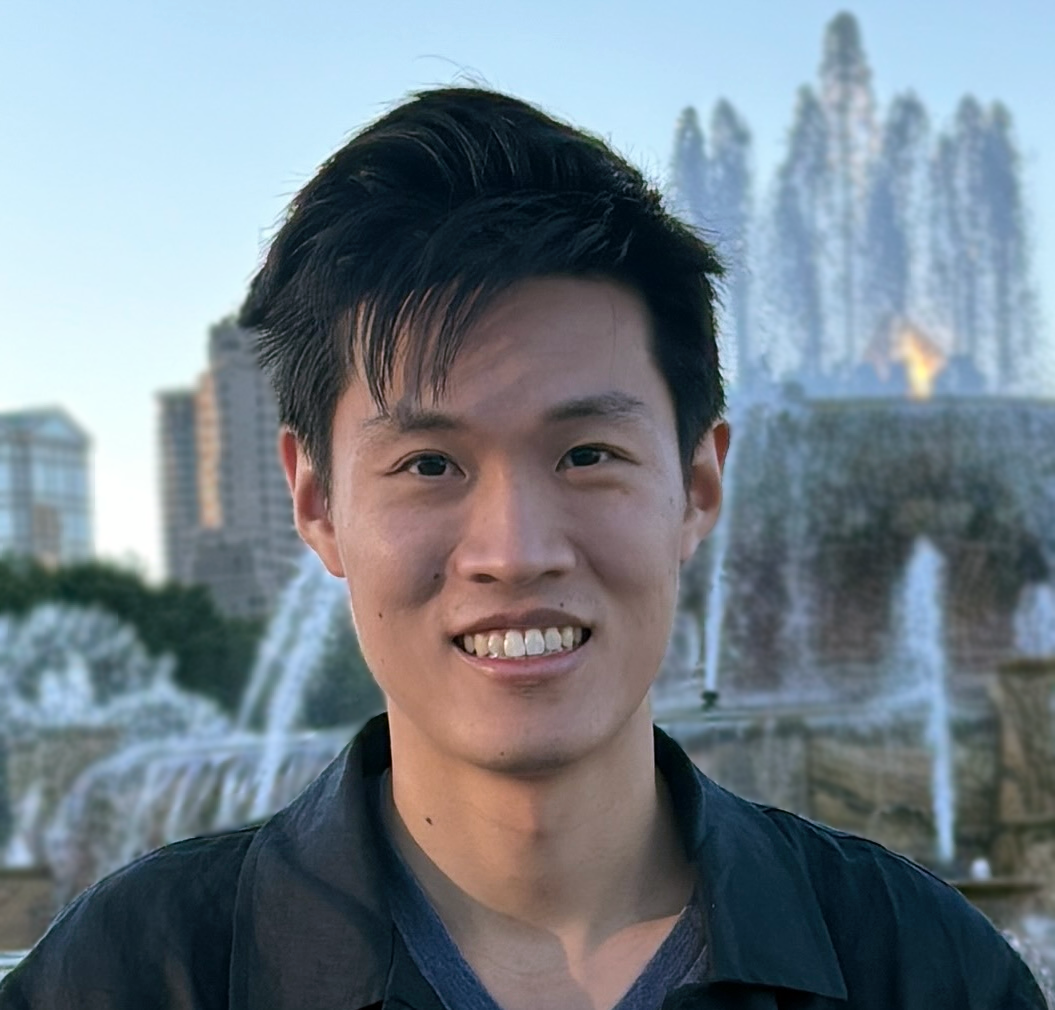
 Jeffrey Ouyang-Zhang
· 4 previous affiliations
- The University of Texas at AustinSince 2020
- PhD student · Since 2020
- Intern · 2025
- Intern · 2022
- Undergrad student · 2018–2019
Research Overview
Jeffrey Ouyang-Zhang focuses on computational biology, geometric deep learning, and protein structure prediction. His early work explored visual priors and network adaptation before shifting toward large-scale biomolecular modeling and generative protein design. Currently, he develops highly efficient architectures and sequence-only models for predicting protein stability, structure, and complex interactions.
Research Trajectory
Jeffrey Ouyang-Zhang's early research investigated representation learning and network adaptation in computer vision. With collaborators, he explored how visual priors about the 3D world assist in learning downstream motor tasks, contributing to the research direction of Task Specificity in Learned Representations in the study Learning to Navigate Using Mid-Level Visual Priors. He subsequently introduced a novel method for adapting pre-trained neural networks to new tasks in Side-Tuning: A Baseline for Network Adaptation via Additive Side Networks. By training a small side network that adds its output to the pre-trained features, this approach achieved strong performance while avoiding catastrophic forgetting and rigidity.
Following this work in computer vision and general machine learning, his focus shifted toward computational biology and protein engineering. He developed the "Mutate Everything" algorithm in Predicting a Protein's Stability under a Million Mutations, a parallel decoding method that predicts the thermodynamic stability of millions of protein mutations in a single forward pass. Building on backbones like AlphaFold and ESM2, this work significantly accelerated double-mutant screening and advanced the area of Parallel Prediction of Protein Mutational Landscapes.
His subsequent research expanded into generative modeling and structural distillation for proteins. In Ambient Proteins - Training Diffusion Models on Noisy Structures, he and his collaborators trained generative models on the full spectrum of AlphaFold2 predictions, treating low-confidence structures as corrupted data. This framework produced highly capable models for generating complex protein backbones, contributing to the broader area of The Computational Experimental Validation Gap. He further explored sequence-based modeling by introducing the Implicit Structure Model (ISM) in Distilling Structural Representations into Protein Sequence Models. By distilling fine-grained structural information from an atomic autoencoder into a standard sequence model, ISM achieves strong performance on structural tasks without requiring 3D coordinates at inference time. This work spans several research directions, including Distilling Structural Knowledge into Protein Sequence Models, Local Structural Microenvironments for Protein Representation, and Protein Disorder Prediction via Structural Model Confidence.
Most recently, his work has addressed the computational bottlenecks of biomolecular structure prediction. He introduced Pairmixer in Triangle Multiplication is All You Need for Biomolecular Structure Representations, a streamlined backbone that demonstrates the computationally heavy "triangle attention" used in AlphaFold3-style models is largely redundant. By relying primarily on efficient triangle multiplication, Pairmixer matches state-of-the-art accuracy while significantly reducing training costs and accelerating inference. In parallel, he collaborated on large-scale evaluations of antibody-antigen modeling in Folding scFv--Antigen Complexes at Scale, introducing a scalable benchmarking pipeline to characterize the reliability of modern structure prediction models on therapeutically important single-chain variable fragments.
Current Directions
The most recent papers in the evidence address the scalability and efficiency of biomolecular structure prediction and generative protein design. Recent work investigates streamlined architectures for modeling large protein complexes, demonstrating that computationally expensive attention mechanisms can be replaced with more efficient geometric operations without sacrificing accuracy. Additionally, ongoing efforts focus on large-scale benchmarking of antibody-antigen interactions and the development of sequence-only models that implicitly capture 3D structural knowledge. These directions collectively aim to reduce the computational overhead of protein engineering while improving the reliability of models used for therapeutic development.
Profile updated
Loading new papers…
Other researchers whose papers cluster into the same research directions — a proxy for overlapping technical interests and shared intellectual neighborhoods.
See something wrong? Report a mistake