

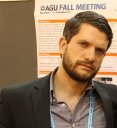
 Javier E. Santos
· 1 previous affiliation
- Los Alamos National LaboratorySince 2021
- Postdoc · Since 2021
Research Overview
Javier E. Santos focuses on physics-informed machine learning, generative modeling for scientific data, and the evaluation of large language models on complex reasoning tasks. His trajectory spans from developing neural surrogate models for fluid flow in porous media to pioneering discrete diffusion frameworks that enforce physical constraints like mass conservation. Most recently, his work investigates multimodal foundation models for geophysics and algorithmic reasoning benchmarks for language models.
Research Trajectory
Santos’s early research focused heavily on accelerating physical simulations and modeling complex fluid dynamics. In 2020, he introduced Modeling nanoconfinement effects using active learning, a physics-based surrogate model that predicts gas adsorption in shale nanopores significantly faster than traditional molecular dynamics. By employing an active learning workflow, this work achieved high-fidelity results with minimal training data, contributing to the broader area of Bridging the Dimensionality Gap in Physical Modeling. He expanded on this multiscale approach by developing MS-Net in Multi-Scale Neural Networks for to Fluid Flow in 3D Porous Media (2021). This hierarchical architecture overcame the memory bottlenecks typical of 3D convolutional networks, enabling the rapid prediction of fluid flow through highly heterogeneous domains like fractured rocks.
In 2023, his research expanded into generative modeling and advanced field reconstruction techniques. He developed Blackout Diffusion: Generative Diffusion Models in Discrete-State Spaces, providing a rigorous theoretical framework for diffusion in discrete spaces. By utilizing exact Markov process analysis rather than variational approximations, the model demonstrated that high-quality generative modeling could be achieved through a "pure-death" forward process without relying on Gaussian noise. Concurrently, he introduced a novel attention-based architecture in Development of the Senseiver for efficient field reconstruction from sparse observations, designed to reconstruct continuous physical fields from limited sensor data.
Throughout 2024, Santos scaled these predictive and reconstructive methods across diverse scientific domains. He continued advancing porous media simulations with Learning a general model of single phase flow in complex 3D porous media, leveraging massive synthetic datasets to achieve state-of-the-art predictions for fluid flow across varying scales. He also participated in the creation of a large-scale multimodal transformer architecture in Developing a Foundation Model for Predicting Material Failure, which utilized language model embeddings to predict failure across diverse materials. Building on his earlier Senseiver work, his research group explored optimal data acquisition strategies in Journey over destination: dynamic sensor placement enhances generalization. They further applied these attention-based networks to geophysics in Machine learned reconstruction of tsunami dynamics from sparse observations. By treating sensor locations as features rather than fixed grid points, the model significantly reduced errors in predicting wave height and arrival time, advancing the research direction of Topographical Priors for Physically Consistent Geospatial Modeling. Additionally, he collaborated on applying retrieval-augmented generation to programming tasks in Enhancing Code Translation in Language Models with Few-Shot Learning via Retrieval-Augmented Generation, intersecting with research areas such as Automated Migration of Legacy Scientific Codebases and The Emergent Reasoning Threshold in Language Models.
In 2025, Santos’s work on generative models yielded Discrete Spatial Diffusion: Intensity-Preserving Diffusion Modeling. This framework treats image intensity as discrete particles to enforce strict mass conservation, a non-negotiable requirement for generating physically consistent scientific data like battery electrodes. He also participated in theoretical evaluations of diffusion mechanisms in Are We Really Learning the Score Function? Reinterpreting Diffusion Models Through Wasserstein Gradient Flow Matching, which reframes the generative process as flow matching rather than traditional score function learning. In the geosciences, he contributed to The Transparent Earth: A Multimodal Foundation Model for the Earth's Subsurface, fusing diverse geophysical data types to predict complex subsurface properties.
His recent focus has also encompassed the rigorous evaluation of large language and vision models. He led the development of a novel benchmark in Benchmarking Large Language Models with Integer Sequence Generation Tasks, evaluating algorithmic reasoning capabilities and contributing to the study of The Divergence of Human and Machine Task Complexity and Difficulty-Adaptive Test-Time Scaling for Reasoning Models. Finally, he directed research on PatchFinder: Leveraging Visual Language Models for Accurate Information Retrieval Using Model Uncertainty, an algorithm that intelligently partitions scanned documents to extract information from historical records with high accuracy.
Current Directions
The most recent papers in the evidence address three primary themes: physically constrained generative modeling, multimodal foundation models for the physical sciences, and the rigorous evaluation of large language and vision models. Work in generative modeling focuses on discrete diffusion processes that strictly preserve physical invariants, such as mass conservation, which are critical for scientific applications. Concurrently, research in foundation models investigates how fusing heterogeneous data modalities can scale to predict complex geophysical and material properties. Finally, recent efforts explore the reasoning capabilities of foundation models, developing benchmarks to test algorithmic generation in LLMs and leveraging model uncertainty in Vision Language Models to improve information retrieval from noisy visual data.
Profile updated
Loading new papers…
Other researchers whose papers cluster into the same research directions — a proxy for overlapping technical interests and shared intellectual neighborhoods.
See something wrong? Report a mistake