

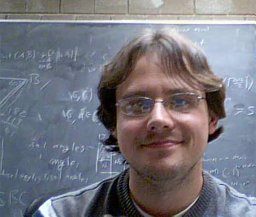
 Jason Rute
· 9 previous affiliations
- IBM Research - ZurichSince 2021
- Postdoc · Since 2021
- Mistral AI (France)Since 2025
- AI Scientist · Since 2025
- IBM2021–2023
- Postdoctoral Researcher – MIT-IBM Watson AI Lab · 2021–2023
- CiBO Technologies2018–2021
- Lead Data Scientist · 2019–2021
- Data Scientist · 2018–2019
- Insight Data Science2018
- Data Science Fellow · 2018
- Signet Education2017–2018
- Tutor · 2017–2018
- Pennsylvania State University2013–2017
- Postdoc · 2013–2017
- Carnegie Mellon University2008–2013
- PhD student · 2008–2013
- University of Wisconsin–Madison1999–2004
- Bachelor of Science (B.S.), Mechanical Engineering, Mathematics, Philosophy · 1999–2004
Research Overview
Jason Rute focuses on algorithmic randomness, computable analysis, and automated theorem proving. His early work established robust definitions of randomness for arbitrary probability spaces and explored the intersection of constructive measure theory with classical analysis. More recently, his research has shifted toward teaching artificial intelligence systems to reason, utilizing large language models and graph neural networks to advance formal mathematics and interactive theorem proving.
Research Trajectory
Jason Rute’s research trajectory is characterized by a distinct shift from pure mathematics and theoretical computer science to applied artificial intelligence and automated reasoning. His early work concentrated on the foundations of algorithmic information theory, specifically extending notions of randomness beyond simple binary sequences to more complex mathematical structures.
In the mid-2010s, Rute made foundational contributions to the research direction Algorithmic Randomness on General Computable Probability Spaces. A central challenge in this domain was defining what it means for an output to be random in continuous spaces or manifolds. In his first-author paper Computable randomness and betting for computable probability spaces, he bridged a long-standing gap by extending the definition of computable randomness to arbitrary computable probability spaces. Using a novel cell decomposition method, he demonstrated that generalized betting strategies in these spaces collapse into the well-known category of Martin-Löf randomness. He continued to refine these theoretical frameworks, addressing noncomputable probability measures in Schnorr randomness for noncomputable measures. This work proved that Schnorr randomness preserves core properties like Van Lambalgen’s Theorem under measure-preserving maps, contributing significantly to themes such as Algorithmic Randomness for Classical Analysis and the broader area of Algorithmic Randomness in Computable Metric Spaces.
By the early 2020s, Rute—who is currently an AI researcher at Mistral AI and was formerly at IBM Research—transitioned his focus toward machine learning, specifically targeting the intersection of language models and formal mathematics. A major bottleneck in automated theorem proving has historically been the scarcity of labeled data. As the first author of Proof Artifact Co-training for Theorem Proving with Language Models, Rute introduced the Proof Artifact Co-Training (PACT) methodology. By extracting self-supervised data from low-level proof terms generated by computer kernels, this approach allowed Transformer models to be co-trained on auxiliary tasks, substantially improving the success rate of neural theorem provers in the Lean interactive assistant.
Building on this integration of neural networks and formal logic, Rute subsequently led the development of new architectures capable of understanding mathematical concepts dynamically. In Graph2Tac: Learning Hierarchical Representations of Math Concepts in Theorem proving, he and his collaborators proposed a system that represents mathematics as a hierarchical graph. Utilizing online representation learning, Graph2Tac enables AI systems to process and prove theorems in entirely new libraries without requiring offline retraining, outperforming traditional static models.
Most recently, Rute has also participated in large-scale, collaborative AI engineering efforts. As a contributing middle author on Voxtral Realtime, he was part of a large research team that developed a natively streaming automatic speech recognition model utilizing delay-conditioning mechanisms to achieve offline-level transcription quality with sub-second latency.
Current Directions
The most recent papers in the evidence indicate a dual focus on advanced automated reasoning and large-scale neural network architectures. A primary current direction involves online representation learning for formal mathematics. Rather than relying on static models trained on fixed libraries, recent work investigates how graph neural networks and k-nearest neighbor approaches can be combined to allow AI theorem solvers to dynamically understand new mathematical definitions and proof styles as they are created. Additionally, recent collaborative work addresses the optimization of large-scale, real-time machine learning systems, exploring novel conditioning mechanisms to minimize latency in streaming architectures.
Profile updated
| Title | Venue | Year |
|---|---|---|
| Timestral | arXiv | 2026 |
| Ministral 3 | arXiv | 2026 |
| Voxtral TTS | arXiv | 2026 |
| Shieldstral | arXiv | 2026 |
| Voxtral Realtime | Open | 2026 |
| Robostral Navigate | arXiv | 2026 |
| Devstral: Fine-tuning Language Models for Coding Agent Applications | arXiv | 2025 |
| Graph2Tac: Online Representation Learning of Formal Math Concepts | ICML | 2024 |
| Proof Artifact Co-Training for Theorem Proving with Language Models | ICLR | 2022 |
| On the close interaction between algorithmic randomness and constructive/computable measure theory | arXiv | 2018 |
Loading new papers…
Other researchers whose papers cluster into the same research directions — a proxy for overlapping technical interests and shared intellectual neighborhoods.
See something wrong? Report a mistake