

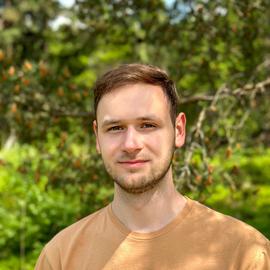
 Jan Hagnberger
· 5 previous affiliations
- LuminarySince 2026
- AI Research Intern · Since 2026
- University of Stuttgart2019–2026
- Scientific Assistant in the Machine Learning and Simulation Lab (MLS) · 2023–2026
- Master of Science - MSc, Data Science and Artificial Intelligence · 2024–2026
- Bachelor of Science - BSc, Software Engineering · 2019–2024
- Fraunhofer Institute for Building Physics2021–2023
- Working Student · 2021–2023
- ARBURG GmbH + Co KG2018
- Summer Job in Powder-Coating Department · 2018
- Die BruderhausDiakonie2016
- Internship in Geriatric Care · 2016
Research Overview
Jan Hagnberger focuses on scientific machine learning, deep learning, and the development of neural surrogate models for solving partial differential equations. His work explores the intersection of numerical analysis and artificial intelligence, utilizing transformer architectures and continuous representations to model complex physical phenomena. His current research addresses scalable, mesh-free simulations for fluid dynamics and aerodynamics.
Research Trajectory
The trajectory of Jan Hagnberger’s research centers on advancing neural surrogate models to solve time-dependent partial differential equations (PDEs) more efficiently and flexibly than traditional numerical methods. His early work in 2024 focused on integrating continuous spatial representations with sequence modeling. He introduced Vectorized Conditional Neural Fields: A Framework for Solving Time-dependent Parametric Partial Differential Equations, an architecture that processes multiple spatio-temporal query points in parallel. By explicitly modeling physical dependencies via attention mechanisms, this framework enables zero-shot super-resolution across 1D, 2D, and 3D systems. This contribution advanced the research direction of Resolution Invariant Neural Operators for Continuous Physical Systems and supported the broader area of Generalizing Neural Simulators to Unseen Physical Regimes. The methodology also intersected with areas such as Linear Complexity Attention for Sequence Modeling and the research direction of Generative Modeling in Function Spaces for Infinite Resolution.
In 2025, his focus expanded to improving the computational and memory efficiency of PDE solvers, particularly when dealing with irregular grids. He developed CALM-PDE: Continuous and Adaptive Convolutions for Latent Space Modeling of Time-dependent PDEs. This model compresses physical dynamics into an efficient latent space using continuous convolutions with learnable, adaptive query points. The approach significantly reduced the memory overhead typically associated with transformer-based models while maintaining strong performance in fluid dynamics simulations. This work aligns closely with the area of Neural Operators for Fast Partial Differential Equation Simulation and addresses challenges related to the research direction of Spectral Bias in Neural Physical Solvers.
Building upon these continuous and adaptive representations, his 2026 research tackles the challenge of high-fidelity 3D aerodynamic simulations without relying on traditional computational meshes. He presented SMART: Scalable Mesh‑free Aerodynamic Simulations from Raw Geometries using a Transformer‑based Surrogate Model. Operating directly on raw point clouds, the SMART architecture couples geometric and physical representations across its layers. This design matches the accuracy of state-of-the-art mesh-dependent models while offering substantial improvements in scalability and memory efficiency, further solidifying his contributions to discretization-agnostic physical modeling.
Current Directions
The most recent papers in the evidence indicate a strong focus on scalable, mesh-free neural architectures for complex physical simulations. Recent work investigates how transformer-based surrogate models can operate directly on raw geometric data, such as point clouds, to perform high-fidelity aerodynamic and fluid dynamics simulations without the need for expensive, traditional computational meshes. A central theme in this ongoing research is the development of continuous, discretization-agnostic representations that improve memory efficiency, computational speed, and robust generalization to unseen physical parameters across irregular domains.
Profile updated
Loading new papers…
Other researchers whose papers cluster into the same research directions — a proxy for overlapping technical interests and shared intellectual neighborhoods.
See something wrong? Report a mistake