

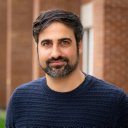
 Ivor J A Simpson
· 4 previous affiliations
- University of SussexSince 2020
- Associate Professor · Since 2022
- Assistant Professor · 2020–2022
- Anthropics Technology Ltd2014–2020
- Researcher · 2014–2020
- University College London2012–2014
- Postdoc · 2012–2014
- University of Oxford2008–2012
- PhD student · 2008–2012
Research Overview
Ivor J A Simpson focuses on probabilistic modeling, uncertainty quantification, and generative architectures for medical image analysis and computer vision. His trajectory spans early foundational work in non-rigid registration uncertainty to recent advances in structured Gaussian approximations and implicit neural representations. Currently, he investigates the theoretical dynamics of deep image regression and Bayesian approaches to longitudinal MRI reconstruction.
Research Trajectory
Simpson’s early research addressed the critical challenge of spatial uncertainty in medical image analysis. He introduced methods to incorporate non-rigid registration uncertainty into spatially normalized statistics, as detailed in Longitudinal Brain MRI Analysis with Uncertain Registration. Recognizing that fixed regularization often fails to account for varying signal-to-noise ratios, he developed probabilistic frameworks to infer optimal regularization levels directly from the data (Probabilistic inference of regularisation in non-rigid registration). This probabilistic approach was subsequently extended to improve statistical prediction through ensemble learning (Ensemble Learning Incorporating Uncertain Registration) and to infer spatially varying regularization using full Bayesian inference (Probabilistic non-linear registration with spatially adaptive regularisation).
Transitioning into deep generative models, his focus expanded to architectures capable of producing sharper, more structured outputs. He guided the development of a hierarchical variational autoencoder (VAE) conditioned on coarser levels to improve image sharpness (Laplacian Pyramid of Conditional Variational Autoencoders). A major theme during this period was moving beyond the assumption of independent pixel uncertainty. He oversaw the creation of networks that predict full Gaussian covariance matrices for synthesized images (Structured Uncertainty Prediction Networks), contributing to the research direction of Denoising through Projection onto the Data Manifold. This structured approach was also integrated directly into VAE training to model residual correlations (Training VAEs Under Structured Residuals). In the domain of generative adversarial networks (GANs), he led work on semantic attribute editing using smooth warp fields trained on unpaired data (The GAN That Warped: Semantic Attribute Editing With Unpaired Data), advancing areas such as Image Synthesis by Relocating Existing Pixels and Resolving Occlusion Holes in Flow Based Video Synthesis.
Returning to medical imaging with advanced deep learning tools, Simpson developed generative models utilizing Rician distributions to correct motion in extremely noisy MRI data (Motion Correction in low SNR MRI using an approximate Rician log-likelihood). He also continued his focus on uncertainty quantification by proposing sparse-structured multivariate Gaussians to approximate the outputs of probabilistic ensemble models (Learning Structured Gaussians to Approximate Deep Ensembles), which intersects with the broader areas of Resource Constrained Uncertainty Estimation and Spatially Aware Inference for Image Restoration and Segmentation. In parallel, he applied flexible amortized variational inference to estimate brain oxygen metabolism parameters from qBOLD MRI (Flexible Amortized Variational Inference in qBOLD MRI).
Most recently, his research has expanded into the theoretical properties of neural networks and implicit representations. He directed research linking phase transitions in deep image regression to the Neural Tangent Kernel (NTK) for sinusoidal networks (A Closer Look at NTK Alignment: Linking Phase Transitions in Deep Image Regression), contributing to the theoretical area of Spectral Bias and the Frequency Principle in Neural Networks. He also oversaw the development of temporally parameterized neural displacement fields to model continuous longitudinal changes in brain morphology (Capturing Longitudinal Changes in Brain Morphology Using Temporally Parameterized Neural Displacement Fields.). Additionally, he collaborated on hierarchical Bayesian approaches for complex-valued MRI reconstruction using learned structured uncertainty distributions (Bayesian MRI Reconstruction with Structured Uncertainty Distributions).
Current Directions
The most recent work in the evidence addresses the intersection of implicit neural representations, theoretical network dynamics, and advanced Bayesian inference for medical imaging. A primary focus is the application of temporally parameterized neural displacement fields to capture continuous, biologically plausible changes in brain morphology over time. Concurrently, ongoing research investigates the theoretical underpinnings of deep image regression, specifically how the Neural Tangent Kernel aligns with image features during distinct phases of training. Furthermore, there is a continued emphasis on probabilistic MRI reconstruction, leveraging variational autoencoders and sparse precision matrices to model complex, structured uncertainty distributions in clinical data.
Profile updated
Loading new papers…
Other researchers whose papers cluster into the same research directions — a proxy for overlapping technical interests and shared intellectual neighborhoods.
See something wrong? Report a mistake