

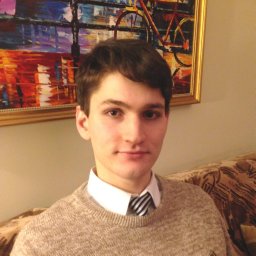
 Isay Katsman
· 7 previous affiliations
- Yale UniversityCurrent
- Current
- PhD student · 2022–2026
- PhD Intern · 2025
- Cornell University2020–2022
- Master of Science - MS, Computer Science · 2020–2022
- Cornell Tech2016–2022
- MS student · 2020–2022
- Undergrad student · 2016–2020
- DRW2021
- Quantitative Research Intern · 2021
- Cornell University Artificial Intelligence2018–2020
- Co President · 2018–2020
- Research Intern · 2018
Research Overview
Isay Katsman focuses on geometric deep learning, generative modeling on manifolds, and the rigorous evaluation of graph neural networks. His early work explored adversarial robustness and continuous-time dynamics in non-Euclidean spaces, establishing foundational techniques for manifold-aware neural architectures. Currently, he investigates zero-parameter sampling methods for compact manifolds and addresses fundamental benchmarking flaws in graph machine learning.
Research Trajectory
Katsman’s early research investigated the vulnerabilities of deep learning models, specifically focusing on adversarial robustness. With collaborators, he developed generative models for creating adversarial examples in Generative Adversarial Perturbations. This work introduced trainable deep neural networks capable of producing both image-agnostic and image-dependent perturbations, demonstrating that a unified architecture could effectively evaluate both classification and semantic segmentation models without relying on hand-crafted attack methods.
Following this work in computer vision and security, Katsman’s focus shifted toward geometric deep learning, where he began adapting Euclidean neural network constructions to better conform to the intrinsic geometry of complex data. He introduced methods for extending classical deep learning operations to Riemannian manifolds in Differentiating through the Fréchet Mean. By formalizing the differentiation of the Fréchet mean, this work provided a crucial building block for deep representation learning, contributing significantly to the area of The Limits of Tangent Space Linearization on Curved Manifolds and the related research direction of Batch Normalization on Riemannian Manifolds.
Continuing his exploration of non-Euclidean spaces, Katsman collaborated on extending continuous-time dynamics to manifolds in Neural Manifold Ordinary Differential Equations. This research generalized Neural ODEs to construct Manifold Continuous Normalizing Flows (MCNFs). Because MCNFs require only local geometry, they generalize to arbitrary manifolds without the need for cumbersome, manifold-by-manifold layer design, advancing the broader area of Representation Learning in Mixed Curvature Riemannian Spaces. He subsequently addressed the critical role of symmetries in manifold distributions in Equivariant Manifold Flows. This paper laid the theoretical foundations for learning symmetry-invariant distributions on arbitrary manifolds, demonstrating its utility by learning invariant SU(n) densities motivated by quantum field theory. This work was a key contribution to the research direction of Geometric Normalizing Flows on Non-Euclidean Manifolds.
Building on these foundational geometric techniques, Katsman developed Riemannian Residual Neural Networks, a geometrically principled framework that generalizes ResNets to arbitrary Riemannian manifolds. By utilizing learned vector fields and Riemannian exponential maps, he created a unified architecture that improved upon existing manifold-specific networks across diverse tasks, including hyperbolic graph datasets and symmetric positive definite (SPD) matrix applications. This significantly advanced the area of Generalizing Machine Learning to Arbitrary Riemannian Manifolds.
More recently, Katsman has turned his attention to the rigorous evaluation of graph neural networks (GNNs) and the datasets used to benchmark them. In Revisiting the Necessity of Graph Learning and Common Graph Benchmarks, he exposed pervasive feature leakage in standard graph datasets, demonstrating that a well-tuned Multi-Layer Perceptron (MLP) can often match or exceed the performance of state-of-the-art GNNs. He advocated for more rigorous synthetic and real-world benchmarks where graph structure is demonstrably necessary. He continued this critical evaluation in Shedding Light on Problems with Hyperbolic Graph Learning, which revealed that simple Euclidean models frequently outperform complex hyperbolic ones on standard benchmarks. By tracing these discrepancies to buggy baselines, coarse geometric metrics, and tasks that do not inherently require graph information, he provided a new synthetic framework to identify when hyperbolic methods truly offer an advantage. Together, these papers heavily shape the research direction concerning The Redundancy of Topology in Graph Learning Benchmarks.
In his most recent work, Katsman has revisited the challenge of modeling distributions over manifolds. He introduced Harmonic Sampling: Zero-Parameter Flows on Compact Manifolds, which addresses the computational expense and instability of training manifold continuous normalizing flows. By projecting target densities onto the manifold's harmonic basis (its eigenfunctions), this zero-parameter framework bypasses the traditional optimization and likelihood maximization paradigms entirely, offering a robust sampling method for applications ranging from directional statistics to lattice quantum field theory.
Current Directions
The most recent papers in the evidence indicate two primary ongoing research directions. First, Katsman is actively investigating the methodological rigor of graph machine learning. This involves auditing standard benchmarks, exposing feature leakage, and developing synthetic frameworks to determine when complex topological or non-Euclidean models (such as hyperbolic GNNs) are genuinely necessary compared to simpler, well-tuned Euclidean baselines.
Second, his work continues to advance generative modeling and sampling on compact Riemannian manifolds. Rather than relying on traditional, optimization-heavy continuous normalizing flows, recent work explores zero-parameter, flow-based sampling frameworks. By leveraging the intrinsic harmonic bases of manifolds, this direction seeks to provide stable, optimization-free methods for sampling complex probability distributions in the natural sciences.
Profile updated
Loading new papers…
Other researchers whose papers cluster into the same research directions — a proxy for overlapping technical interests and shared intellectual neighborhoods.
See something wrong? Report a mistake