

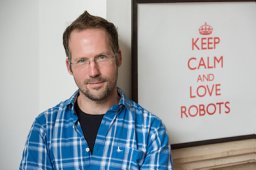
 Ingmar Posner
· 4 previous affiliations
- Oxa (prev. Oxbotica Ltd.)Since 2014
- Founder · Since 2014
- University of OxfordSince 2011
- Associate Head of Department (Research) · Since 2025
- Full Professor · Since 2018
- Associate Professor in Engineering Science (Information Engineering) and Fellow of Pembroke College · 2011–2018
- DPhil, Engineering · 2001–2005
- Amazon (United States)Since 2021
- Principal Researcher · Since 2021
- Aston University1997–2001
- MEng, Electronic Systems Engineering · 1997–2001
Research Overview
Ingmar Posner focuses on robot learning, object-centric representations, and 3D scene understanding. His early work addressed active perception and efficient spatial representations for mobile robots navigating complex environments. More recently, his research emphasizes the development of modular world models and causal representation learning to enable sample-efficient, generalizable robotic control.
Research Trajectory
His early research concentrated on spatial representations and active perception for mobile robotics. He introduced Efficient Non-Parametric Surface Representations Using Active Sampling for Push Broom Laser Data, a method utilizing Gaussian Processes and information-theoretic active sampling to compress large 3D laser point clouds into continuous surface representations in real-time. He also participated in developing frameworks for the research direction of Cost Aware Active Perception for Mobile Robots, contributing to Active Exploration for Robust Object Detection, which weighed the informational benefits of moving to new vantage points against the physical costs of navigation.
Transitioning toward deep learning for perception and control, his work explored how neural networks could learn complex behaviors directly from data. He developed Deep Inverse Reinforcement Learning, integrating maximum entropy paradigms with fully convolutional networks to learn nonlinear reward functions from expert demonstrations. In Deep Tracking: Seeing Beyond Seeing Using Recurrent Neural Networks, he framed object tracking as an end-to-end deep learning task, mapping raw sensor inputs to object tracks even under occlusion. To handle native 3D data efficiently, his lab proposed Vote3Deep: Fast object detection in 3D point clouds using efficient convolutional neural networks, which leveraged feature-centric voting and sparsity regularization to achieve high accuracy without relying on computationally expensive dense 3D grids.
In the late 2010s, he investigated how agents acquire and utilize physical intuition, participating in the creation of ShapeStacks: Learning Vision-Based Physical Intuition for Generalised Object Stacking, a simulation dataset designed for stability prediction. Concurrently, he addressed complex control problems by decomposing them into simpler sub-tasks, as detailed in TACO: Learning Task Decomposition via Temporal Alignment for Control.
A major theme in his subsequent trajectory is the development of object-centric and causal world models. He introduced GENESIS: Generative Scene Inference and Sampling with Object-Centric Latent Representations, an autoregressive model capable of decomposing 3D scenes and sampling coherent new ones, advancing the broader area of Dynamic Slot Allocation for Object Centric Learning. His research then expanded into causal representation learning to enable fast, modular adaptation in robotics, resulting in Variational Causal Dynamics: Discovering Modular World Models from Interventions. This work identifies reusable components across environments, contributing to the area of Causal Discovery in Non-Stationary Environments. This modular approach was further refined in Compete and Compose: Learning Independent Mechanisms for Modular World Models, which separates the learning of interaction rules from their composition to improve sample efficiency and interpretability.
His recent work continues to push the boundaries of world models and robotic manipulation. He designed SPARTAN: A Sparse Transformer World Model Attending to What Matters, a model that discovers context-dependent causal relationships between objects, aligning with the research direction of Sparsity Driven Identifiability in Causal Representation Learning. To tackle challenging robotic control tasks, his group presented COMBO-Grasp: Learning Constraint-Based Manipulation for Bimanual Occluded Grasping, which coordinates stabilizing and grasping policies to handle environmental constraints, contributing to the area of Zero-Shot Sim-to-Real Transfer for Robotic Control. For deformable objects, he proposed D-Cubed: Latent Diffusion Trajectory Optimisation for Dexterous Deformable Manipulation, utilizing a latent diffusion model pre-trained on task-agnostic play data. Language conditioning was integrated into multi-task imitation learning through LUMOS: Language-Conditioned Imitation Learning with World Models, which mitigates policy-induced distribution shifts by learning in the latent space of a world model.
Finally, his recent theoretical and foundational contributions include participating in Posterior Sampling Reinforcement Learning with Gaussian Processes for Continuous Control: Sublinear Regret Bounds for Unbounded State Spaces, establishing near-optimal Bayesian regret bounds for continuous control tasks. Furthermore, his work demonstrated that underlying physical parameters can be uniquely disentangled from raw trajectory data using mechanism sparsity in Disentangling Dynamical Systems: Causal Representation Learning Meets Local Sparse Attention.
Current Directions
Recent work investigates the intersection of causal representation learning, modular world models, and advanced robotic manipulation. The most recent papers in the evidence address how robots can learn robust, generalizable skills in complex, unstructured environments. A major focus is on enforcing mechanism sparsity to disentangle underlying physical parameters from raw trajectory data, allowing models to discover context-dependent causal relationships without predefined equations. In robotic control, current research explores latent diffusion models for dexterous manipulation of deformable objects and language-conditioned imitation learning that mitigates distribution shifts by operating within the latent space of learned world models. Additionally, his work continues to advance the broader area of Compressing Trajectories into Continuous Latent Action Spaces, enabling more sample-efficient and adaptable continuous control in high-dimensional state spaces.
Profile updated
Loading new papers…
Other researchers whose papers cluster into the same research directions — a proxy for overlapping technical interests and shared intellectual neighborhoods.
See something wrong? Report a mistake