

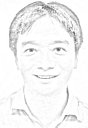
 Hui Ji
· 1 previous affiliation
- National University of SingaporeSince 2023
- Full Professor · Since 2023
Research Overview
Hui Ji focuses on computational vision, imaging sciences, and deep learning, with a particular emphasis on solving ill-posed inverse problems such as image restoration and reconstruction. His trajectory spans from early mathematical frameworks using wavelet and framelet systems to recent innovations in self-supervised and physics-informed neural networks. Currently, his work addresses ground-truth-free image recovery, tackling complex real-world degradation through zero-shot learning and deep unrolling techniques.
Research Trajectory
Hui Ji’s early research concentrated on mathematical and algorithmic frameworks for image restoration, particularly in the broader area of Resolving Kernel Image Ambiguity in Blind Deblurring. He participated in developing methods to recover clear images from motion blur caused by camera shake, a classic inverse problem in digital imaging. This work included Blind motion deblurring from a single image using sparse approximation (2009), which formulated blind blurring as a joint optimization problem that simultaneously maximized the sparsity of the blur kernel and the clear image under redundant tight frame systems, such as curvelets and framelets. Building on these mathematical foundations, he subsequently contributed to Framelet-Based Blind Motion Deblurring From a Single Image (2012), which applied an adapted split Bregman method to efficiently solve the regularization of sparsity under tight wavelet frames.
As deep learning emerged as a dominant paradigm for computer vision, his focus shifted toward mitigating the heavy reliance of neural networks on large, paired datasets of clean and degraded images. In 2020, he advanced the research direction of Self-Ensembling through Multi-Shot Stochastic Inference by developing dataset-free approaches to image recovery. He introduced Self-supervised Bayesian Deep Learning for Image Recovery with Applications to Compressive Sensing (2020), which trained a Bayesian network with random weights to predict target images with uncertainty, thereby reducing mean squared error through ensemble averaging. In the same year, he proposed Self2Self With Dropout: Learning Self-Supervised Denoising From Single Image, a method that trained a denoising network exclusively on the input noisy image by leveraging dropout on Bernoulli-sampled instances. Continuing this trajectory into the area of Self-Supervised Denoising via Statistical Independence, his group addressed the overfitting challenges inherent in unsupervised learning with Recorrupted-to-Recorrupted: Unsupervised Deep Learning for Image Denoising (2021), introducing a novel data augmentation technique that operates without ground-truth images.
Between 2022 and 2024, he expanded these unsupervised and self-supervised paradigms to more complex physical imaging systems, making significant contributions to the research direction of Deep Algorithm Unrolling for Computational Image Reconstruction. He developed Augmented Deep Unrolling Networks for Snapshot Compressive Hyperspectral Imaging (2022), which unrolled a proximal gradient descent algorithm and incorporated a memory-assistant descent module alongside cross-stage self-attention to exploit the inherent self-similarities of hyperspectral images. This architecture was further refined in Enhanced deep unrolling networks for snapshot compressive hyperspectral imaging (2024). In parallel, his work in Hybrid Physics-Based Deep Learning for Image Restoration included Ground-Truth Free Meta-Learning for Deep Compressive Sampling (2023). This method combined external meta-learning on compressive sampling measurements with internal, sample-specific adaptation guided by an improved Stein's unbiased risk estimator. He also advanced the area of Self-Supervised Medical Image Reconstruction without Ground Truth via Siamese Cooperative Learning for Unsupervised Image Reconstruction From Incomplete Measurements (2024), utilizing twin sub-networks that perform reconstruction cooperatively across complementary null and range spaces.
His group has consistently adapted these unsupervised techniques to diverse and specialized domains. For video processing, he introduced Unsupervised Deep Video Denoising with Untrained Network (2023), which employed a temporal attention mechanism and an unsupervised loss function acting as an unbiased estimator of its supervised counterpart. In scientific imaging, he tackled phase unwrapping with Unsupervised Deep Unrolling Networks for Phase Unwrapping (2024), leveraging a recorruption-based self-reconstruction loss in the gradient domain to handle sparse outliers. Other domain-specific innovations include Enhancing Underwater Images via Asymmetric Multi-Scale Invertible Networks (2024), which framed underwater enhancement as a regularized image decomposition problem, and Text-Guided Portrait Image Matting (2024), which utilized semantic textual descriptions rather than traditional trimaps to guide alpha matte estimation.
Most recently, his research has focused heavily on real-world degradation, where noise is spatially correlated and spatially variant. Addressing these challenges, he developed Pseudo-Siamese Blind-spot Transformers for Self-Supervised Real-World Denoising (2024), a transformer-based approach that operates directly on single noisy images without clean targets. He also explored continuous coordinate-based implicit neural representations in Cross-Scale Self-Supervised Blind Image Deblurring via Implicit Neural Representation (2024), enforcing mathematical cross-scale consistency to bypass the need for sharp ground truths. Pushing the boundaries of zero-shot image restoration, he introduced Zero-Shot Blind-Spot Image Denoising via Cross-Scale Non-Local Pixel Refilling (2025), a method that suppresses correlated noise by refilling masked pixels with distant, structurally similar pixels found across different image scales. Looking ahead, his work continues to integrate physical models with neural architectures, as demonstrated by his recent investigation into Deep intrinsic image decomposition via physics-aware neural networks (2026).
Current Directions
The most recent papers in the evidence address the challenge of real-world image restoration in scenarios where clean ground-truth data is entirely unavailable. Recent work investigates zero-shot and self-supervised denoising techniques, particularly focusing on how to handle spatially correlated noise in complex, real-world sensor data. This includes the development of cross-scale pixel refilling strategies and blind-spot transformer architectures that learn to denoise using only single, corrupted images. Additionally, ongoing research explores the deep integration of physical formation models with neural networks—such as deep unrolling networks and implicit neural representations—to solve highly ill-posed inverse problems like intrinsic image decomposition, phase unwrapping, and snapshot compressive hyperspectral imaging.
Profile updated
Loading new papers…
Other researchers whose papers cluster into the same research directions — a proxy for overlapping technical interests and shared intellectual neighborhoods.
See something wrong? Report a mistake