

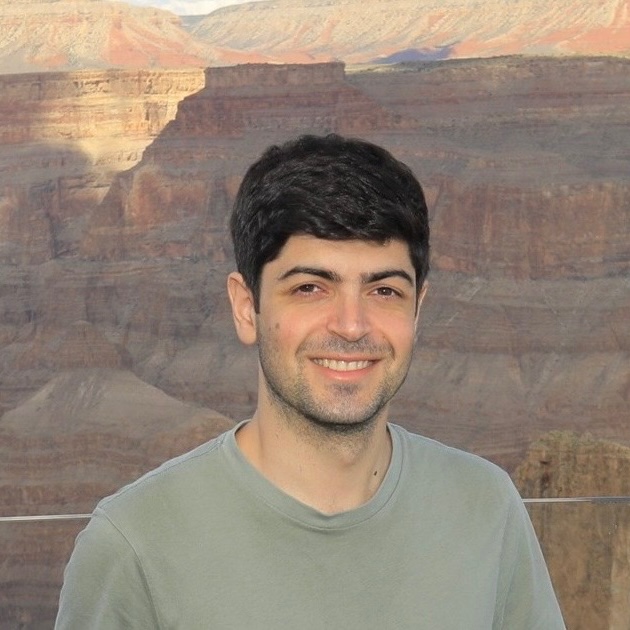
 Hrayr Harutyunyan
· 6 previous affiliations
- Google (United States)Since 2022
- Researcher · Since 2023
- Student Researcher · 2022
- Google DeepMind (United Kingdom)Since 2023
- Research Scientist · Since 2023
- University of Southern California2018–2023
- Doctor of Philosophy - PhD, Computer Science · 2018–2023
- PhD student · From 2018
- Applied Scientist Intern · 2020
- YerevaNN2016–2018
- Researcher · 2016–2018
- Yerevan State University2016–2018
- MS student · 2016–2018
Research Overview
Hrayr Harutyunyan focuses on information-theoretic generalization, representation learning, and the reasoning capabilities of sequence models. His early work explored latent factor models and the fundamental limits of neural network generalization through the lens of information theory. Recently, his research investigates in-context learning, long-context sequence modeling, and continuous reasoning architectures.
Research Trajectory
His early research spanned representation learning and applied machine learning for healthcare. In 2017, he contributed to the area of Disentangled Representation Learning with Correlated Latent Factors by exploring how to handle naturally correlated latent variables, demonstrating that synergy minimization could successfully separate features where traditional independence-based methods fail (Disentangled representations via synergy minimization). Concurrently, he developed standardized benchmark suites and specialized recurrent neural architectures for clinical time series data, establishing robust baselines for tasks like mortality prediction and phenotyping (Multitask Learning and Benchmarking with Clinical Time Series Data).
Moving into structured data and graphical models, he participated in research on Overcoming the Homophily Assumption in Graph Neural Networks, helping to identify the theoretical limitations of standard graph convolutional networks in learning general neighborhood mixing relationships (MixHop: Higher-Order Graph Convolutional Architectures via Sparsified Neighborhood Mixing). He also introduced a method for estimating graphical model structures from high-dimensional data, advancing the direction of Modular Latent Factor Models for High-Dimensional Systems. This work leveraged information-theoretic measures to encourage modular structures with linear stepwise complexity, avoiding the unrealistic sparsity priors of prior approaches (Fast structure learning with modular regularization.).
A major theme of his trajectory involves the intersection of information theory and deep learning generalization. He developed techniques to estimate the informativeness of individual training samples, contributing to the broader area of Gradient Sketching for Scalable Data Attribution by measuring how specific samples inform both the final weights and the computed function of a network (Estimating informativeness of samples with Smooth Unique Information). This theoretical foundation led to new information-theoretic generalization bounds for black-box learning algorithms that rely on prediction information rather than training algorithm outputs, making them applicable to deterministic algorithms (Information-theoretic generalization bounds for black-box learning algorithms). He further explored the formal limitations of these approaches, demonstrating that sample-wise information-theoretic bounds do not exist for expected squared generalization gaps, though pair-wise bounds remain viable (Formal limitations of sample-wise information-theoretic generalization bounds). Alongside this theoretical work, he investigated the failure modes of domain generalization algorithms, showing that enforcing domain invariance can sometimes backfire by degrading representation quality on new domains (Failure Modes of Domain Generalization Algorithms).
His research on representation robustness continued with methods to identify and isolate spurious shortcuts in pretrained image models. By employing specialized linear autoencoders, he advanced the direction of Statistical Independence Regularization via Kernel Measures to separate core features from entangled spurious ones, improving model reliability on worst-case scenarios (Identifying and Disentangling Spurious Features in Pretrained Image Representations). This body of work on how neural networks transform data into knowledge culminated in his dissertation, which formalized connections between memorization, generalization, and information theory, touching on areas like Generalization Bounds via Scalar Loss Projections (On information captured by neural networks: connections with memorization and generalization). Applying these insights to model compression, he proposed a theoretical framework based on "supervision complexity" to explain the generalization behavior of distilled student networks, justifying the utility of techniques like early stopping in knowledge distillation (Supervision Complexity and its Role in Knowledge Distillation).
Most recently, his focus has shifted toward the architecture and reasoning capabilities of sequence models. He addressed the recall limitations of State Space Models (SSMs) like Mamba by introducing "Mimetic Initialization," a compute-free technique that aligns SSM layers with linear attention at the start of training to significantly improve length generalization (Mimetic Initialization Helps State Space Models Learn to Recall). He also explored the robustness of large language models, demonstrating how to train in-context learners for classification tasks that resist spurious correlations (In-context learning in presence of spurious correlations). Expanding on reasoning architectures, he collaborated on frameworks that replace discrete token sampling with continuous-valued superpositions, enabling language models to explore multiple reasoning paths in parallel within a single forward pass (Continuous Chain of Thought Enables Parallel Exploration and Reasoning).
Current Directions
The most recent papers in the evidence address the architectural efficiency and reasoning capabilities of large language models and alternative sequence architectures. Recent work investigates how to improve the recall and length extrapolation of State Space Models through specialized initialization strategies that bridge the gap between SSMs and attention mechanisms. Additionally, current research explores the robustness of in-context learning against spurious correlations and the development of continuous latent representations that allow models to evaluate multiple reasoning paths in parallel, moving beyond the limitations of discrete token-by-token generation.
Profile updated
Loading new papers…
Other researchers whose papers cluster into the same research directions — a proxy for overlapping technical interests and shared intellectual neighborhoods.
See something wrong? Report a mistake