

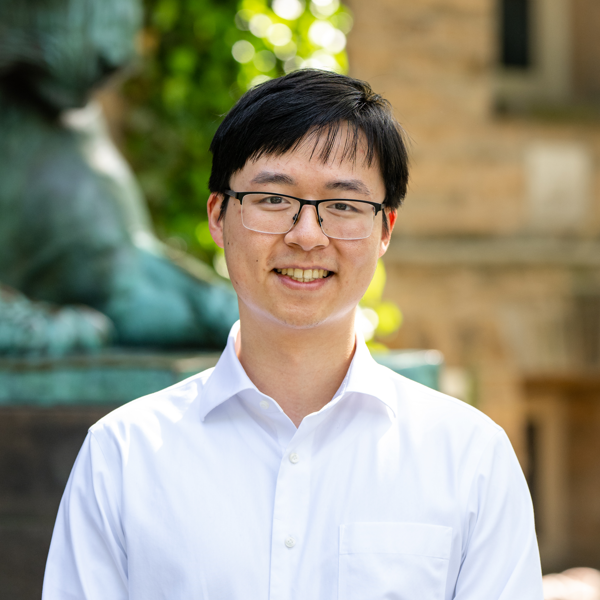
 Howard Yen
· 1 previous affiliation
- Princeton UniversitySince 2019
- PhD student · Since 2024
- MS student · 2023–2024
- Undergrad student · 2019–2023
Research Overview
Howard Yen focuses on long-context language modeling, reasoning-intensive retrieval, and the evaluation of complex agentic systems. His early work addressed grounded attribution and social simulation, evolving into a sustained focus on extending context windows and benchmarking long-form reasoning. Most recently, he investigates long-horizon agentic search and parallel scaling for complex research tasks.
Research Trajectory
Yen’s early research explored how language models can simulate human interactions and ground their outputs in verifiable evidence. In 2023, he introduced the Explore-Generate-Simulate (EGS) framework in Improving Interpersonal Communication by Simulating Audiences with Language Models. This system leverages language models as social simulators to generate diverse advice and anticipate the reactions of specific stakeholders, identifying communication strategies that outperform standard prompting techniques. Concurrently, he addressed the challenge of hallucination in information-seeking models by developing ALCE, a benchmark for evaluating end-to-end systems that retrieve evidence and generate citations. Detailed in Enabling Large Language Models to Generate Text with Citations, this work required models to process diverse questions and retrieval corpora, advancing the research direction of Automated Attribution Verification via Natural Language Inference.
In 2024, Yen’s focus shifted toward overcoming the architectural and training limitations associated with processing massive inputs. He developed the Context Expansion with Parallel Encoding (CEPE) framework in Long-Context Language Modeling with Parallel Context Encoding, a method designed to bypass the significant computational overhead typically required to extend context windows. Working with collaborators, he also conducted extensive empirical studies on continued pre-training and supervised fine-tuning for long-context capabilities. This research, presented in How to Train Long-Context Language Models (Effectively), established robust evaluation protocols using instruction data rather than simple perplexity metrics. It provided clear guidance on data mixing and contributed to the broader area of Staged Context Extension for Large Language Models.
By 2025, Yen’s work increasingly emphasized rigorous evaluation and the mechanics of reasoning over long contexts. He led the development of the HELMET benchmark in HELMET: How to Evaluate Long-context Models Effectively and Thoroughly, which spans seven diverse real-world application categories. The study demonstrated that popular synthetic tests, such as "Needle-in-a-Haystack," fail to predict actual performance on complex reasoning tasks. He further investigated the trade-offs of efficient inference methods, participating in a study on Reasoning-Focused Evaluation of Efficient Long-Context Inference Techniques. This work found that weight quantization often provides a superior memory-performance balance compared to KV cache eviction when tasks demand precise string retrieval. To address hallucination in constrained generation, he contributed to Precise Information Control in Long-Form Text Generation, introducing a training framework that forces models to rely strictly on provided claims and significantly improves generation faithfulness.
Alongside evaluation, Yen advanced the mechanics of retrieval for complex queries. He co-authored BRIGHT: A Realistic and Challenging Benchmark for Reasoning-Intensive Retrieval, which revealed significant performance drops in existing models when queries require multi-step logic rather than simple semantic matching. This benchmark highlighted the importance of the research direction Thought-Driven Retrieval for Complex Reasoning Tasks and the broader area of Reasoning Intensive Retrieval for Complex Queries. Digging into the internal mechanisms of these models, he also contributed to Query-Focused Retrieval Heads Improve Long-Context Reasoning and Re-ranking. This work identified specific attention heads responsible for information extraction by analyzing how they allocate attention mass relative to a specific query. The resulting QRRETRIEVER method advanced work in the areas of Internal Attention for Zero-Shot Document Ranking and Functional Specialization in Sparse Attention Heads.
In 2026, Yen’s trajectory expanded into long-horizon agentic search, addressing how autonomous systems navigate complex information environments over time. He introduced the Simple Lightweight Information Management (SLIM) framework in Lost in the Maze: Overcoming Context Limitations in Long- Horizon Agentic Search, which separates search from browsing and periodically summarizes interaction history to prevent agents from losing context during deep research. Additionally, he collaborated on Agentic Aggregation for Parallel Scaling of Long-Horizon Agentic Tasks, proposing the AggAgent system. This approach treats parallel trajectories as a searchable environment, using an aggregator agent to verify and synthesize final answers from multiple independent rollouts.
Current Directions
The most recent papers in the evidence indicate a strong focus on long-horizon agentic search and the parallel scaling of autonomous systems. Yen’s current work investigates how AI agents can navigate complex, multi-step research tasks without losing context or succumbing to the limitations of massive interaction histories. This involves developing lightweight information management frameworks that decouple search from browsing to reduce unnecessary tool calls and computational costs. Furthermore, he is exploring methods for parallel test-time scaling in agentic workflows, designing aggregator agents capable of synthesizing insights from multiple independent rollouts. Broadly, these directions aim to make autonomous web research more efficient, reliable, and scalable for complex problem-solving.
Profile updated
Loading new papers…
Other researchers whose papers cluster into the same research directions — a proxy for overlapping technical interests and shared intellectual neighborhoods.
See something wrong? Report a mistake