

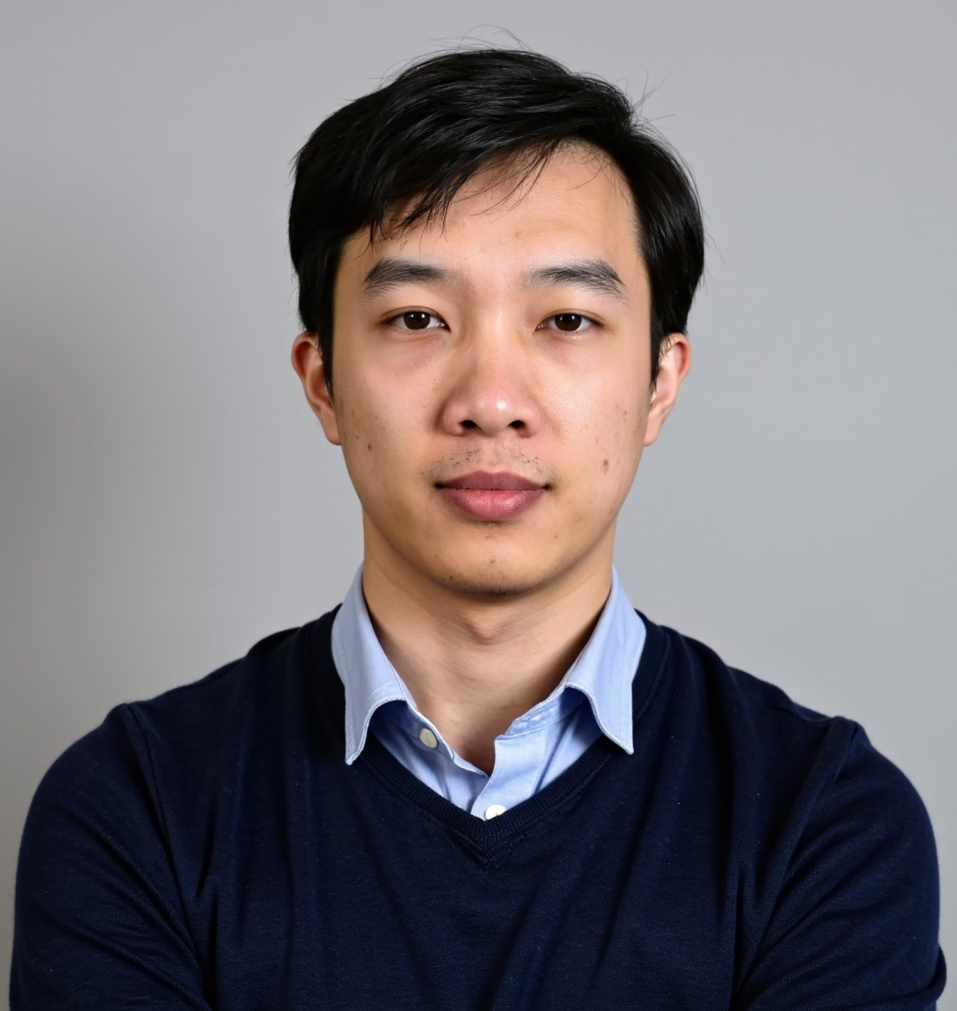
 Hieu Le
· 4 previous affiliations
- Assistant Professor · Since 2025
- Postdoc · 2023–2025
- Amazon (United States)2020–2022
- Researcher · 2020–2022
- Stony Brook University2014–2020
- PhD student · 2014–2020
Research Overview
Hieu Le focuses on building controllable and reliable machine vision systems, with specific emphasis on image restoration, few-shot learning, and semantic segmentation. His trajectory spans from physics-grounded models for shadow removal to generative feature hallucination for data-scarce environments. Most recently, his work addresses 3D surface representation, training data attribution, and efficient generation in diffusion models.
Research Trajectory
Hieu Le’s early research addressed fundamental challenges in video and image segmentation, focusing on robust clustering and learning from limited annotations. In 2015, he introduced Efficient Video Segmentation Using Parametric Graph Partitioning, a framework that grouped superpixels into spatio-temporal volumes. By modeling edge weights with Weibull Mixture Models, the algorithm automatically identified cluster boundaries without requiring predefined cluster counts. He later extended his focus on segmentation to domains with scarce pixel-level annotations. In Weakly Labeling the Antarctic: The Penguin Colony Case (2019), he developed a weakly-supervised framework that leveraged image-level labels, such as the percentage of guano coverage, to filter out noisy data and segment penguin colonies in satellite imagery. This work provided practical solutions for ecological monitoring while contributing to the area of Learning from Spatially Misaligned Labels.
Between 2018 and 2022, Le developed a sustained and impactful body of work focused on shadow detection and removal. He initially tackled the problem through adversarial training in A+D Net: Training a Shadow Detector with Adversarial Shadow Attenuation (2018). This framework employed a shadow attenuation network to generate challenging, fainter shadows, which in turn trained a robust detector network to identify them. Moving from detection to restoration, he proposed Shadow Removal via Shadow Image Decomposition (2019), which combined a simplified physical illumination model with specialized neural networks to decompose images into shadow-free counterparts, shadow parameters, and soft shadow mattes. This approach aligned with the broader area of Continuous Alpha Matting for Complex Image Restoration.
Continuing this trajectory, he addressed the reliance on expensive paired training data in From Shadow Segmentation to Shadow Removal (2020). By utilizing physics-based constraints and an adversarial approach trained on patches from the same image, the method enabled shadow removal without paired shadow and shadow-free images, advancing the research direction of Robust Restoration Beyond Binary Segmentation Masks. He further refined these physical models in Physics-Based Shadow Image Decomposition for Shadow Removal (2022), integrating neural networks with a linear transformation model to achieve highly accurate, weakly-supervised shadow removal. This research was central to the area of Penumbra Aware Shadow Removal via Soft Masking and Physics.
As his focus expanded into data-scarce learning environments, Le made significant contributions to few-shot classification and object detection by generating synthetic features. In Variational Feature Disentangling for Fine-Grained Few-Shot Classification (2021), he designed a Variational Autoencoder (VAE) framework that disentangled class-discriminative information from intra-class variance, such as pose or lighting. This allowed the model to sample from learned distributions and hallucinate diverse training data for novel classes, driving forward the direction of Hallucinating Training Samples in Latent Feature Space. He built upon this generative approach in Generating Representative Samples for Few-Shot Classification (2022), utilizing a conditional VAE to generate visual samples based on semantic embeddings while explicitly filtering out non-representative samples during training. This methodology contributed to the area of Synthesizing Latent Features for Unseen Categories. To address similar data scarcity in object detection, he introduced Generating Features with Increased Crop-Related Diversity for Few-Shot Object Detection (2023). This framework, Norm-VAE, mapped the difficulty of an object crop to the magnitude of a latent vector, generating a spectrum of features from perfect views to challenging partial crops to improve classifier robustness.
In parallel with his few-shot learning research, Le explored zero-shot capabilities and advanced semi-supervised techniques. He developed Zero-Shot Object Counting (2023), a system capable of counting instances of any object class using only the class name as input. By combining semantic embeddings with an automated patch selection process, the method eliminated the need for human-annotated exemplars at test time. Returning to segmentation challenges, he proposed Beyond Pixels: Semi-supervised Semantic Segmentation with a Multi-scale Patch-Based Multi-label Classifier (2024). This work introduced a plug-in module that provided patch-level supervision to identify classes within an image region, effectively eliminating distractors and enhancing the segmentation of small objects.
Most recently, Le’s research has expanded into 3D vision and the mechanics of generative models. He introduced Gradient Distance Function (2025) to address the brittleness of Unsigned Distance Functions (UDFs) in representing non-watertight surfaces. By associating each 3D point with a vector representing both distance and direction to the closest surface point, the method maintained differentiability at the surface. In collaborative efforts, he contributed to Learning to Weight Parameters for Training Data Attribution (2026), a self-supervised method that identifies which neural network parameters are most reliable for tracing outputs back to their training data. He also participated in Counting Stacked Objects (2026), an approach that decomposes the counting of heavily occluded 3D objects into geometric reconstruction and depth analysis from multi-view images. Additionally, his collaborative work includes Importance-Based Token Merging for Efficient Image and Video Generation (2026), which optimizes diffusion models by prioritizing and merging tokens based on their relevance to the input prompt, reducing computational costs while preserving generation quality.
Current Directions
The most recent papers in the evidence address the reliability, interpretability, and efficiency of complex vision and generative systems. Recent work investigates novel 3D representations, such as Gradient Distance Functions, to model open surfaces more robustly than traditional unsigned distance functions. In the realm of generative AI, current research explores self-supervised methods for training data attribution—identifying which network parameters are most reliable for tracing outputs back to their sources—as well as importance-based token merging techniques to reduce computational overhead in diffusion models. Additionally, ongoing efforts in visual enumeration tackle the geometric challenges of counting stacked and heavily occluded 3D objects from multi-view images.
Profile updated
Loading new papers…
Other researchers whose papers cluster into the same research directions — a proxy for overlapping technical interests and shared intellectual neighborhoods.
See something wrong? Report a mistake