

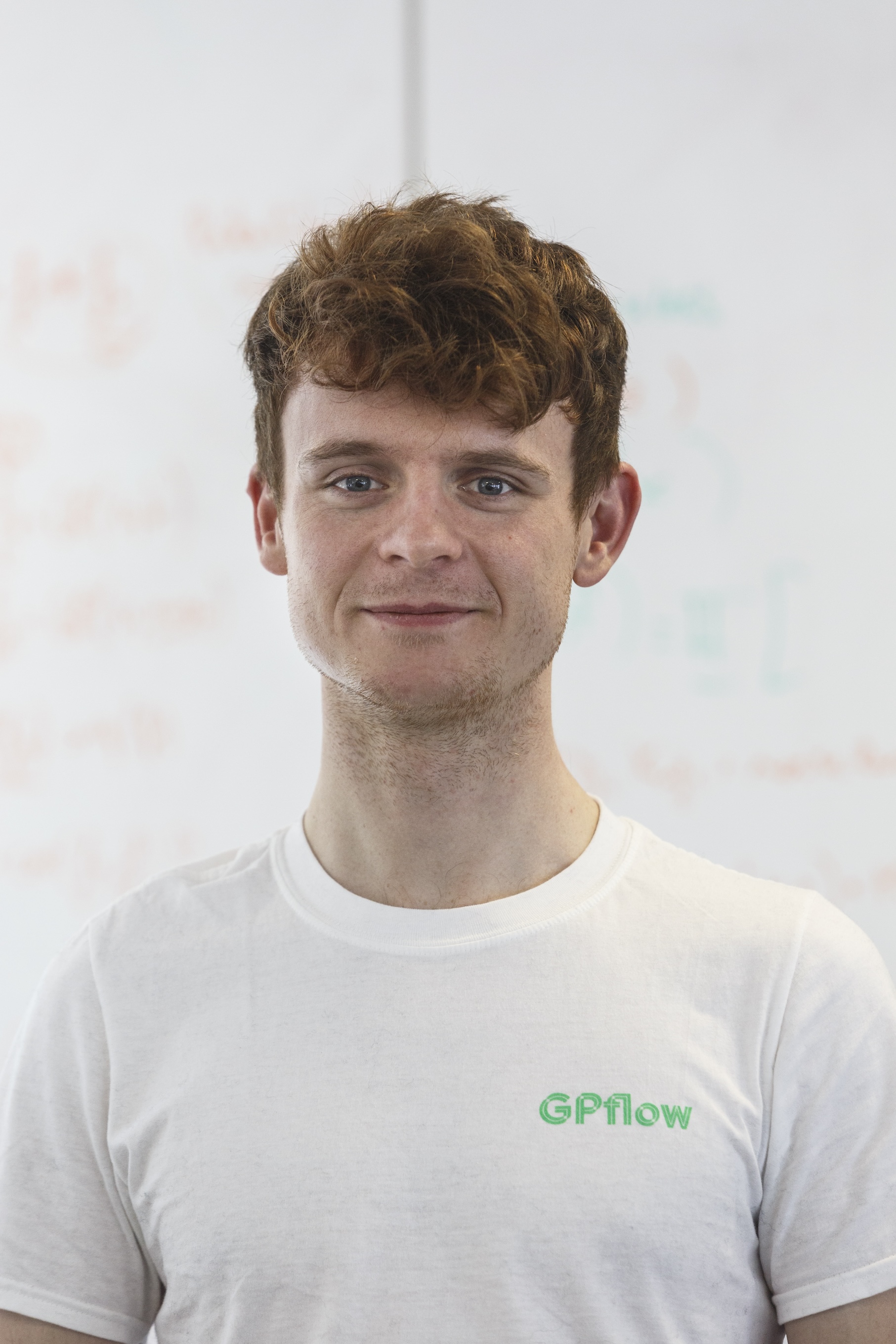
 Henry Moss
· 3 previous affiliations
- Lancaster UniversitySince 2024
- Assistant Professor · Since 2024
- Postgraduate Student · 2017–2021
- University of Cambridge2023–2025
- Postdoc · 2023–2025
- Secondmind Ltd2021–2023
- Senior Researcher · 2021–2023
Research Overview
Henry Moss focuses on scalable Bayesian modeling, active learning, and Bayesian optimization for complex scientific and engineering domains. His trajectory spans the development of information-theoretic acquisition functions and sparse Gaussian processes to handle high-dimensional, structured, and multi-objective search spaces. Recently, his work emphasizes integrating physical symmetries into probabilistic models and optimizing sequential experimental design for real-world applications like molecular search and sensor deployment.
Research Trajectory
Moss’s early research addressed the computational bottlenecks of model selection and hyperparameter tuning. He introduced FIESTA: Fast IdEntification of State-of-The-Art models using adaptive bandit algorithms, which applied adaptive multi-armed bandit strategies to efficiently identify optimal models while accounting for random initialization variance across multiple train-test splits. Expanding into the area of Sample Efficient Optimization for High Cost Objectives, he developed BOSS: Bayesian Optimization over String Spaces, bypassing the need for continuous latent projections by applying string kernels and genetic algorithms directly to raw sequence data. To handle multi-task scenarios, he proposed MUMBO: MUlti-task Max-Value Bayesian Optimization, an information-theoretic acquisition function designed for computational efficiency when leveraging low-cost surrogate evaluations. He also addressed the optimization of stochastic functions with BOSH: Bayesian Optimization by Sampling Hierarchically, utilizing hierarchical Gaussian processes to dynamically model individual realizations rather than optimizing a fixed average of noisy samples. This work contributed to broader efforts in the field of High-Dimensional Bayesian Optimization.
A major theme in Moss’s subsequent work is the research direction of Scaling Gaussian Processes Beyond Cubic Complexity. He contributed to the analysis of Scalable Thompson Sampling using Sparse Gaussian Process Models, which investigated the approximation errors introduced by sparse models in optimization loops, advancing the area of Inducing Point Approximations for Scalable Gaussian Processes. Building on his focus on information-theoretic methods, he introduced GIBBON: General-purpose Information-Based Bayesian Optimisation, a closed-form lower bound approximation to max-value entropy search that supports non-Euclidean spaces and synchronous batching at a fraction of traditional computational costs. He later extended these principles to multi-objective problems with PF2ES: Parallel Feasible Pareto Frontier Entropy Search for Multi-Objective Bayesian Optimization, using a variational lower bound to estimate mutual information and efficiently handle unknown constraints and parallel evaluations to identify optimal trade-offs.
In 2024, Moss’s research expanded to incorporate physical symmetries and complex deployment constraints. He guided the development of Integration-free kernels for equivariant Gaussian fields with application in dipole moment prediction, which avoids expensive mathematical integrations to build computationally efficient equivariant models. He also addressed sequential experimental design where transitioning between evaluation points is expensive, introducing MONGOOSE: Path-wise Smooth Bayesian Optimisation via Meta-learning to learn non-myopic, smooth optimization policies. In the domain of Sample Selection Guided by Model Uncertainty, his work on Big Batch Bayesian Active Learning by Considering Predictive Probabilities improved upon existing batch active learning algorithms by isolating predictive probabilities, enabling faster and more accurate large-scale data querying. To bridge the gap between theoretical advancements and practical deployment, he led the creation of Trieste: Efficiently Exploring The Depths of Black-box Functions with TensorFlow, an open-source library integrating Bayesian optimization seamlessly into the TensorFlow ecosystem.
Recent work continues to refine Gaussian process scalability and structured search spaces. He further advanced equivariant modeling with Integration-free Kernels for Equivariant Gaussian Process Modelling, utilizing the geometric concept of fundamental regions to achieve massive speedups in tasks like fluid flow and molecular modeling. Investigating generative models, he contributed to Linear combinations of latents in generative models: subspaces and beyond, proposing a closed-form transform for combining latent variables without violating underlying statistical assumptions. Returning to combinatorial spaces, Omnipresent Yet Overlooked: Heat Kernels in Combinatorial Bayesian Optimization demonstrated that many specialized kernels are mathematically equivalent to heat kernels on Hamming graphs, simplifying the optimization pipeline. He also critically re-examined the use of variational autoencoders for molecular search in Return of the Latent Space COWBOYS: Re-thinking the use of VAEs for Bayesian Optimisation of Structured Spaces. Most recently, his research addresses dynamic physical environments; BALLAST: Bayesian Active Learning with Look-ahead Amendment for Sea-drifter Trajectories under Spatio-Temporal Vector Fields optimizes the placement of ocean drifters by simulating future trajectories through physics-informed Gaussian processes.
In 2026, Moss introduced Conditioning Gaussian Processes on Almost Anything, establishing an equivalence between GPs and linear diffusion models to enable sampling conditioned on arbitrary point-wise likelihood evaluations, including non-linear physics and natural language models. In active learning, Moss contributed to Active Learning for Gaussian Process Regression Under Self-Induced Boltzmann Weights, deriving acquisition functions that approximate intractable self-induced Boltzmann targets in closed form for applications like potential energy surface modeling. Within generative modeling and optimization, Moss co-authored Search at the Cost of Sampling: Nearly-Instant Latent Space Bayesian Optimization, utilizing spherical geometry and linear surrogates to dramatically accelerate sequential candidate proposal, while supervising Generative Models as Adaptive Trust Regions for Discrete Bayesian Optimisation to substitute combinatorial edit-distance neighbourhoods with learned proposals from pretrained generative models.
Current Directions
The most recent papers in the evidence indicate a dual focus on embedding physical priors into scalable probabilistic models and refining optimization over complex, structured spaces. Work in 2025 and 2026 explores the integration of geometric equivariance into Gaussian processes using fundamental regions, drastically reducing the computational overhead of modeling physical systems like fluid dynamics and molecular structures. Concurrently, Moss investigates dynamic active learning frameworks that account for spatio-temporal movement, such as optimizing sensor placement in vector fields. His recent research also critically evaluates and simplifies latent space optimization and GP inference, demonstrating how generative models can provide adaptive trust regions or ultra-fast proposals while linear diffusion formulations generalize GP conditioning to complex non-linear physics and language.
Profile updated
Loading new papers…
Other researchers whose papers cluster into the same research directions — a proxy for overlapping technical interests and shared intellectual neighborhoods.
See something wrong? Report a mistake