

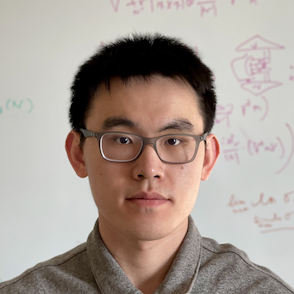
 Haoxiang Wang
· 6 previous affiliations
- Thinking Machines LabSince 2026
- Member of Technical Staff · Since 2026
- Luma AI2025–2026
- Research Scientist · 2025–2026
- Nvidia (United States)2024–2025
- Researcher · 2024–2025
- Doctor of Philosophy - PhD, Electrical & Computer Engineering · 2019–2024
- Bachelor of Science (B.S.), Physics, Statistics & Computer Science · 2015–2019
- Research Intern · 2023
- Applied Scientist Intern · 2022
3 other authors named Haoxiang Wang: Haoxiang Wang (70 papers), Haoxiang Wang (Peking University · 5 papers), Haoxiang Wang (Peking University · 1 paper)
Research Overview
Haoxiang Wang focuses on large language model alignment, vision-language integration, and robust generalization under distribution shifts. His early research established theoretical foundations for meta-learning and domain adaptation before transitioning to the optimization of generative foundation models. Currently, his work addresses reinforcement learning from human feedback, reward modeling, and reasoning capabilities in physical and embodied AI systems.
Research Trajectory
During his doctoral studies at the University of Illinois Urbana-Champaign, Wang’s early research concentrated on the theoretical underpinnings of meta-learning and domain adaptation. In 2021, he demonstrated that Multi-Task Learning (MTL) and Gradient-Based Meta-Learning (GBML) optimize nearly identical objectives in deep networks. Through Bridging Multi-Task Learning and Meta-Learning: Towards Efficient Training and Effective Adaptation, he showed that a first-order MTL approach could match the performance of complex meta-learning algorithms while significantly accelerating training. Building on this theoretical focus, he proved that model-agnostic meta-learning (MAML) with over-parameterized deep neural networks converges to global optima at a linear rate in Global Convergence of MAML and Theory-Inspired Neural Architecture Search for Few-Shot Learning. This work introduced Meta Neural Tangent Kernels (MetaNTK) and a corresponding training-free neural architecture search method.
In 2022, Wang expanded his focus to out-of-distribution generalization. He introduced Invariant-Feature Subspace Recovery (ISR) in Provable Domain Generalization via Invariant-Feature Subspace Recovery. By shifting from non-convex optimization to a provable subspace recovery method using principal component analysis, he showed that models could learn to ignore spurious correlations using data from as few as two training environments. This contributed to the broader area of Robustness to Subpopulation Shift and Spurious Correlations. That same year, he provided theoretical grounding for Gradual Domain Adaptation in Understanding Gradual Domain Adaptation: Improved Analysis, Optimal Path and Beyond. Moving away from pessimistic exponential error bounds, he proved the existence of an optimal number of intermediate steps and demonstrated that adaptation is most effective when following a geodesic path in the space of data distributions, advancing the research direction of Distributional Interpolation via Wasserstein Geodesics.
Wang subsequently began exploring the integration and generalization of foundation models. During an internship at Apple, he developed SAM-CLIP: Merging Vision Foundation Models towards Semantic and Spatial Understanding, a method for merging a semantic expert (CLIP) and a spatial expert (SAM) into a unified Vision Transformer via multi-task distillation and memory replay. Returning to the challenge of distribution shifts, he addressed multi-domain, multi-class setups in Enhancing Compositional Generalization via Compositional Feature Alignment, developing the CG-Bench suite to evaluate models' ability to generalize to unseen domain-class combinations.
After joining NVIDIA as a research scientist, Wang’s focus shifted heavily toward the alignment of large language models (LLMs) and reinforcement learning from human feedback (RLHF). He introduced the Directional Preference Alignment (DPA) framework in Arithmetic Control of LLMs for Diverse User Preferences: Directional Preference Alignment with Multi-Objective Rewards. Unlike scalar-reward RLHF, DPA incorporates multi-objective reward modeling and represents user preferences as unit vectors in a reward space, advancing the research direction of Multi-Dimensional Preference Alignment for Language Models. Continuing this trajectory, he addressed the black-box nature of reward models in Interpretable Preferences via Multi-Objective Reward Modeling and Mixture-of-Experts. This research made preference proxies more human-interpretable, contributing to the areas of Dynamic Weighting for Context Sensitive Evaluation and Generative Reward Models for Interpretable Alignment.
In collaborative efforts to scale these alignment techniques, he worked on Semi-Supervised Reward Modeling via Iterative Self-Training, introducing a method to train high-quality reward models without extensive human labeling. This supported the broader area of Scaling Model Alignment with Synthetic Preference Signals. He also participated in the development of a reproducible recipe for online iterative learning in RLHF Workflow: From Reward Modeling to Online RLHF, utilizing diverse open-source datasets to bridge the gap between offline and online RLHF settings.
Most recently, Wang has investigated the intersection of reasoning and reinforcement learning. He directed research on NFT: Bridging Supervised Learning and Reinforcement Learning in Math Reasoning, challenging the assumption that supervised learning is fundamentally unable to learn from failures in reasoning tasks. Concurrently, he contributed to DiffusionNFT: Online Diffusion Reinforcement with Forward Process, which proposes a highly efficient method for applying reinforcement learning to diffusion models, extending alignment techniques beyond text generation.
Current Directions
The most recent papers in the evidence address the intersection of supervised learning and reinforcement learning to enhance the reasoning capabilities of generative models. Recent work investigates how to effectively bridge these paradigms for complex tasks like mathematical reasoning, challenging the reliance on reinforcement learning alone as a self-improvement loop. Additionally, ongoing research explores the application of reinforcement learning techniques to diffusion models, aiming to improve training efficiency and align these models more closely with human preferences. This builds upon a sustained focus on online iterative reinforcement learning from human feedback (RLHF), multi-objective reward modeling, and the development of interpretable alignment frameworks for foundation models.
Profile updated
Loading new papers…
Other researchers whose papers cluster into the same research directions — a proxy for overlapping technical interests and shared intellectual neighborhoods.
See something wrong? Report a mistake