

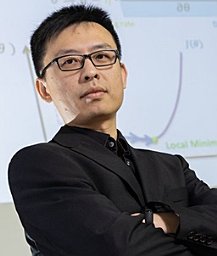
 Haojin Yang
· 7 previous affiliations
- GreenBitAISince 2024
- CEO · Since 2024
- GreenBitAI GmbHSince 2024
- CEO · Since 2024
- German University of Digital ScienceSince 2026
- Full Professor · Since 2026
- Hasso Plattner InstituteSince 2010
- Guest Researcher · Since 2026
- Research Group Leader · 2020–2025
- Associate Professor · 2017–2025
- Postdoc · 2014–2017
- PhD student · 2010–2013
- University of Potsdam2010–2025
- Privatedozent · 2019–2025
- 其他, Habilitation, Computer Science · 2014–2019
- Doctor of Scientiarum Naturalium, Computer Science · 2010–2013
- 华为2021–2023
- Chief AI Advisor, Edge Cloud Innovation Lab · 2021–2023
- 阿里巴巴集团2019–2020
- Staff Algorithm Expert, Head of Edge Computing Lab Beijing Branch, AI Labs and Video Cloud · 2019–2020
1 other author named Haojin Yang: Haojin Yang (Peking University · 3 papers)
Research Overview
Haojin Yang focuses on efficient artificial intelligence, deep model acceleration, and computer vision. His research trajectory spans from early work in multimedia analysis and lecture video indexing to the development of highly optimized binary neural networks and knowledge distillation frameworks. Currently, he investigates data pruning strategies, robust intrusion detection, and hallucination mitigation in large vision-language models.
Research Trajectory
Yang’s early research addressed practical challenges in multimedia information retrieval. He developed solutions for indexing educational content, evaluating automatic speech recognition techniques for academic recordings in German Speech Recognition: A Solution for the Analysis and Processing of Lecture Recordings. He also participated in medical imaging research, contributing to 3D conditional generative adversarial networks designed to handle imbalanced datasets in voxel-GAN: Adversarial Framework for Learning Imbalanced Brain Tumor Segmentation.
A central and enduring theme of his work is the compression and acceleration of deep learning models for resource-constrained environments. In 2017, he introduced BMXNet: An Open-Source Binary Neural Network Implementation Based on MXNet, providing a foundational library for quantized and XNOR-Networks. Building on this, he explored architectural design principles specific to binary models in BinaryDenseNet: Developing an Architecture for Binary Neural Networks. He later expanded these efficiency efforts to ultralight convolutional neural networks, proposing asymmetrical bottlenecks to optimize memory and computation in AsymmNet: Towards Ultralight Convolution Neural Networks Using Asymmetrical Bottlenecks.
By 2022, his group had made significant advances in the research direction of Bitwise Logic for Efficient Neural Network Inference and the broader area of Bridging the Binary Neural Network Accuracy Gap. This effort culminated in Join the High Accuracy Club on ImageNet with A Binary Neural Network Ticket, which introduced BNext, a binary neural network that successfully bridged the performance gap with full-precision models on large-scale datasets. He formalized these optimization strategies further in Towards Optimization-Friendly Binary Neural Network, detailing a pipeline that leverages teacher-selection metrics to improve binary student networks. Beyond binary networks, he also investigated post-training quantization for natural language processing, demonstrating that extreme compression can act as a regularizer for the BERT model family in Empirical Evaluation of Post-Training Quantization Methods for Language Tasks.
Parallel to his work on model compression, Yang has extensively researched knowledge distillation and novel class discovery (NCD). He contributed to the research area of Training Resource Optimization for Multi-Teacher Knowledge Distillation by developing a framework that selectively distills reliable knowledge to improve robustness against noisy labels in Not All Knowledge Is Created Equal: Mutual Distillation of Confident Knowledge. In the domain of NCD, his research critically examined the role of labeled datasets. He analyzed how semantic similarity between labeled and unlabeled sets impacts discovery in A Closer Look at Novel Class Discovery from the Labeled Set, and subsequently introduced the concept of "transfer leakage" to demonstrate that supervised knowledge is not universally beneficial across all levels of semantic relevance in Supervised Knowledge May Hurt Novel Class Discovery Performance.
Moving into 2024 and 2025, Yang's research expanded to address the efficiency and reliability of large-scale foundation models and complex data pipelines. He developed comprehensive data pruning techniques, utilizing early-training logit history to identify redundant images and correct mislabeled samples in Data Pruning Can Do More: A Comprehensive Data Pruning Approach for Object Re-identification. In the security domain, he explored self-supervised contrastive pretraining to mitigate feature distribution shifts in network intrusion detection systems with Feature Distribution Shift Mitigation with Contrastive Pretraining for Intrusion Detection. His recent work also addresses the optimization of large language models, distilling reasoning capabilities into smaller models to improve in-context learning efficiency in SeCoKD: Aligning Large Language Models for In-Context Learning with Fewer Shots. Most recently, his group tackled object hallucination in large vision-language models, proposing latent editing frameworks to suppress the influence of misleading visual priors during inference in Image Token Matters: Mitigating Hallucination in Discrete Tokenizer-based Large Vision-Language Models via Latent Editing.
Current Directions
The most recent papers in the evidence indicate a dual focus on the operational efficiency and the robust alignment of large-scale artificial intelligence. Recent work investigates methods to streamline training and inference, utilizing advanced data pruning and knowledge distillation to maintain high performance in resource-constrained or few-shot scenarios. Concurrently, there is a strong emphasis on model reliability, addressing open problems such as feature distribution shifts in real-world network traffic and the mitigation of hallucinated outputs driven by discrete tokenizers in multimodal foundation models.
Profile updated
Loading new papers…
Other researchers whose papers cluster into the same research directions — a proxy for overlapping technical interests and shared intellectual neighborhoods.
See something wrong? Report a mistake