

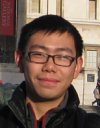
 Haocheng Shen
· 3 previous affiliations
- VivoSince 2022
- Researcher · Since 2022
- Tencent (China)2018–2021
- Researcher · 2018–2021
- University of Dundee2014–2018
- PhD student · 2014–2018
Research Overview
Haocheng Shen focuses on computer vision, medical image analysis, and the efficient adaptation of vision-language foundation models. His trajectory spans early work in feature representation and medical anomaly detection to recent advancements in prompt learning and generative image synthesis. Currently, he investigates controllable generation and test-time adaptation techniques for multimodal architectures.
Research Trajectory
Shen’s early research explored foundational techniques in video analysis and feature representation. His initial work included Human Action Recognition by Random Features and Hand-Crafted Features: A Comparative Study, which investigated the efficacy of hand-crafted descriptors like 3D HoG/HoF and SIFT against random feature representations. By employing encoding methods such as Sparse Coding and Bag of Features alongside spatial-temporal pyramids, this work provided a rigorous comparative baseline for classifying human actions in complex video datasets.
Following this, Shen transitioned into the domain of medical image analysis, focusing on the segmentation of complex anatomical structures. He contributed to the development of specialized convolutional architectures, as seen in Boundary-Aware Fully Convolutional Network for Brain Tumor Segmentation. He further advanced this domain with Efficient symmetry-driven fully convolutional network for multimodal brain tumor segmentation. This research introduced a symmetry-driven fully convolutional network that utilized symmetry difference images to extract multi-level contextual information. This approach contributed significantly to the research direction of Bilateral Symmetry Priors for Medical Anomaly Detection and the broader area of Holistic Global Learning for High Resolution Images. Expanding on the challenges of medical diagnostics, particularly the scarcity of abnormal training data, Shen explored generative approaches in Counterfeit Anomaly Using Generative Adversarial Network for Anomaly Detection. By leveraging generative adversarial networks (GANs), this framework detected outliers through reconstruction errors, offering a viable pathway for identifying rare diseases when only normal data is readily available.
In subsequent years, Shen’s focus shifted toward the efficient adaptation of large-scale vision-language models (VLMs). Recognizing the limitations and instability of visual prompt learning compared to text prompting, he introduced Progressive Visual Prompt Learning with Contrastive Feature Re-formation (later expanded in a journal publication, Progressive Visual Prompt Learning with Contrastive Feature Re-formation). This work proposed a Progressive Visual Prompt (ProVP) structure designed to strengthen interactions among prompts across different network layers and effectively propagate image embeddings. This methodology advanced the research areas of Mitigating Feature Distortion in Foundation Model Adaptation and Latent Feature Regularization for Stable Neural Adaptation.
Continuing his work on VLM fine-tuning, Shen collaborated on DPL: Decoupled Prompt Learning for Vision-Language Models. This research addressed the common issue of models overfitting to seen classes by mathematically decomposing the attention mechanism and removing redundant interactions between learnable prompts, thereby contributing to the direction of Hybrid Discrete Continuous Prompt Tuning. He also participated in developing highly efficient inference techniques, co-authoring Efficient Test-Time Prompt Tuning for Vision-Language Models. By shifting the adaptation process from individual images to predefined class names using self-supervised learning, this framework dramatically reduced memory overhead and accelerated inference, aligning with the broader research area of Aligning Auxiliary Tasks for Robust Test-Time Adaptation.
Most recently, Shen has engaged with the challenges of controllable generative synthesis. In ControlAR: Controllable Image Generation with Autoregressive Models, he and his collaborators introduced a framework for integrating spatial controls—such as depth maps and segmentation masks—into autoregressive image models. By utilizing a conditional decoding approach rather than prefilling control tokens, the method enabled autoregressive models to generate images at arbitrary resolutions and aspect ratios. He further explored generative control in TransLight: Image-Guided Customized Lighting Control with Generative Decoupling, which utilized diffusion models to decouple light from image content. This allowed for the transfer of complex, geometric lighting effects like lens flares from a reference image to a target portrait while preserving the original image's integrity.
Current Directions
The most recent papers in the evidence indicate that Shen is currently focused on the intersection of generative AI and fine-grained multimodal control. His latest work investigates how to impose precise spatial, geometric, and environmental constraints onto large-scale image generation models. This includes developing conditional decoding mechanisms for autoregressive architectures to handle arbitrary aspect ratios, as well as leveraging diffusion models to decouple and transfer complex lighting conditions in portrait photography. Alongside generative synthesis, he continues to explore parameter-efficient and test-time adaptation strategies that allow massive vision-language foundation models to generalize robustly to unseen domains with minimal computational overhead.
Profile updated
Loading new papers…
Other researchers whose papers cluster into the same research directions — a proxy for overlapping technical interests and shared intellectual neighborhoods.
See something wrong? Report a mistake