

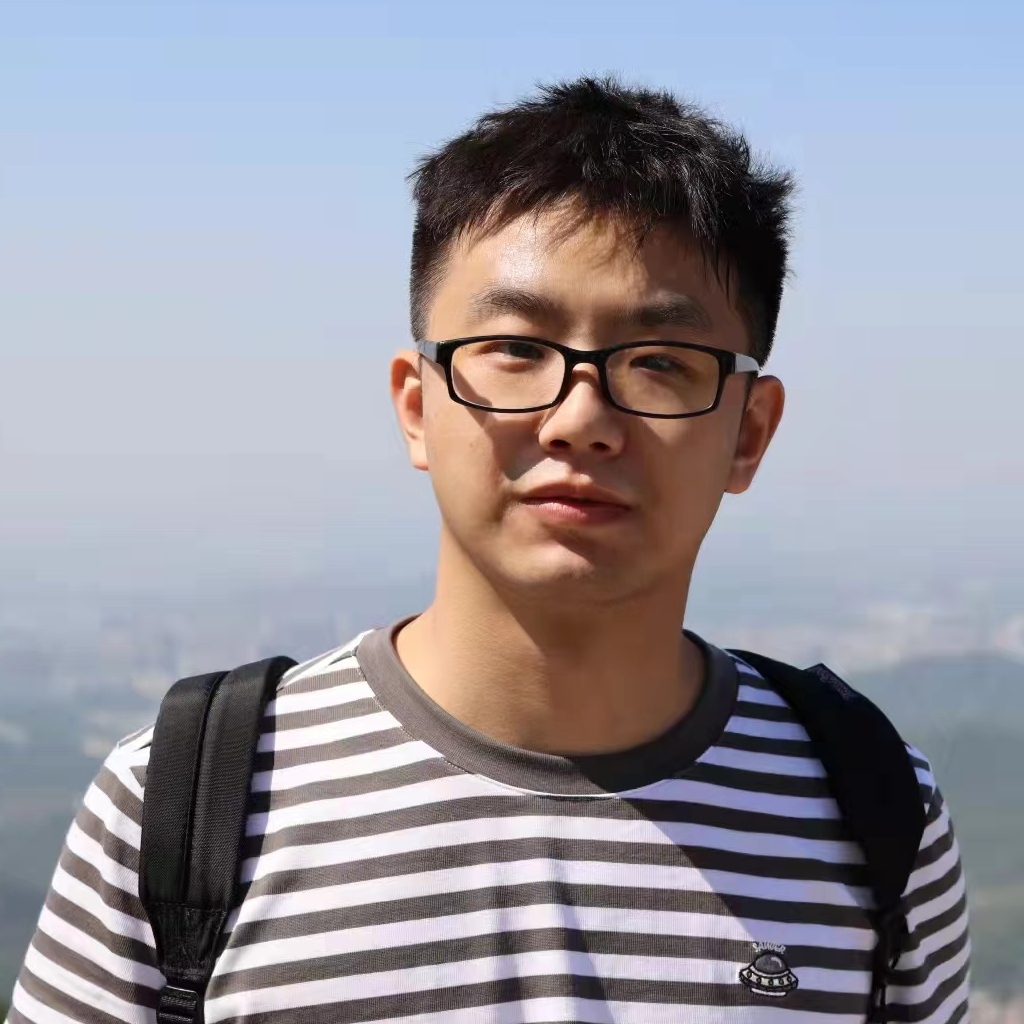
 Hao Zhang
· 7 previous affiliations
- Nvidia (United States)Since 2024
- Researcher · Since 2024
- Current
- 英伟达公司Since 2024
- Research Scientist · Since 2024
- 实习生 · 2020–2024
- 字节跳动2024
- Research Internship · 2024
- PhD student · 2020–2024
- 微软2023
- Research Intern · 2023
- Shanghai Jiao Tong University2015–2019
- Undergrad student · 2015–2019
- 学士
36 other authors named Hao Zhang: Hao Zhang (Balyasny Asset Management · Balyasny Asset Management L.P. · 103 papers), Hao Zhang (Petuum · Snowflake Inc. (United States) · University of California San Diego · Carnegie Mellon University · 88 papers), Hao Zhang (Wuhan University · 82 papers), Hao Zhang (Harbin Institute of Technology · 37 papers), Hao Zhang (29 papers), and 31 more
Research Overview
Hao Zhang focuses on large multimodal models, visual understanding, and the efficient generation of text and images. His early trajectory concentrated on advancing transformer-based object detection and unified image segmentation architectures. More recently, his work has expanded into grounded visual chat systems and the acceleration of diffusion-based language models for high-speed parallel decoding.
Research Trajectory
The early phase of Zhang's research centered on foundational improvements to Detection Transformers (DETR). He contributed to DAB-DETR: Dynamic Anchor Boxes are Better Queries for DETR, which reformulated DETR queries using explicit box coordinates. This approach improved positional priors and helped resolve the slow training convergence that historically plagued DETR models. Building on the need for faster and more stable training, he developed DN-DETR: Accelerate DETR Training by Introducing Query DeNoising. By feeding noised ground-truth boxes into the decoder and training the model to reconstruct them, this work bypassed the instability of bipartite matching, resulting in significant training speedups. This denoising paradigm culminated in DINO: DETR with Improved DeNoising Anchor Boxes for End-to-End Object Detection, a highly efficient end-to-end detector that utilized contrastive denoising training and mixed query selection to improve performance and scalability across both model and data sizes.
In 2023, his focus expanded from bounding boxes to dense, pixel-level understanding. He introduced Mask DINO: Towards A Unified Transformer-based Framework for Object Detection and Segmentation, which extended the DINO architecture with a specialized mask branch to unify instance, panoptic, and semantic segmentation within a single framework. Continuing to refine segmentation architectures, he proposed MP-Former: Mask-Piloted Transformer for Image Segmentation, leveraging noised ground-truth masks as guidance during training to resolve inconsistencies in prior models without adding inference costs. During this period, he also explored spatial perception in autonomous driving contexts, developing DA-BEV: Depth Aware BEV Transformer for 3D Object Detection to integrate depth awareness into transformer-based 3D detection pipelines.
As large language models began to intersect more deeply with computer vision, Zhang's research shifted toward open-set recognition and the broader area of Language-Guided Query Initialization for Open-Vocabulary Detection. He developed A Simple Framework for Open-Vocabulary Segmentation and Detection (OpenSeeD), which jointly learned from coarse box annotations and fine-grained mask datasets to identify and segment novel objects. This text-driven approach was further advanced in collaboration with others through Grounding DINO: Marrying DINO with Grounded Pre-training for Open-Set Object Detection, which deeply integrated image and text features across multiple stages to detect arbitrary objects based on complex human descriptions.
By late 2023 and into 2024, his work increasingly focused on integrating visual grounding directly into conversational AI, contributing to the research direction of Reasoning Segmentation with Multimodal Large Language Models. He introduced Set-of-Mark Prompting Unleashes Extraordinary Visual Grounding in GPT-4V, a technique that overlays visual marks—such as numbers and masks—onto image regions to enable zero-shot spatial reasoning in large multimodal models. He also developed LLaVA-Grounding: Grounded Visual Chat with Large Multimodal Models, connecting a language model to specialized grounding encoders. Supported by a novel 150K-instance dataset, this system allowed complex conversations to be tied to precise bounding boxes and masks. This trajectory of aligning complex modalities continued with his participation in LLaVA-OneVision: Easy Visual Task Transfer. By utilizing a "Higher AnyRes" visual representation, this work consolidated single-image, multi-image, and video understanding into a single architecture, advancing the area of Progressive Multi-Stage Training for Multimodal Alignment and touching upon the area of Zero-Shot Video Intelligence from Static Image Pre-training.
Most recently, the research arc has expanded into the fundamental mechanics of language model generation, specifically targeting the acceleration of diffusion-based LLMs. He co-developed Fast-dLLM: Training-free Acceleration of Diffusion LLM by Enabling KV Cache and Parallel Decoding, addressing the historical slowness of diffusion models by enabling KV caching for parallel token generation. This work directly contributed to the area of Caching for Bidirectional Diffusion Language Models. The framework was subsequently refined in Fast-dLLM v2: Efficient Block-Diffusion LLM, which combined parallel generation within blocks with sequential processing between them to significantly increase decoding speed while maintaining accuracy. Concurrently, he collaborated on Efficient-DLM: From Autoregressive to Diffusion Language Models, and Beyond in Speed, which converted pretrained autoregressive models into diffusion models using position-dependent masking, advancing the broader research direction of Hybrid Masking for Faster Parallel Decoding.
Current Directions
The most recent papers in the evidence address the efficiency and architectural design of diffusion-based large language models. Moving beyond traditional autoregressive generation, this work investigates methods for high-speed parallel decoding. By developing block-wise attention patterns, position-dependent masking, and novel caching mechanisms for bidirectional diffusion models, current efforts focus on bridging the performance gap between diffusion and autoregressive models while achieving significantly higher inference throughput.
Profile updated
Loading new papers…
Other researchers whose papers cluster into the same research directions — a proxy for overlapping technical interests and shared intellectual neighborhoods.
See something wrong? Report a mistake