

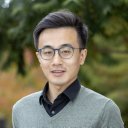
 Hao Peng
· 4 previous affiliations
- University of Illinois Urbana-ChampaignSince 2023
- Assistant Professor · Since 2023
- Current
- Researcher · 2022–2023
- University of Washington2016–2022
- PhD student · 2016–2022
- Peking University2012–2016
- Undergrad student · 2012–2016
6 other authors named Hao Peng: Hao Peng (Beihang University · 380 papers), Hao Peng (Tsinghua University · 26 papers), Hao Peng (Google (United States) · 7 papers), Hao Peng (2 papers), Hao Peng (Zhejiang Normal University · 2 papers), and 1 more
Research Overview
Hao Peng focuses on advancing the reasoning capabilities, context scaling, and reinforcement learning methodologies of large language models. His trajectory spans early work in neural network regularization and sequence modeling to recent breakthroughs in multi-step reasoning and agentic systems. Currently, his research emphasizes optimizing reinforcement learning pipelines and using executable code to elicit complex, generalizable reasoning in foundation models.
Research Trajectory
Peng's early research addressed foundational challenges in natural language processing and sequence modeling. In A Comparative Study on Regularization Strategies for Embedding-based Neural Networks (2015), he explored methods to mitigate severe overfitting in neural NLP models. This interest in robust representations extended to structured prediction and summarization. With collaborators, he investigated attention mechanisms for extreme summarization in A Convolutional Attention Network for Extreme Summarization of Source Code (2016), contributing to the broader research direction of Pointer Generator Mechanisms for Grounded Text Generation. He further advanced structured NLP tasks by introducing a deep architecture in Deep Multitask Learning for Semantic Dependency Parsing (2017) that simultaneously handled multiple formalisms. Seeking to bridge the gap between empirical neural models and classical machine learning intuitions, he formalized the connection between recurrent neural networks and weighted finite state automata in Rational Recurrences (2018). He also continued to refine text generation techniques in Text Generation with Exemplar-based Adaptive Decoding (2019).
As transformer architectures became dominant, Peng's focus shifted toward scaling their efficiency and context windows. To address the quadratic complexity of standard attention, he proposed a linear time and space alternative in Random Feature Attention (2021), using random feature methods to approximate the softmax function. This foundational work on efficiency naturally led to later efforts in massive context scaling. In Data Engineering for Scaling Language Models to 128K Context (2024), his research demonstrated that latent long-context capabilities could be unlocked in base models through targeted data upsampling rather than extensive architectural changes. He further optimized long-context processing with A Little Goes a Long Way: Efficient Long Context Training and Inference with Partial Contexts (2025), introducing a hybrid architecture that applies full attention only in middle layers to drastically reduce compute and memory costs.
Concurrently, Peng began investigating how to elicit and distill complex reasoning capabilities in language models, contributing significantly to the research area of The Emergent Reasoning Threshold in Language Models. In Complexity-Based Prompting for Multi-step Reasoning (2023), he showed that selecting prompts with higher reasoning complexity substantially improves performance on multi-step tasks. He then explored whether these capabilities were strictly emergent in massive models, demonstrating in Specializing Smaller Language Models towards Multi-Step Reasoning (2023) that complex reasoning could be successfully distilled into models under 11 billion parameters.
To push reasoning beyond static text generation, Peng's work increasingly leveraged executable code. He participated in the development of the CodeAct framework in Executable Code Actions Elicit Better LLM Agents (2024), which treats Python code as the primary action space to handle complex logic. This work advanced the dual research directions of Executable Code as the Universal Interface for Agents and Autonomous Agents with Executable Code Actions. Building on this paradigm, he later introduced a framework in Executable Counterfactuals: Improving LLMs' Causal Reasoning Through Code (2026) that forces models to perform true abductive causal reasoning, a key contribution to the area of Reinforcement Learning for Generalizable Reasoning in Large Models.
In his most recent work, Peng has deeply investigated the optimization pipelines used to align and enhance reasoning models, particularly focusing on the interplay between supervised fine-tuning (SFT) and reinforcement learning (RL). He addressed data selection biases in SFT with Improving Influence-based Instruction Tuning Data Selection for Balanced Learning of Diverse Capabilities (2025). Recognizing that standard SFT can sometimes hinder subsequent RL, he developed a reweighting method in Good SFT Optimizes for SFT, Better SFT Prepares for Reinforcement Learning (2026) to align offline training with future online trajectories. This aligns with his broader interest in the area of Reinforcement Learning with Verifiable Rewards. He also explored novel reward mechanisms, introducing Implicit Process Reward Models in Free Process Rewards without Process Labels (2025) to obtain step-by-step reasoning signals without manual annotation. Further optimizing the RL phase, he demonstrated in The Unreasonable Effectiveness of Entropy Minimization in LLM Reasoning (2025) that forcing model confidence can boost performance without labeled data. Challenging conventional optimization wisdom, his research in Do We Need Adam? Surprisingly Strong and Sparse Reinforcement Learning with SGD in LLMs (2026) revealed that simple Stochastic Gradient Descent is highly effective and memory-efficient for the RL phase. Finally, he investigated the fundamental mechanics of RL in language models, demonstrating in From f(x) and g(x) to f(g(x)): LLMs Learn New Skills in RL by Composing Old Ones (2026) how reinforcement learning enables models to compose existing knowledge into novel skills.
Current Directions
The most recent papers in the evidence indicate a strong focus on optimizing the reinforcement learning and reasoning pipelines for large language models. Recent work investigates how to extract granular, step-by-step process rewards without relying on expensive human annotations, and how alternative optimization strategies—such as entropy minimization and stochastic gradient descent—can dramatically improve the efficiency and efficacy of the RL phase. Additionally, current research addresses the fundamental mechanics of causal reasoning and skill acquisition, exploring how executable code environments can scaffold true abductive reasoning and how models compose existing capabilities into new skills during reinforcement learning.
Profile updated
Loading new papers…
Other researchers whose papers cluster into the same research directions — a proxy for overlapping technical interests and shared intellectual neighborhoods.
See something wrong? Report a mistake