

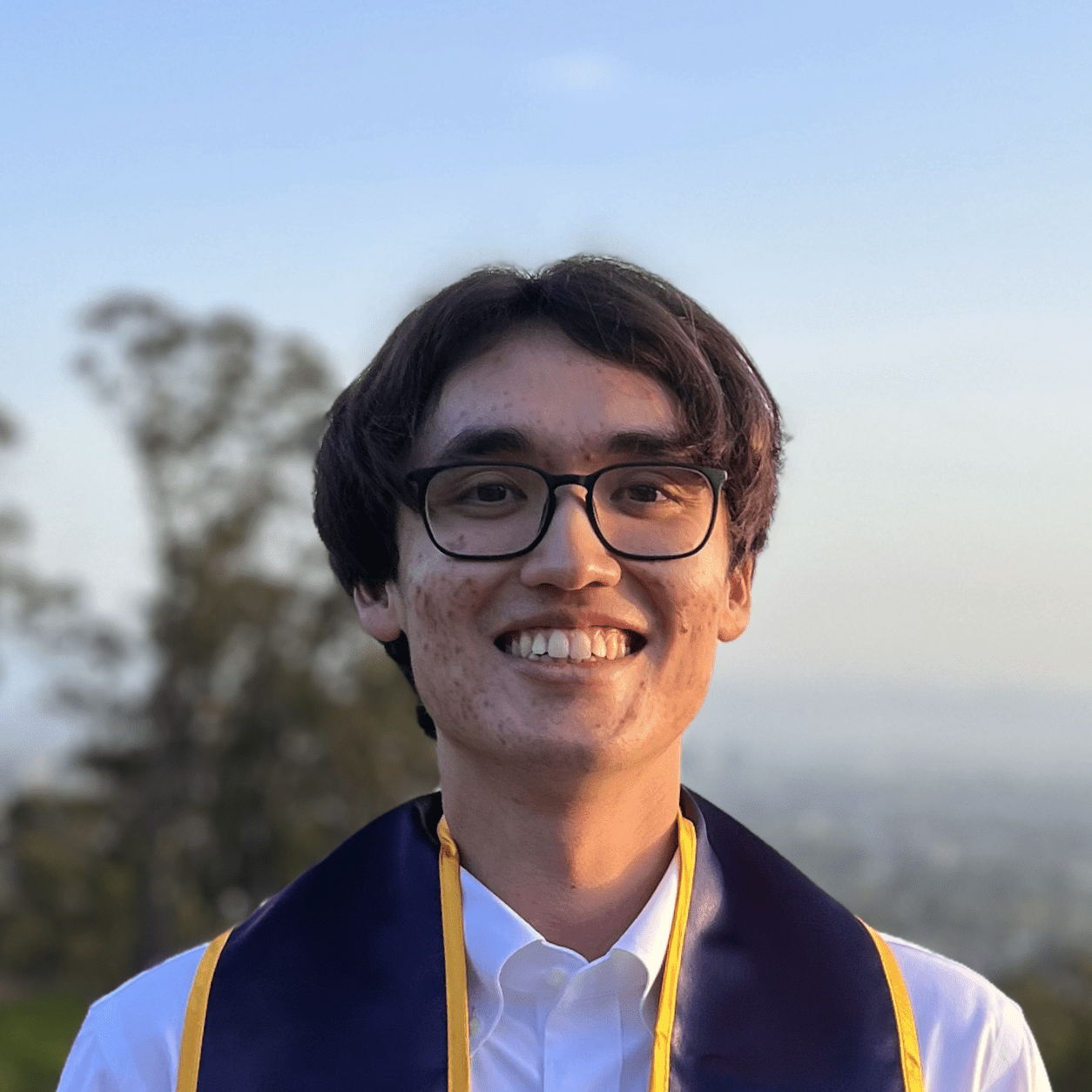
 Hansen Lillemark
· 7 previous affiliations
- University of California San DiegoSince 2024
- PhD student · Since 2024
- Visiting PHD Student · 2025
- New Theory2024
- Founding Research Scientist · 2024
- University of California, Berkeley2022–2024
- Machine Learning Researcher · 2022–2024
- Bachelor of Arts - BA, Computer Science (3.92)
- Symbolic Software Solutions2021–2023
- Co-Founder, CTO · 2021–2023
- Undergrad student · 2019–2022
- High School Diploma (4.0)
Research Overview
Hansen Lillemark focuses on geometric deep learning, equivariant neural architectures, and the development of structured world models for embodied artificial intelligence. His trajectory spans foundational work on non-Euclidean machine learning to the integration of continuous symmetries into predictive models of dynamic environments. Currently, he investigates flow-equivariant memory systems and multi-agent reasoning frameworks for complex embodied tasks.
Research Trajectory
Lillemark’s early research explored how neural architectures can better capture the compositional and structural properties of complex data. In Visual Scene Representation with Hierarchical Equivariant Sparse Coding, he participated in developing a hierarchical neural network designed for the unsupervised learning of part-whole decompositions in visual scenes. Unlike models relying on global group equivariance, this architecture maintained equivariance to part-whole transformations throughout its hierarchy via Bayesian inference, giving rise to rich bottom-up, top-down, and lateral information flows hypothesized to mirror perceptual inference in the visual cortex. Concurrently, he contributed to natural language processing research, exploring data-level input reformulations to improve the finetuning of foundation language models for challenging translation tasks in Simple and Effective Input Reformulations for Translation. This work demonstrated that strategic input modifications could yield significant performance improvements on massively multilingual benchmarks without requiring additional training data or inference-time adjustments.
The focus of his work increasingly shifted toward the integration of geometric and topological structures into machine learning. He co-authored a comprehensive synthesis of this paradigm in Beyond Euclid: An Illustrated Guide to Modern Machine Learning with Geometric, Topological, and Algebraic Structures. This work mapped out the mathematical foundations necessary for handling non-Euclidean data, arguing that extracting knowledge from such data requires a broader mathematical perspective. The guide touched upon several key research areas, highlighting the importance of the research direction The Computational Overhead of Non-Euclidean Deep Learning and the broader area of Statistical Analysis on Curved Riemannian Manifolds. Furthermore, it addressed the area of Geometric Equivariance for Extreme Parameter Efficiency and the methodological need for the research area of Standardized Evaluation Protocols for Machine Learning Research when assessing these mathematically complex models.
Building on these geometric foundations, Lillemark began applying structural priors to world models for embodied artificial intelligence. He contributed to Geometric Priors for Generalizable World Models via Vector Symbolic Architecture, which utilized learnable Fourier Holographic Reduced Representations and complex multiplication to encode geometric priors. This approach resulted in more stable, interpretable, and generalizable long-horizon predictions compared to standard multilayer perceptron models. He subsequently led the development of a novel framework for modeling continuous sensory streams in Flow Equivariant World Models: Structured Dynamics Outside the Field of View. Recognizing that embodied systems experience the world as continuous streams of sensory input entrained to motion, this work unified the self-motion of an agent and the motion of external objects as one-parameter Lie group flows. This allowed the network to maintain group equivariance with respect to these transformations rather than laboriously relearning them from data.
Alongside his work on single-agent world models, Lillemark investigated the collaborative capabilities of large language models in embodied environments. In Collaborating Action by Action: A Multi-agent LLM Framework for Embodied Reasoning, he participated in the creation of MINDcraft, an extensible platform for testing LLM agents in open-world settings, and the accompanying MineCollab benchmark. This research identified efficient natural language communication as a primary limitation in state-of-the-art agent collaboration, contributing to the research direction of The Multi Agent Coordination Bottleneck and the broader area of Action Abstraction for Strategic Reinforcement Learning.
Most recently, Lillemark extended his work on flow equivariance to address the challenge of object permanence and hallucination in predictive models. He introduced Flow Equivariant World Models: Structured Memory for Dynamic Environments, which embedded the mathematical symmetries of motion directly into the architecture's memory. By ensuring that the model's internal representations "flow" in synchronization with both agent and object movements, this approach enabled accurate tracking of entities even during extended periods of occlusion, preventing the hallucinations common in standard world models.
Current Directions
The most recent papers in the evidence indicate a sustained focus on equipping embodied AI systems with robust, geometrically grounded world models. A primary theme is the use of Lie group symmetries and flow equivariance to structure neural memory, ensuring that agents can maintain accurate, long-term representations of dynamic environments without succumbing to compounding errors or hallucinations. Additionally, ongoing work addresses the complexities of multi-agent embodied reasoning, specifically targeting the communication and coordination bottlenecks that arise when multiple language-model-driven agents attempt to collaborate on complex, open-world tasks. Together, these directions aim to bridge the gap between abstract geometric deep learning and the practical demands of robust, interactive artificial intelligence.
Profile updated
Loading new papers…
Other researchers whose papers cluster into the same research directions — a proxy for overlapping technical interests and shared intellectual neighborhoods.
See something wrong? Report a mistake