

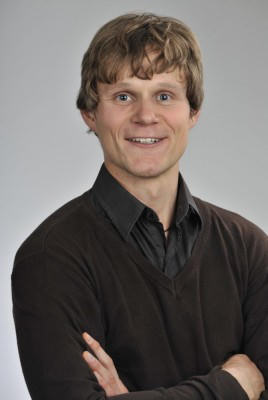
 Hannes Nickisch
· 8 previous affiliations
- PhilipsSince 2011
- Senior Scientist · Since 2016
- Scientist · 2011–2016
- Philips ResearchCurrent
- Current
- Philips Japan, Limited2011–2016
- Researcher · 2011–2016
- Postdoctoral Researcher · 2010–2011
- Max Planck Society2006–2010
- Doctor of Philosophy - PhD, Machine Learning · 2006–2010
- Research Intern · 2009
- Technische Universität Berlin2001–2006
- Master's degree, Computer Science, Psychology, Machine Learning · 2001–2006
- Siemens Healthcare (United States)2004–2005
- Research Intern · 2005
- Research Intern · 2004
Research Overview
Hannes Nickisch focuses on scalable Bayesian inference, Gaussian process modeling, and zero-shot visual object categorization. His research trajectory spans from early work in Bayesian experimental design and sparse generalized linear models to the development of highly efficient approximations for large-scale kernel methods. His most recent work investigates state-space formulations for Gaussian processes with non-Gaussian likelihoods.
Research Trajectory
Nickisch’s early research concentrated on scaling Bayesian inference to high-dimensional settings, particularly for applications in experimental design. During this period, he contributed to the research direction of Likelihood Informed Subspaces for High Dimensional Bayesian Inference and the broader area of Recursive Matrix Inversion for Efficient Online Learning. A primary application of these methods was detailed in Bayesian Experimental Design of Magnetic Resonance Imaging Sequences, where he and his collaborators developed a scalable variational inference algorithm to optimize MRI sequences. This work required approximate inference for dense, non-Gaussian models on a scale that had rarely been addressed in clinical research.
In 2009, Nickisch advanced the area of Decoupling Optimization via Variable Splitting. As first author on Convex variational Bayesian inference for large scale generalized linear models, he introduced a double-loop algorithm that decoupled the optimization criterion. This relaxation, proven to be convex for any log-concave model, allowed large-scale inference to be solved primarily through large linear systems, significantly accelerating solvers for tasks like Bayesian active learning in binary classification.
Concurrently, Nickisch made significant second-author contributions to computer vision, specifically addressing the challenge of classifying objects without prior training examples. In Learning to detect unseen object classes by between-class attribute transfer, he helped introduce attribute-based classification. This approach enabled object detection based on human-specified, high-level semantic descriptions rather than direct image training data, forming a foundational step in zero-shot visual object categorization.
Between 2011 and 2015, his focus shifted toward overcoming the computational bottlenecks inherent in Bayesian non-parametrics, particularly Gaussian Processes (GPs). He engaged with themes such as Scalable Bayesian Inference via Variational Optimization and the research direction of Scaling Beyond the Quadratic Bottleneck of Feature Dimensions. In Additive Gaussian Processes, he co-authored an expressive parameterization for additive functions that generalized standard GP models. This structure allowed for the efficient evaluation of all input interaction terms—ordinarily an exponential calculation—while remaining computationally tractable.
The drive for scalability culminated in his work within the area of Structured Kernel Interpolation for Scalable Gaussian Processes. He was the second author on Kernel Interpolation for Scalable Structured Gaussian Processes (KISS-GP), which introduced a framework generalizing inducing point methods to produce highly efficient kernel approximations, bypassing the traditional cubic scaling limitations of GPs. Later, participating as a middle author, he contributed to Scalable Log Determinants for Gaussian Process Kernel Learning. This research proposed stochastic approximations using Chebyshev and Lanczos models to estimate log determinants and their derivatives in linear time, relying only on fast matrix-vector multiplications.
Current Directions
The most recent work in the evidence, dating to 2018, investigates state-space formulations for Gaussian processes. Specifically, this direction addresses the challenge of modeling with non-Gaussian likelihoods by leveraging state-space methods, which allow for the efficient resolution of one-dimensional Gaussian process models. This focus reflects a continued interest in expanding the exactness and applicability of Bayesian non-parametric models to complex, real-world data distributions where standard Gaussian assumptions are insufficient.
Profile updated
Loading new papers…
Other researchers whose papers cluster into the same research directions — a proxy for overlapping technical interests and shared intellectual neighborhoods.
See something wrong? Report a mistake