

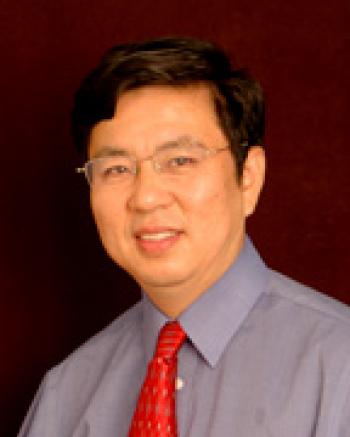
 Hailiang Liu
· 1 previous affiliation
- Iowa State UniversitySince 2002
- Full Professor · Since 2002
Research Overview
Hailiang Liu focuses on the intersection of computational mathematics, partial differential equations (PDEs), and the mathematical foundations of deep learning. His research program is centered on developing high-order numerical methods for complex physical systems, analyzing the stability and convergence of numerical schemes for hyperbolic conservation laws, and establishing theoretical guarantees for optimization dynamics in deep neural networks. By leveraging techniques from applied analysis and scientific computing, he addresses problems in fluid dynamics, mathematical biology, and data-driven modeling, with a particular emphasis on structure-preserving algorithms that respect physical constraints such as energy dissipation and mass conservation.
Research Trajectory
The evolution of Liu’s work reflects a consistent focus on the rigorous analysis of numerical approximations for nonlinear PDEs, beginning with foundational studies in hyperbolic conservation laws. In the mid-1990s and early 2000s, his research addressed the stability of discrete shocks in numerical schemes. This period was characterized by the use of weighted energy methods to prove the asymptotic stability of stationary discrete shocks for the Lax-Friedrichs scheme, particularly in the context of non-convex scalar conservation laws. This early work established polynomial decay rates for perturbations, providing a mathematical basis for understanding how discrete approximations behave over long temporal scales.
As his research progressed, Liu expanded his focus toward High-Order Discretization for Complex Physical Simulations. He became a significant contributor to the development of Discontinuous Galerkin (DG) methods, applying them to a wide range of systems including Euler-Poisson equations, Poisson-Nernst-Planck (PNP) systems, and kinetic models. This phase of his career emphasized the creation of schemes that are not only high-order in accuracy but also robust in the face of physical singularities and complex boundary conditions. His work on the Direct Discontinuous Galerkin (DDG) and Alternating Evolution (AE) methods sought to resolve the challenges of simulating high-order derivatives and non-local interactions in physical media.
In the last decade, Liu’s trajectory has shifted toward the integration of classical numerical analysis with modern machine learning. This transition is marked by a focus on Unconditionally Energy Stable Schemes for Gradient Flows and the application of these principles to deep learning optimization. He has developed a suite of "physics-preserving" algorithms that treat the training of neural networks as a dynamical system, applying the same rigorous stability requirements used in fluid simulation to the convergence of stochastic gradient descent. This has led to the development of novel adaptive gradient methods that incorporate energy and momentum variables to ensure stable and efficient learning in non-convex landscapes.
Current Directions
Liu’s current research is divided between the refinement of structure-preserving numerical methods and the theoretical analysis of deep learning architectures. A major theme in his recent work is the use of Singular Potentials as Barriers for Physical Constraints. This approach is critical for simulating systems where densities or concentrations must remain within specific physical bounds, such as in biological cell segregation or ion transport. By incorporating the Onsager reciprocal relation into numerical frameworks, he has developed methods that automatically satisfy the second law of thermodynamics, ensuring that simulated systems evolve toward energy minima without numerical instability.
In the domain of deep learning, Liu is investigating the convergence properties of implicit neural networks and Neural Ordinary Differential Equations (Neural ODEs). His work in this area addresses Initialization Sensitivity in Non-Convex Optimization, seeking to provide global convergence theories for over-parameterized networks. He has also participated in collaborative research exploring the behavior of wide neural networks, contributing to the understanding of how deep equilibrium models and infinite-depth residual networks behave as Gaussian processes. This research aims to bridge the gap between the empirical success of deep learning and the lack of robust theoretical guarantees for its training and generalization.
Furthermore, Liu is exploring Variance Reduction via Stochastic Recursive Momentum in stochastic optimization. By reframing momentum not just as a tool for acceleration but as a way to stabilize the noisy gradients encountered in large-scale data science, he has introduced algorithms like AEGDM and SGDEM. These methods are designed to inherit the rapid convergence of adaptive methods like Adam while maintaining the superior generalization properties typically associated with standard stochastic gradient descent. His current projects also involve Multicomponent Cross-Diffusion in Complex Mixtures, applying advanced numerical schemes to model the interdependent flow of multiple chemical species in crowded environments.
Representative Work
Nonlinear stability of stationary discrete shocks for nonconvex scalar conservation laws. Published in 1996, this paper provides a foundational analysis of the Lax-Friedrichs scheme. Liu utilizes a weighted energy method to prove the asymptotic stability of stationary discrete shocks, specifically for scalar conservation laws where the flux function is non-convex. The work is significant for establishing that perturbations with zero total summation decay over time, a result further extended in his 2001 study, Convergence rates to discrete shocks for nonconvex conservation laws, which quantified these decay rates as polynomial functions of time.
On the SAV-DG method for a class of fourth order gradient flows. In this work, Liu introduces a hybrid method combining the Scalar Auxiliary Variable (SAV) approach with Discontinuous Galerkin discretizations. The primary contribution is a two-step procedure that pre-evaluates the scalar auxiliary variable, reducing the computational complexity of solving fourth-order gradient flow equations from $O(N^2)$ to $O(N)$. This method maintains unconditional energy stability, making it highly effective for simulating complex pattern formation in physical systems.
An Adaptive Gradient Method with Energy and Momentum. This paper introduces the AEGDM algorithm, which addresses the trade-off between convergence speed and generalization in deep learning. By introducing an auxiliary energy variable, Liu creates an optimization framework that adaptively adjusts the learning rate while remaining grounded in the stability principles of gradient flows. This work represents a significant step in applying numerical PDE techniques to improve the reliability of neural network training.
SGDEM: stochastic gradient descent with energy and momentum. Building on the AEGD framework, this paper proposes SGDEM for non-convex stochastic optimization. Liu proves that the inclusion of both energy and momentum variables allows the algorithm to feature unconditional energy stability. The paper derives energy-dependent convergence rates and regret bounds, providing a theoretical justification for the algorithm's performance across various deep learning benchmarks.
The Onsager principle and physics preserving numerical schemes. In this collaborative work, Liu develops a unified framework for building structure-preserving numerical simulations for dissipative systems. By leveraging the Onsager reciprocal relation, the research treats time-stepping as a constrained optimization problem. This ensures that numerical models of physical phenomena, such as ion diffusion or fluid flow, inherently respect mass conservation and the law of energy dissipation.
A global convergence theory for deep ReLU implicit networks via over-parameterization. This research addresses the theoretical gap in implicit deep learning, where prediction rules are defined by equilibrium equations. Liu provides an analysis of the well-posedness of these equations during training and establishes a global convergence theory for stochastic gradient descent in the context of over-parameterized ReLU networks. The work clarifies how the recursive prediction rules of modern architectures can be guaranteed to converge to a global minimum despite the non-convexity of the loss landscape.
Profile updated
| Title | Venue | Year |
|---|---|---|
| The Onsager principle and structure preserving numerical schemes | Journal of Computational Physics | 2025 |
| Unconditionally energy stable IEQ-FEMs for the Cahn-Hilliard equation and Allen-Cahn equation | Numer. Algorithms | 2025 |
| A positivity-preserving hybrid DDG method for Poisson-Nernst-Planck systems | arXiv | 2025 |
| Global Convergence in Neural ODEs: Impact of Activation Functions | ICLR | 2025 |
| SGEM: stochastic gradient with energy and momentum | Numer. Algorithms | 2024 |
| Positivity-preserving and energy-dissipating discontinuous Galerkin methods for nonlinear nonlocal Fokker-Planck equations | arXiv | 2024 |
| Infinitely Deep Residual Networks: Unveiling Wide Neural ODEs as Gaussian Processes | Openreview | 2024 |
| Inf-Sup neural networks for high-dimensional elliptic PDE problems | Journal of Computational Physics | 2024 |
| OTCOP: Learning optimal transport maps via constraint optimizations | ICLR | 2023 |
| Global Dynamics and Photon Loss in the Kompaneets Equation | SIAM J. Math. Anal | 2023 |
| Paper | Venue | Year |
|---|---|---|
| Adaptive Preconditioned Gradient Descent with EnergyGitHubtxping/ | arXiv | 2023 |
| AEGD: Adaptive Gradient Decent with EnergyGitHubtxping/ | arXiv | 2020 |
Loading new papers…
Other researchers whose papers cluster into the same research directions — a proxy for overlapping technical interests and shared intellectual neighborhoods.
See something wrong? Report a mistake